Building in Public as an Introverted Founder: How Sharing Architectural Decisions, Operational Mistakes and Real Numbers Attracts Early Adopters and Talent
By Kaushal Patel10 min read
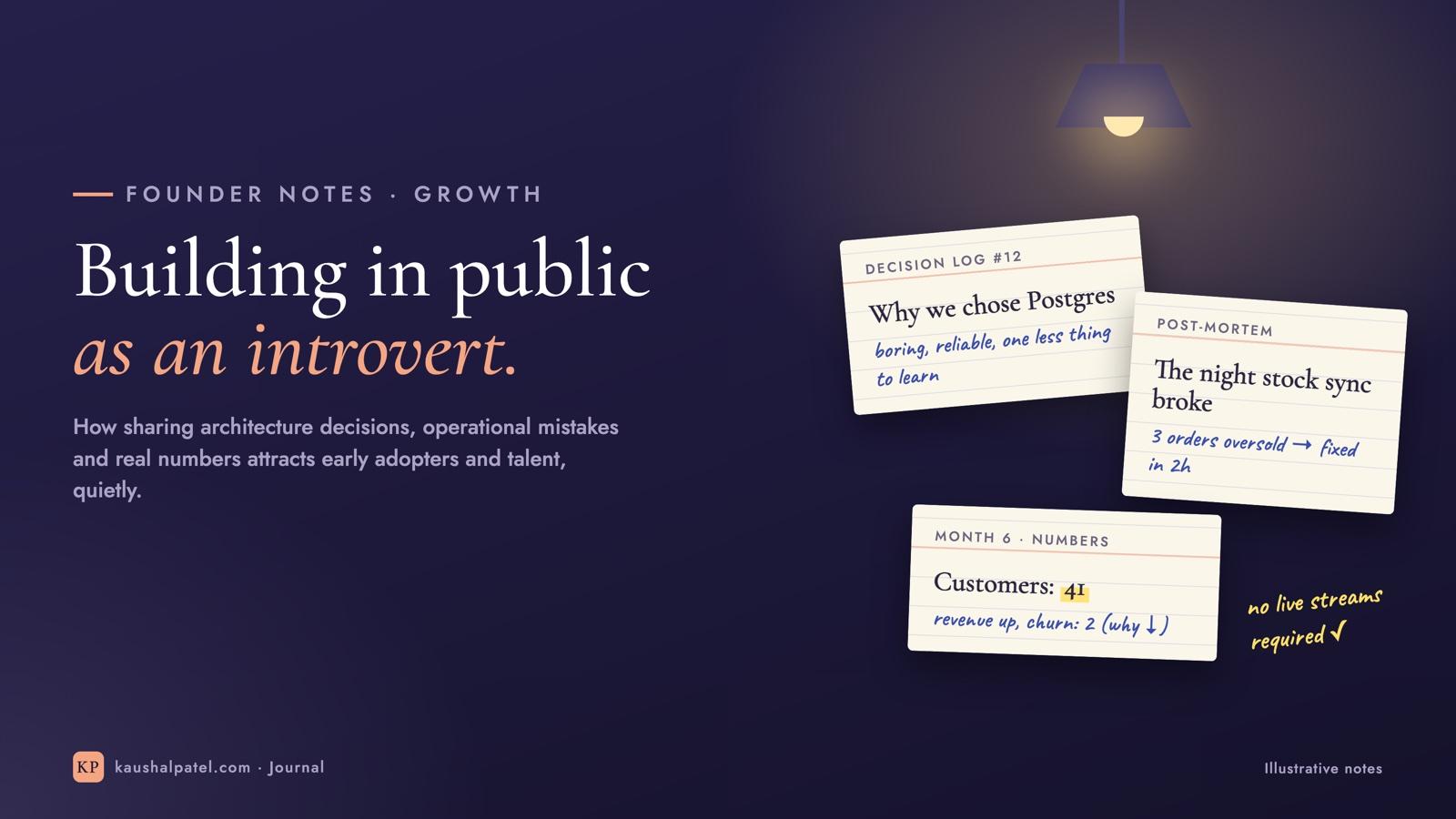
“Build in public” often sounds like advice for extroverts: post every day, go live, reply to everyone, have opinions about everything. If you’re an introverted founder, that picture is exhausting before you’ve even started, so you stay quiet, build in private and hope the product speaks for itself.
It usually doesn’t. But the answer isn’t to become loud. Some of the most valuable building-in-public content is quiet, written and deep: why you chose an architecture, what broke and what you changed, and how many customers you really have. That kind of honesty plays to an introvert’s strengths, and it attracts exactly the people a small company needs: early adopters who trust you, and engineers who want to work with you.
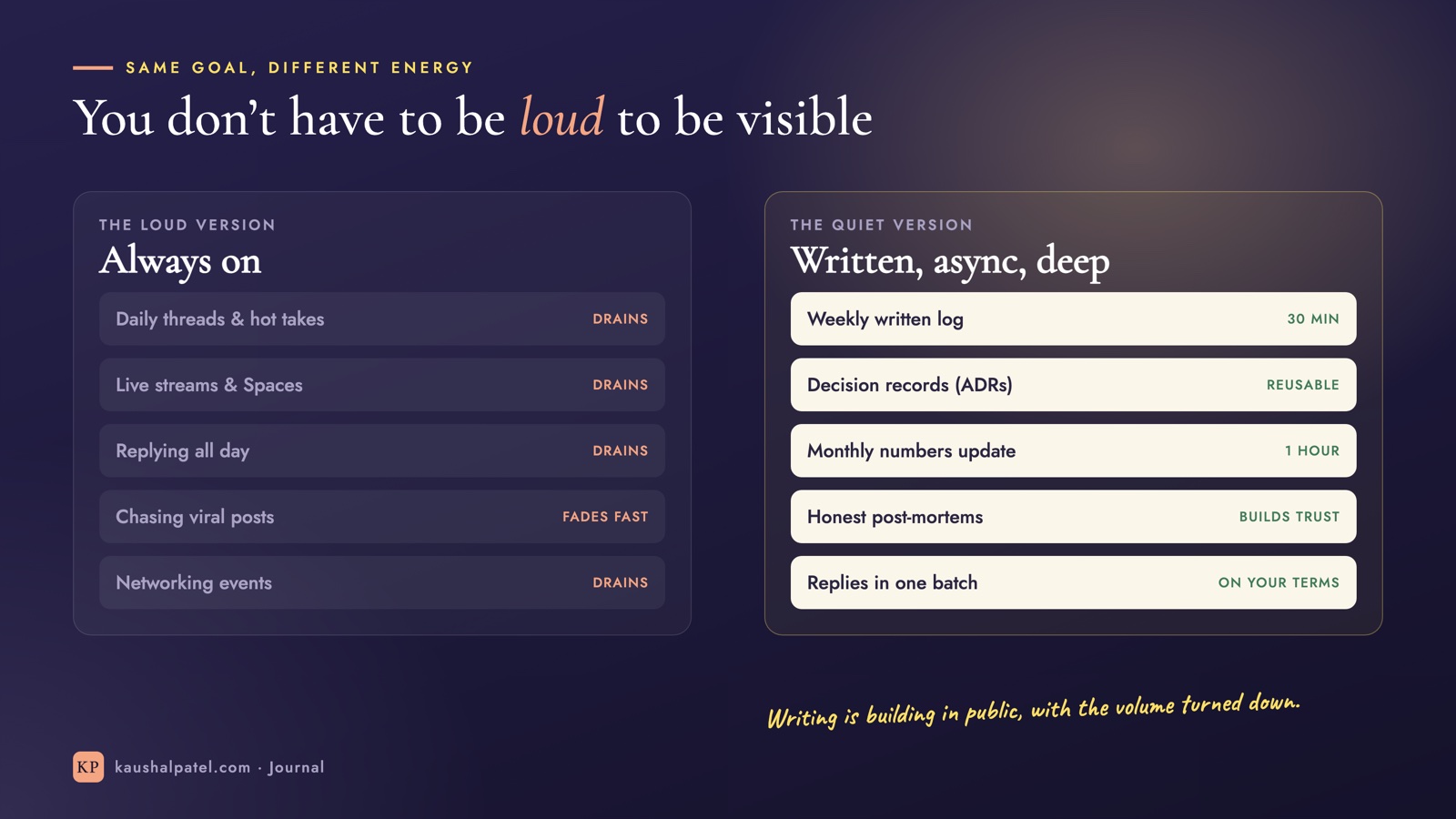
Same goal, different energy
Writing is building in public, with the volume turned down.
Introversion isn’t shyness or a lack of opinions. It’s about where your energy comes from. Constant real-time interaction drains it; focused, thoughtful work restores it. So choose formats that work like that:
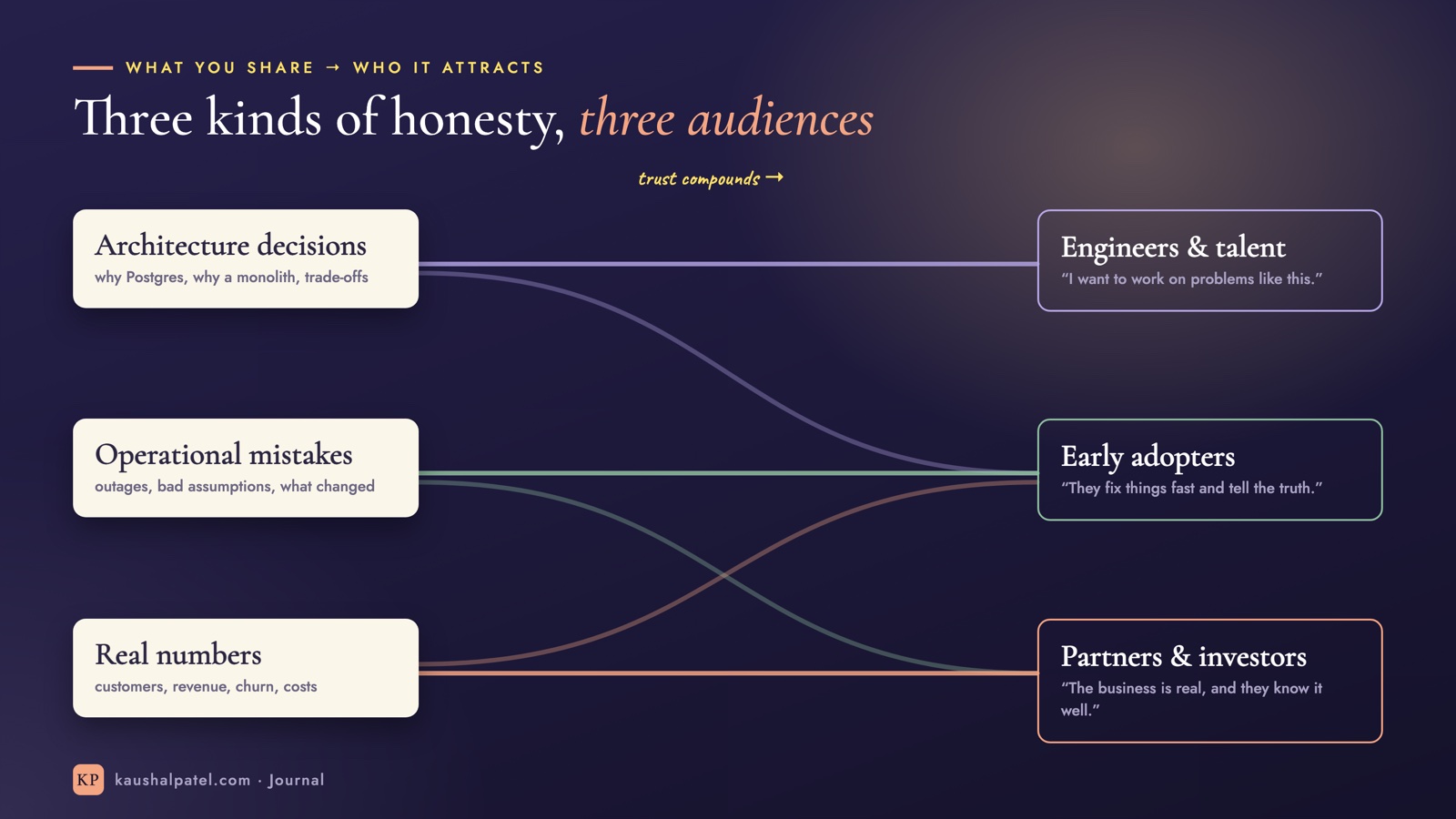
Building in public isn’t just about attention. Different kinds of sharing attract different people, and a small company needs all of them.
What you share decides who shows up.
1. Architecture decisions attract talent
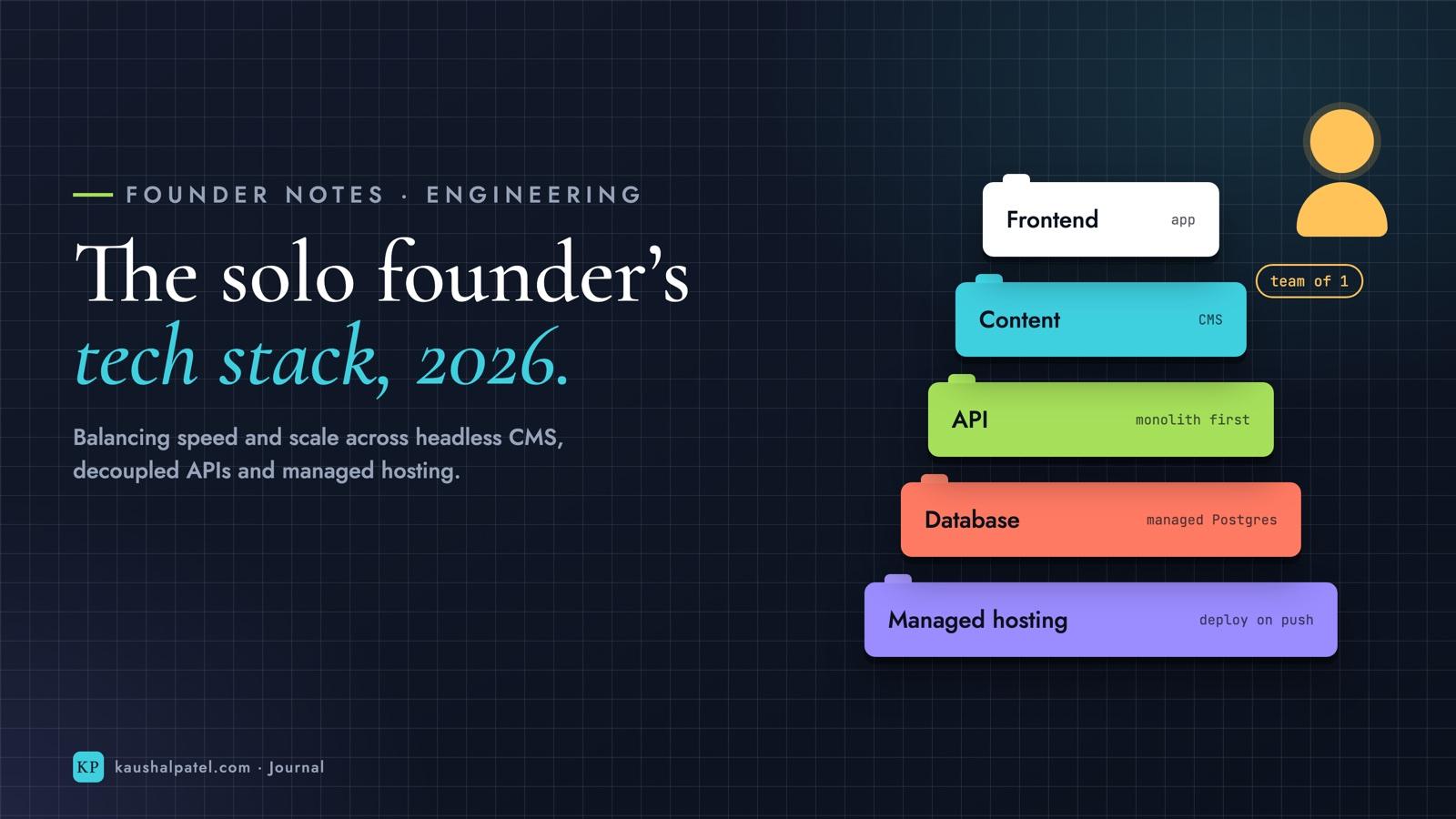
Good engineers want to work on interesting problems with people who think clearly. A post explaining why you chose a modular monolith over microservices, or Postgres over a document database, with the trade-offs you accepted, is the best job advert a small company can write. It shows how you think, what you value and what working with you would be like. (If you want material, my solo founder’s tech stack post is basically a list of such decisions.)
The simplest format is an Architecture Decision Record (ADR): a short document per decision. Write it for yourself first, because future-you will thank you, then publish the ones that don’t reveal anything sensitive:
# ADR 012: Use Postgres for orders and stock

Date: 2026-11-10
Status: Accepted

## Context
Orders, stock and invoices are relational and need transactions.
We're one developer; we want one database we already know well.

## Decision
Use managed Postgres. No separate document store for now.

## Trade-offs we accept
- Schema changes need migrations
- Full-text search is "good enough", not great

## Revisit when
Search becomes a core feature, or one table passes ~50M rows.
2. Operational mistakes attract early adopters
This feels backwards, but it works. Early adopters know a young product will have problems. What they really want to know is: when something breaks, will this founder tell me the truth and fix it fast? An honest post-mortem answers that better than any marketing page.
Larger companies show how much trust this builds. GitLab published a detailed public post-mortem after a serious database incident in 2017, and even live-streamed parts of the recovery. Cloudflare regularly publishes in-depth technical write-ups of its outages. Neither hid the mistake; both explained it, and many customers respected them more for it.
A simple, calm structure for your own post-mortems:
What happened, in plain words, with times.
Who was affected, and how much.
Why it happened: the root cause, not just the trigger.
What we did to fix it on the day.
What we changed so it can’t happen the same way again.
3. Real numbers attract partners and serious users
Customers, revenue, churn and costs make your story concrete. Some companies take this a long way. Buffer has publicly shared how it calculates salaries, and Baremetrics’ “Open Startups” project let companies publish live revenue dashboards. You don’t have to go that far. You choose the level of detail, from exact figures to ranges to growth only. What matters is that the numbers are real and regular.
Interactive · Monthly update builder
Write your next update in five minutes
Fill in the fields, choose how much revenue to reveal, and copy the result. The sample text shows the format, so replace it with your own.
November 2026: building in public update

Numbers
- Customers: 41 (+6 this month)
- Revenue: ₹40,000–₹50,000 a month

One decision
Moved stock sync from a nightly import to webhooks, so marketplace stock now updates within a minute.

One mistake
A bad import oversold three orders. We apologised, refunded the shipping and added a stock check before every sync.

One win
Two customers recommended us to other wholesalers without being asked.

Next month
Shipping labels inside the app, and a public changelog.

Questions or ideas? Reply any time. I answer every message on Fridays.
Hover or tap the box to copy. One decision, one mistake, one win and your numbers is enough. Consistency matters far more than length.
What to share, and what to keep private
Building in public doesn’t mean publishing everything. Some things belong to other people, and some details are risky. A simple guide:
Exploitable details, anything before the fix is live
Numbers
Customers, revenue (exact, range or growth), costs
Anything you’re not comfortable seeing quoted forever
Customers
Stories, with their permission
Names, data and screenshots without permission
Team
How you hire, how you work
Individual performance, health, personal matters
Strategy
Why you’re building, what you’ve learned
Live negotiations, unannounced deals
Quick game · Share it or keep it?
Would you post this?
Six things an introverted founder might be thinking of sharing. Decide, then open each card.
“Why we chose a monolith instead of microservices”, with the trade-offs.
Share it. Great for attracting engineers, and it costs you nothing to reveal.
A screenshot of a customer’s dashboard showing their sales.
Keep it, unless they say yes. It’s their data. Ask first, or blur everything that identifies them.
A post-mortem about a bug that exposed a security weakness, written while it’s still being fixed.
Not yet. Fix it, notify anyone affected as required, then publish, without details someone could reuse.
“We lost two customers this month, and here’s why.”
Share it. Honest churn posts build more trust than wins. Focus on what you learned and changed.
Revenue, as a range, every month.
Share it, if you’re comfortable. A range or growth percentage keeps it real without exposing exact figures.
Frustration about a difficult client, while you’re upset.
Keep it. Write it down privately. If there’s a lesson, share the lesson later, calmly, without identifying anyone.
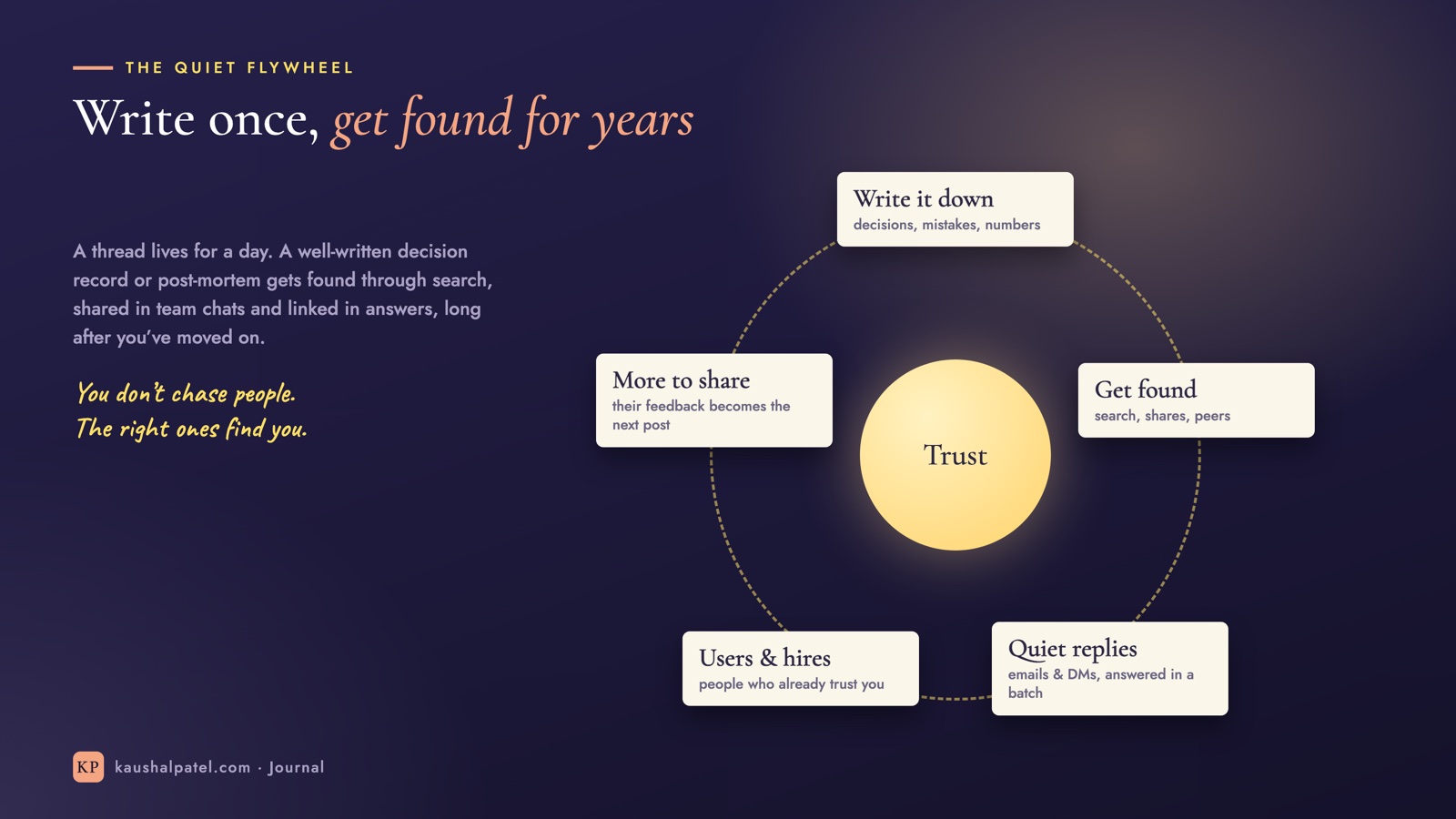
The quiet flywheel
Write once, get found for years. The right people come to you.
Here’s the part introverts tend to love: written, specific posts work while you sleep. Someone searching “why we moved from cron jobs to a queue” finds your decision record a year later. A potential hire reads your post-mortems before applying, and arrives already knowing how you work. An early adopter emails you because your monthly update describes their exact problem.
You don’t need to network. You need to leave a clear, honest trail that the right people can follow, and to answer them when they arrive.
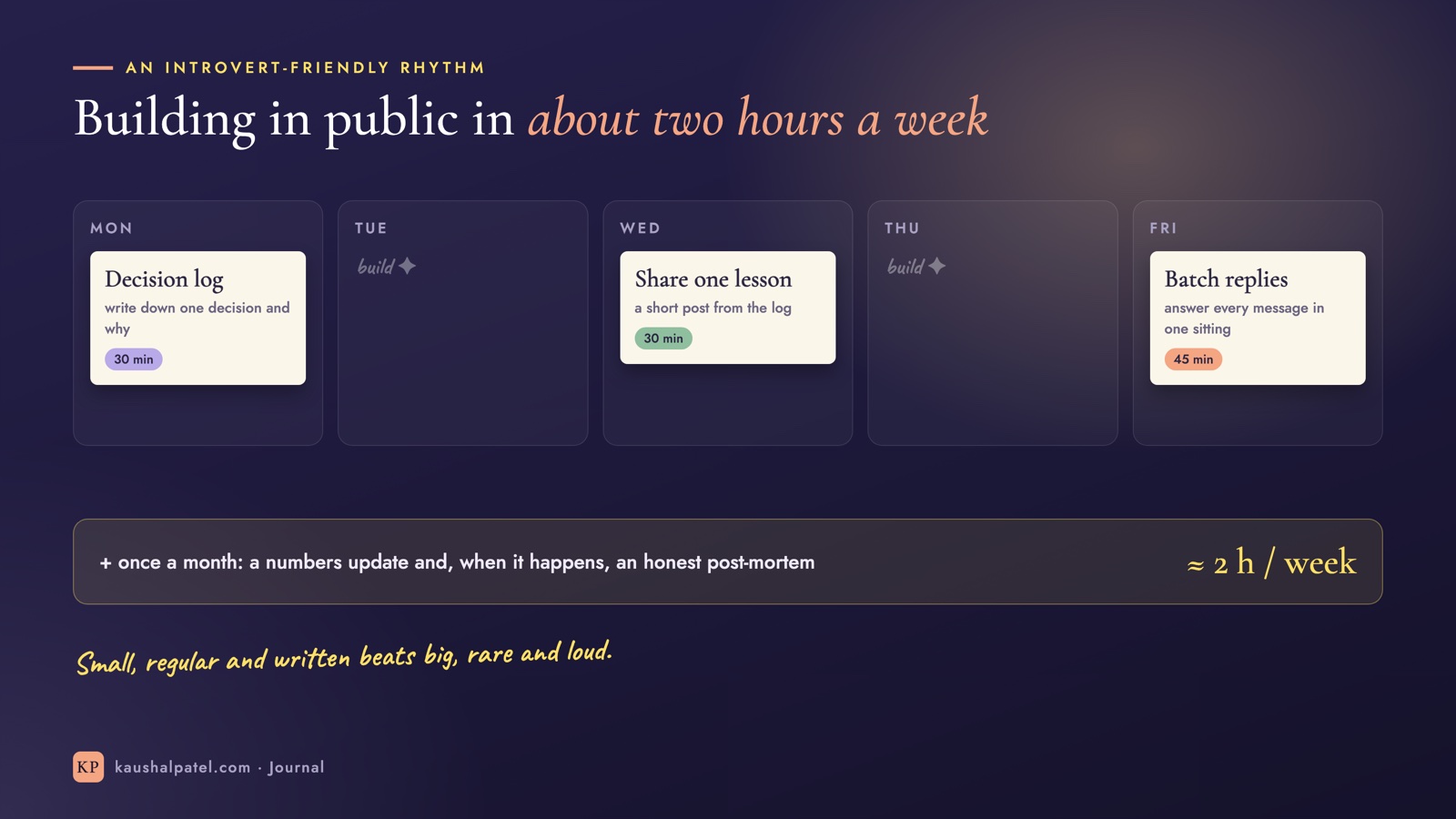
An introvert-friendly rhythm
Small, regular and written beats big, rare and loud.
Keep a private log first. Every day or two, write a few lines: what you decided, what broke and what you learned. Most of your public posts come straight from here.
Publish on a schedule, not a mood. One short post a week from the log and one numbers update a month. Put them in your calendar like meetings.
Pick one or two places. Your own blog plus one platform where your audience already is. You don’t need to be everywhere.
Batch your replies. Turn off notifications and answer everything in one sitting, once or twice a week. Say so publicly, so people know when to expect you.
Let writing lead. Podcasts and talks can come later, if you want them, and they’re far easier once people already know your writing.
Before you hit publish, check
It’s specific: a real decision, a real number or a real mistake, not a vague lesson.
It contains nothing that belongs to a customer or teammate without their permission.
Any incident is fixed, and nothing in the post could help someone attack you.
You’d be comfortable seeing it quoted in a year.
There’s a clear way for interested people to reach you, and you’ve set a time to reply.
Frequently asked questions
What if nobody reads it at first?
Almost nobody does, at first. Written posts compound: search, shares and links build slowly. Treat the first months as building an archive. Your tenth post brings readers to your first.
Won’t competitors copy me if I share my decisions?
Rarely in a way that matters. Knowing why you made a choice doesn’t give them your customers, your speed or your understanding of the problem. Keep truly sensitive things private, such as security, deals and customer data.
Do I have to share revenue?
No. Share what you’re comfortable with: exact figures, a range, growth percentages or just customer counts. Consistency matters more than precision.
How do I handle negative comments?
Reply calmly to genuine questions, ignore bad-faith ones, and never reply while upset. Batching replies helps a lot: you answer when you’re ready, not when the notification arrives.
The bottom line
Building in public isn’t a personality test. You don’t have to be loud, quick or always online. Write down how you build, what goes wrong and how you’re really doing, and share it on a rhythm you can sustain. The people who find you that way, early adopters who trust you and engineers who think like you, are exactly the ones a young company needs.
Building something and want to compare notes, or need help with the product itself? Say hello.
Headless CMS, decoupled APIs or a monolith, managed hosting or a VPS: how to pick a 2026 stack one person can run, with a hosting cost calculator and checklist.
Marketplace fees, ad spend and D2C acquisition: how to see your true profit per order in every channel, with a margin calculator, break-even ROAS and a roadmap.
Why technical founders struggle with marketing, and how to prove demand before writing production code: a signal ladder, funnel calculator and 30-day sprint.