Distribution First, Product Second: Why Most Technical Founders Fail at Marketing — and How to Test Customer Demand Before Writing a Single Line of Production Code
By Kaushal Patel11 min read
If you can code, building feels like progress. You open the editor, set up auth, design the database, polish the dashboard, and six months later you have a beautiful product. Then you launch it, and almost nobody comes.
This is the most common way technical founders fail. The code was rarely the problem. They built first and looked for customers second. In CB Insights’ well-known analysis of startup post-mortems, no market need was the most-cited reason for failure, well ahead of running out of money or being beaten by competitors.
The fix is simple to say and uncomfortable to do: find your distribution first, prove people will pay, and only then write production code.
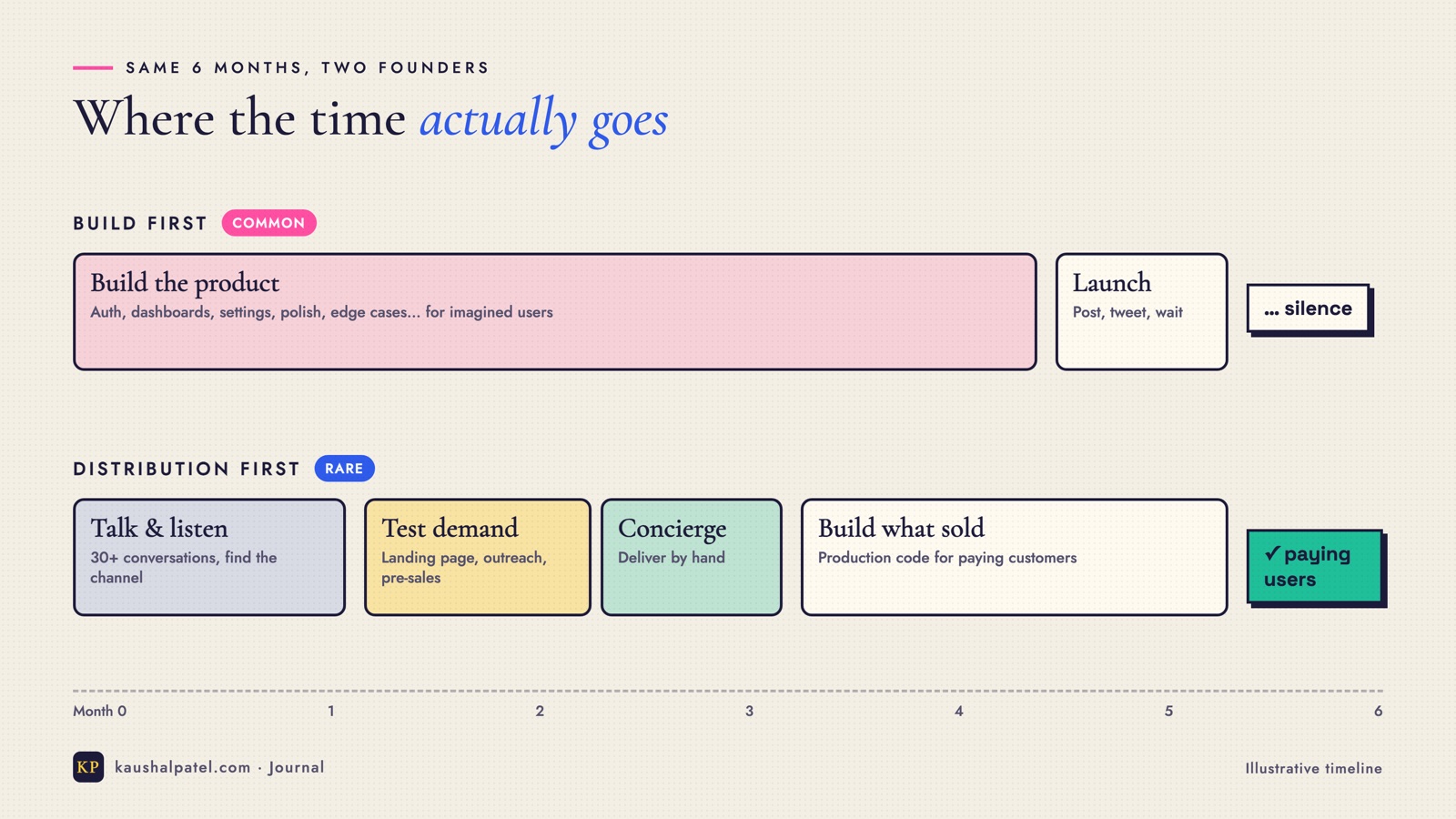
Where the time actually goes
Same six months, two founders. Only one of them ends with paying users.
Both founders write code. The difference is when. The distribution-first founder builds later, builds less, and builds for people who have already said yes.
Why technical founders struggle with marketing
It isn’t a lack of intelligence. It’s a set of habits that work brilliantly in engineering and backfire in a market.
Engineering habit
Why it feels right
What to do instead
“If it’s good, people will come”
Good code gets noticed by other engineers
Assume nobody is looking. Go to where buyers already are
Build the full system first
Half-finished software feels embarrassing
Sell a promise, a mock-up or a manual service first
Hide behind the keyboard
Coding is comfortable, selling is awkward
Book five customer calls a week, every week
Talk about features
Features are what you spent time on
Talk about the problem and the result, in the customer’s words
Launch once, then wait
Shipping feels like the finish line
Treat launch as one small channel among many
Avoid pricing questions
Asking for money feels pushy
Show a price from day one. It’s the clearest test there is
Distribution first, explained
“Distribution” sounds like a marketing word, but it’s really three practical questions you can answer before any code exists:
Who exactly has the problem badly enough to pay? Not “small businesses”, but “textile wholesalers in Surat with 20+ retail buyers”.
Where do they already gather? WhatsApp groups, trade associations, LinkedIn, markets, forums, existing suppliers.
What message makes them reply? The problem in their own words, with a clear result and a price.
When you can reach a specific group, through a specific channel, with a message that gets replies, you have distribution. Building the product after that is the easier half.
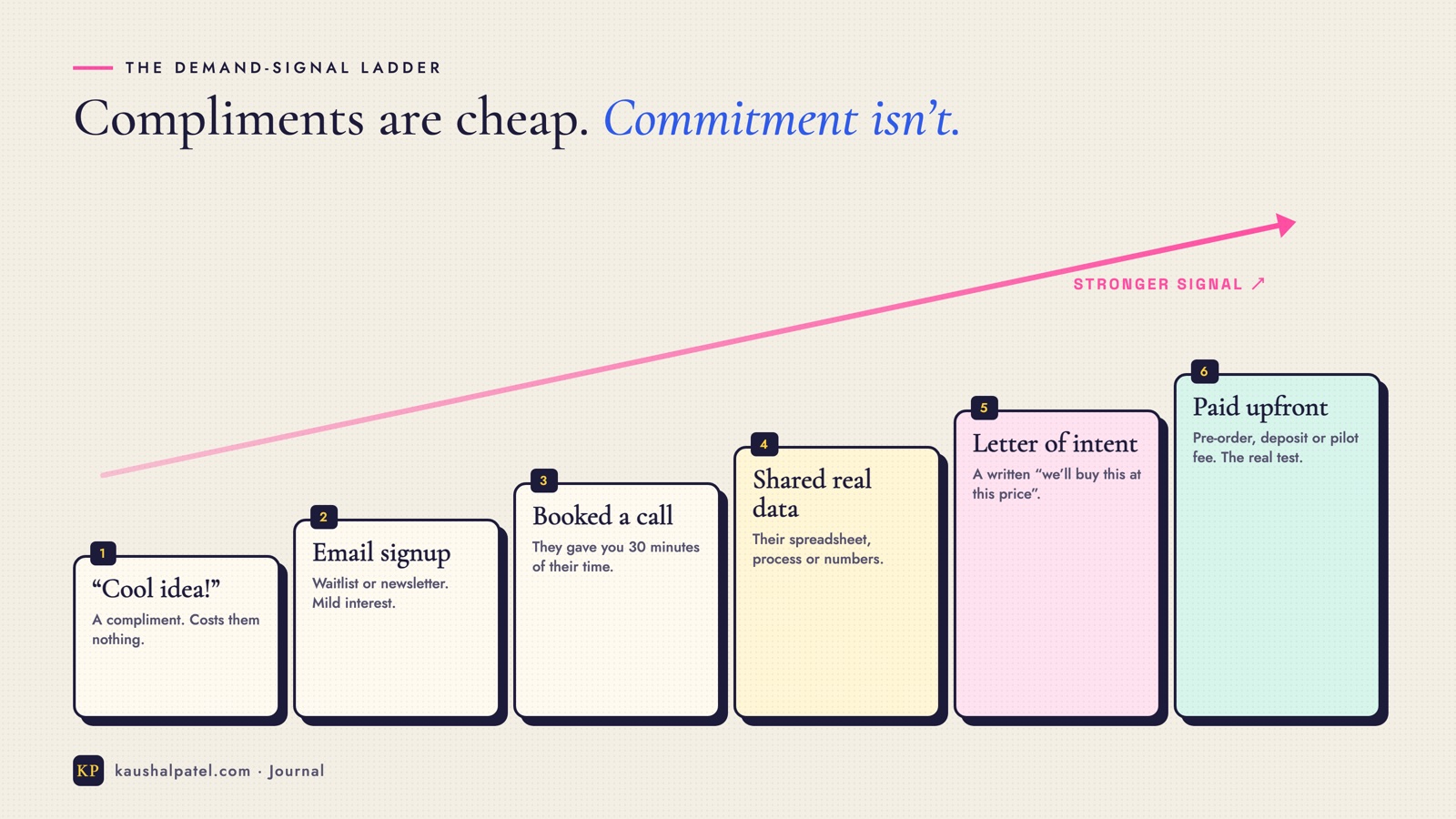
Compliments are cheap. Commitment isn’t.
The trap in “customer validation” is that people are polite. Friends say “great idea”. Strangers like your post. None of that costs them anything, so none of it proves demand. Real signals cost the customer something: time, data, reputation or money.
The higher a signal sits on the ladder, the more it costs the customer, and the more it tells you.
Quick game · Real signal or false positive?
Would you build on this?
Five things a founder might hear. Decide how much each one is worth, then open the card.
“My friends and family all say they love the idea.”
False positive. People who care about you are the least reliable judges. They won’t be your customers, and they don’t want to hurt your feelings.
Your LinkedIn post about the idea got 400 likes.
False positive. Likes measure how interesting a post is, not whether anyone will pay. Count the people who messaged you to ask how to get it.
500 people joined the waitlist after a viral thread.
Weak signal. Better than likes, but an email address is free. Email the list with a price and an offer, and see how many reply.
A clinic owner sends you their messy spreadsheet and asks when they can start.
Strong signal. They gave you real data and real urgency. Ask for a pilot fee next.
Three distributors pay a deposit for a pilot of a product that doesn’t exist yet.
The real thing. Money before code is the strongest evidence you can get. Now build, for exactly these three.
Six ways to test demand without production code
Test
What you make
Time
What it proves
Problem interviews
A list of questions about their current process
1–2 weeks
The pain is real, frequent and costly
Landing page with a price
One page: problem, promise, price, a “Get early access” button
1–2 days
The message gets clicks and sign-ups
Founder-led outreach
A short, personal message to 100 well-chosen people
1 week
You can reach buyers and get replies
Mock-up demo
Clickable design, slides or a video walkthrough
2–4 days
The solution makes sense to them
Pre-sale or paid pilot
A simple agreement and a payment link
1–2 weeks
They will pay, at a price you choose
Concierge service
Spreadsheets, forms and your own time, delivered by hand
2–4 weeks
You can deliver the result, and what to automate first
None of these needs production code. A landing page can be built in a no-code tool in an afternoon. A concierge “product” can be a WhatsApp group, a Google Sheet and you.
Some well-known companies started exactly this way. Zappos’ founder photographed shoes in local stores and posted them online; when someone ordered, he bought the pair at full price and shipped it, proving people would buy shoes online before building any inventory system. Dropbox used a short demo video to grow its beta waitlist by tens of thousands of people before the product was widely available. Buffer started as a two-page website that explained the idea and then showed pricing plans, to see whether anyone would click “buy” before the app existed.
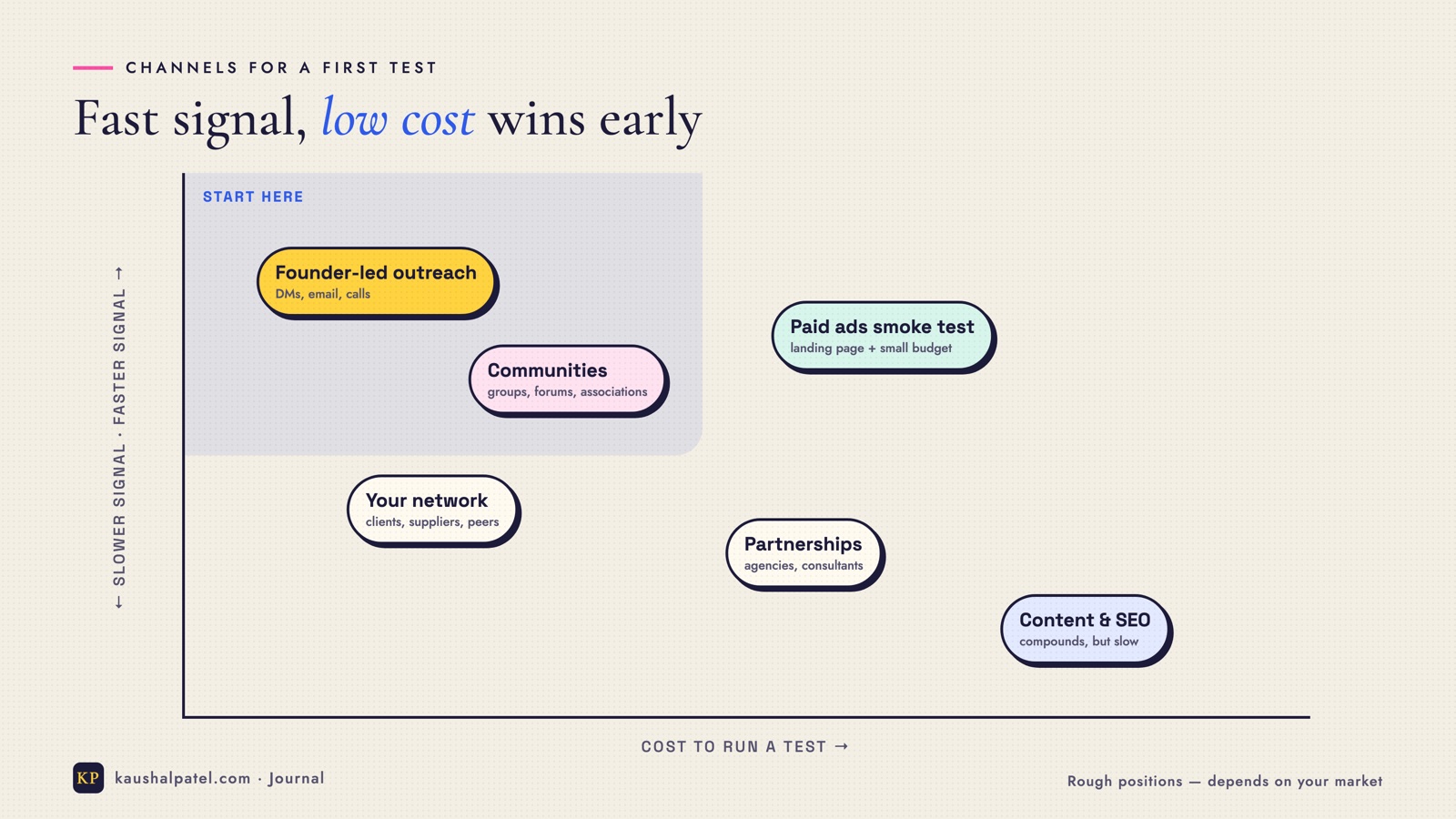
Pick a channel you can test this week
Rough positions: for a first test, choose the fastest, cheapest signal. Content and SEO come later.
Content and SEO are wonderful long-term channels. This site is partly built on them. But they take months to tell you anything. For a first demand test, start where you get an answer in days: direct, personal outreach to people who fit your customer profile exactly.
Here’s a simple outreach message you can adapt. Notice it talks about their problem, asks a small question, and doesn’t pitch a product:
Hi {name},

I'm talking to {role}s in {city/industry} about how they
handle {specific task}, e.g. tracking {orders / stock}
across {WhatsApp, Excel and phone calls}.

I'm not selling anything yet. I'm trying to understand
what's painful about it. Would you be open to a 15-minute
call this week? Happy to share what I learn from the
other {role}s I speak to.

Thanks,
{your name}
Interactive · Outreach funnel
How many conversations does it take?
Founder-led sales is a numbers game you can plan. Enter your own rates, and use conservative ones if you’re unsure.
Messages in 4 weeks200
Replies30
Calls12
Paying customers3
Customers in 4 weeks
3
Revenue from them
₹15,000
Messages for 10 customers
667
If the numbers look scary, that’s the point: it’s far better to discover your funnel before six months of building than after.
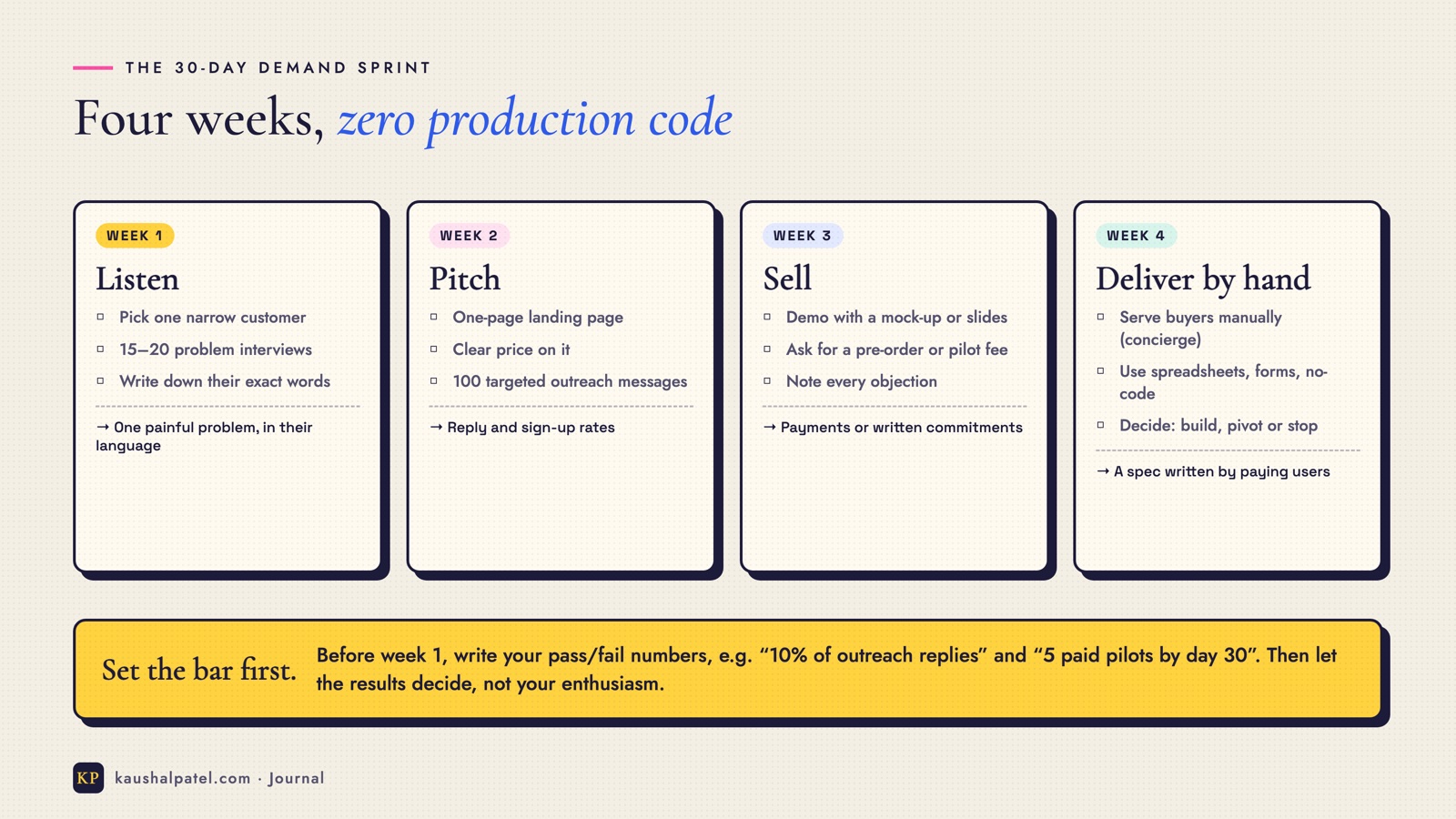
The 30-day demand sprint
Four weeks, zero production code, and a clear decision at the end.
Week 1: Listen. Pick one narrow customer group. Hold 15–20 interviews about how they handle the problem today. Ask about the last time it went wrong, what it cost and what they tried. Don’t pitch.
Week 2: Pitch. Write a one-page offer using their exact words. Put a price on it. Send 100 personal messages through the channel where they already are.
Week 3: Sell. Show a mock-up, slides or a short video. Ask for a pre-order, a deposit or a paid pilot. Write down every objection; they’re your roadmap.
Week 4: Deliver by hand. Serve the people who paid, using spreadsheets, forms and your own time. Then decide, based on the numbers you set at the start: build, change the offer, or stop.
Interactive · Ready to build?
Score your demand evidence
Be honest, because nobody else will see your answers. Each answer scores 0–3.
Not yet. Keep talking to customers. Code now would be a guess.
Promising. Run a paid test: put a price on the offer and ask for a deposit or pilot fee.
Build a thin version, only for the customers who committed, and keep selling while you do.
Build. You have distribution and demand, which is the hard part. Now ship fast for the people waiting.
0/18
Answer all six questions to see if you’re ready to build.
Then build, but differently
When the evidence is in, your engineering skills become an unfair advantage. You’re not guessing any more. You have a short list of paying customers, their exact words, their spreadsheets and their objections. That changes how you build:
Build the loop they paid for, end to end, before anything else. Settings pages and dashboards can wait.
Automate the most painful manual step first. Your concierge weeks tell you exactly which one that is.
Keep selling while you build. Distribution is a habit, not a phase. Five customer conversations a week, forever.
Ship to real users weekly. Paying customers forgive rough edges if the core problem gets solved.
This is how I approach client work too. Projects like the Mahavir Fashion B2B wholesale portal started from how buyers actually ordered (phone calls and WhatsApp) before a single screen was designed. Understanding how a business already sells and operates is the best spec there is. (Related: The “Boring” Startup Advantage on choosing problems worth solving, and Bootstrapping vs. Raising Early on funding the build.)
Before you write production code, check
You can name your customer narrowly, by role, industry and situation.
You’ve had at least 15–20 real conversations about the problem.
You have a channel that reliably gets replies from those people.
Someone has paid, or signed a commitment, at a price you set.
You’ve delivered the result by hand at least once and know what to automate first.
Frequently asked questions
Isn’t selling something that doesn’t exist dishonest?
Not if you’re clear about it. “We’re building this now, and early customers get it first at a lower price” is honest and common. Take deposits only for things you intend to deliver, and refund anyone who asks.
What if someone copies my idea while I’m testing it?
Ideas are rarely the hard part, and execution plus distribution is. The bigger risk for most founders is building something nobody wants, not being copied.
I’m an introvert. Do I really have to do sales?
At the start, yes, but it doesn’t have to be loud. Thoughtful one-to-one messages and calls suit introverts well. You’re asking questions and listening, which is exactly what engineers are good at.
Can a prototype count as “no production code”?
Yes. Clickable mock-ups, no-code tools and quick throwaway scripts are fine. The rule is: don’t build the scalable, maintainable system until people have committed to using it.
The bottom line
For technical founders, building is the comfortable part, and that’s exactly why it’s dangerous to start there. Find the people, the channel and the message first. Ask for money before you ask for a repository. When demand is proven, your ability to build becomes a superpower instead of an expensive guess.
Have an idea and want help testing demand, or need to build the product once customers are lined up? Let’s talk.
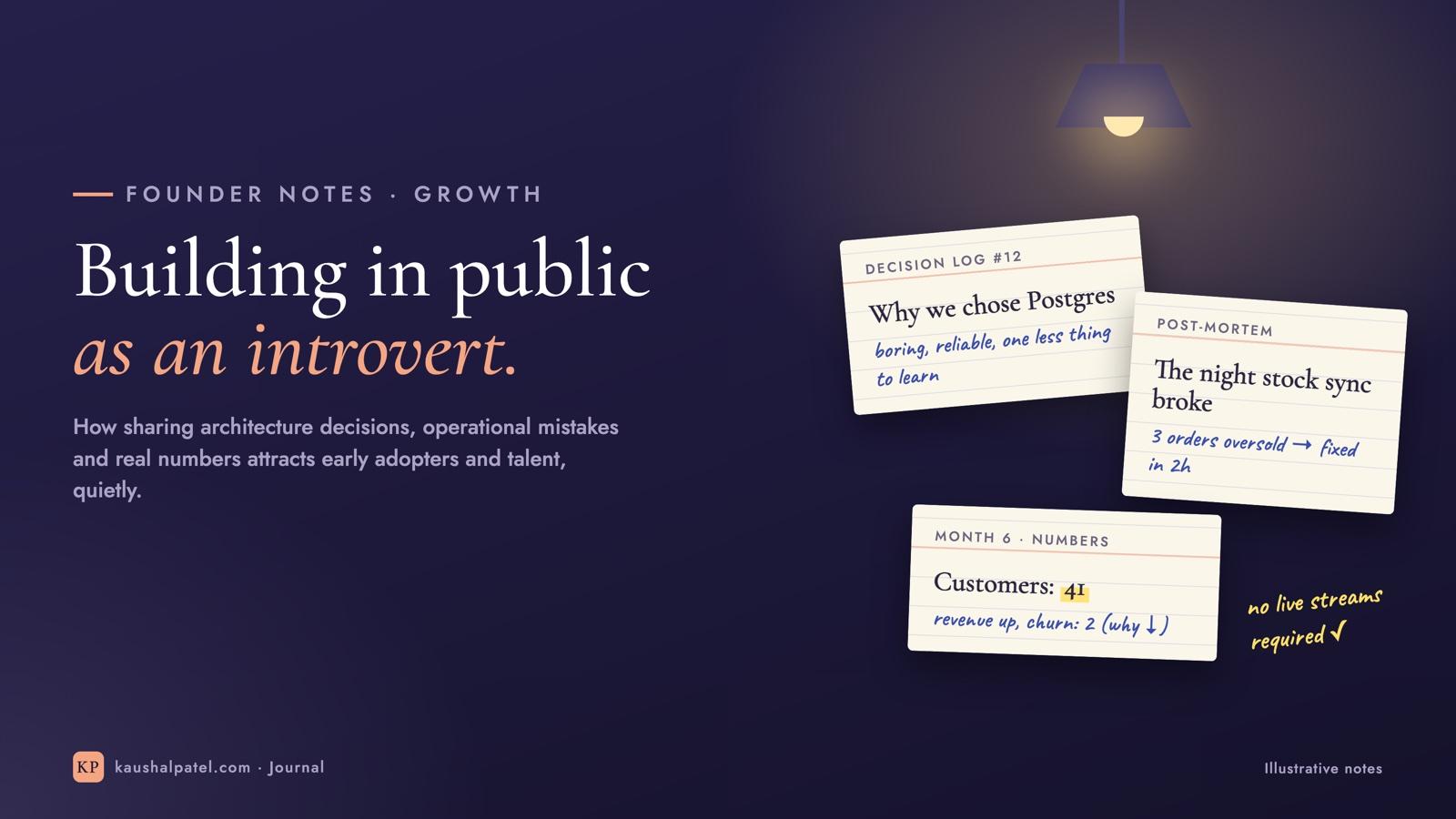
Quiet, written building in public: share architecture decisions, mistakes and real numbers to attract early adopters and talent, with an update builder.
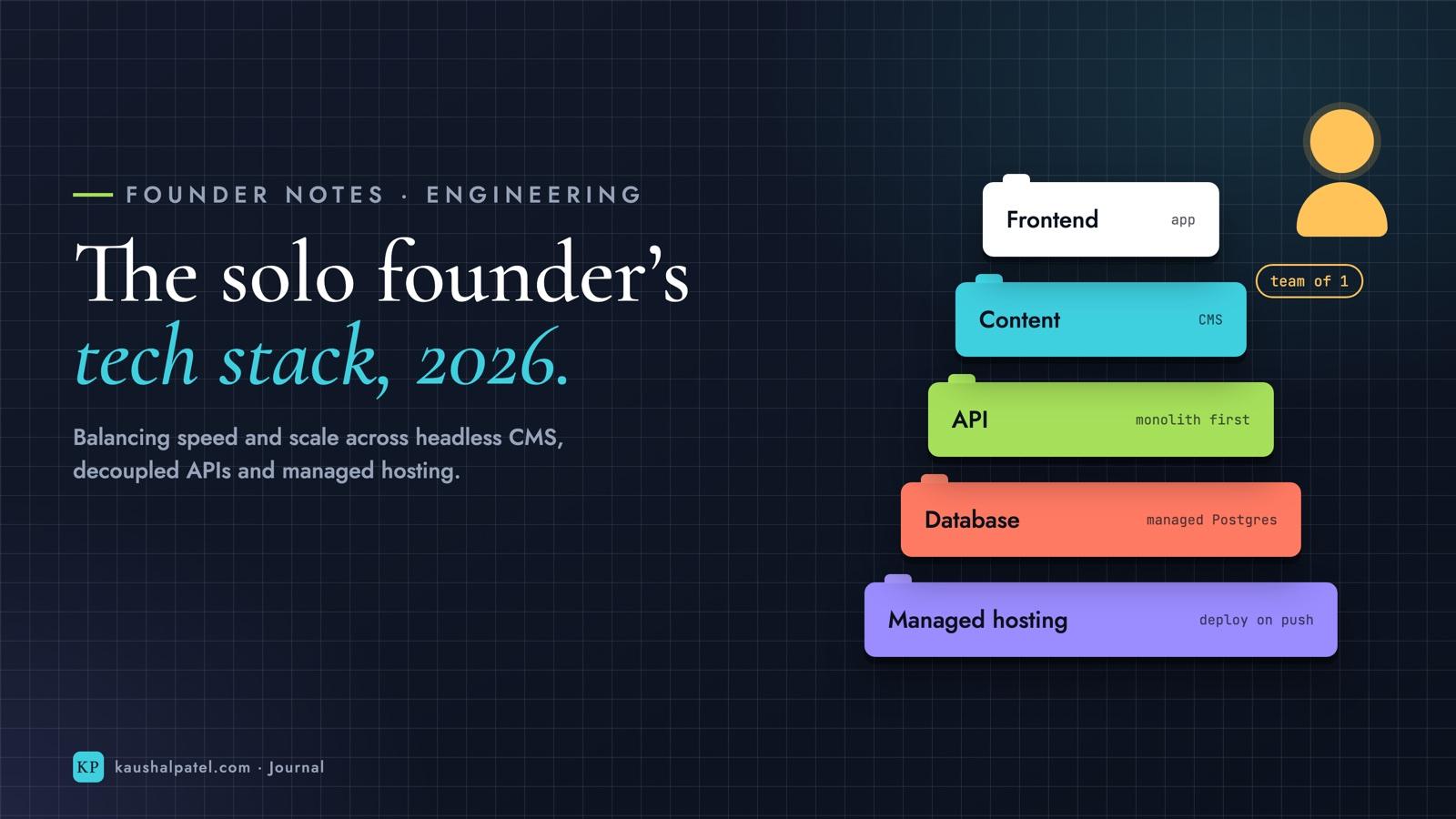
Headless CMS, decoupled APIs or a monolith, managed hosting or a VPS: how to pick a 2026 stack one person can run, with a hosting cost calculator and checklist.
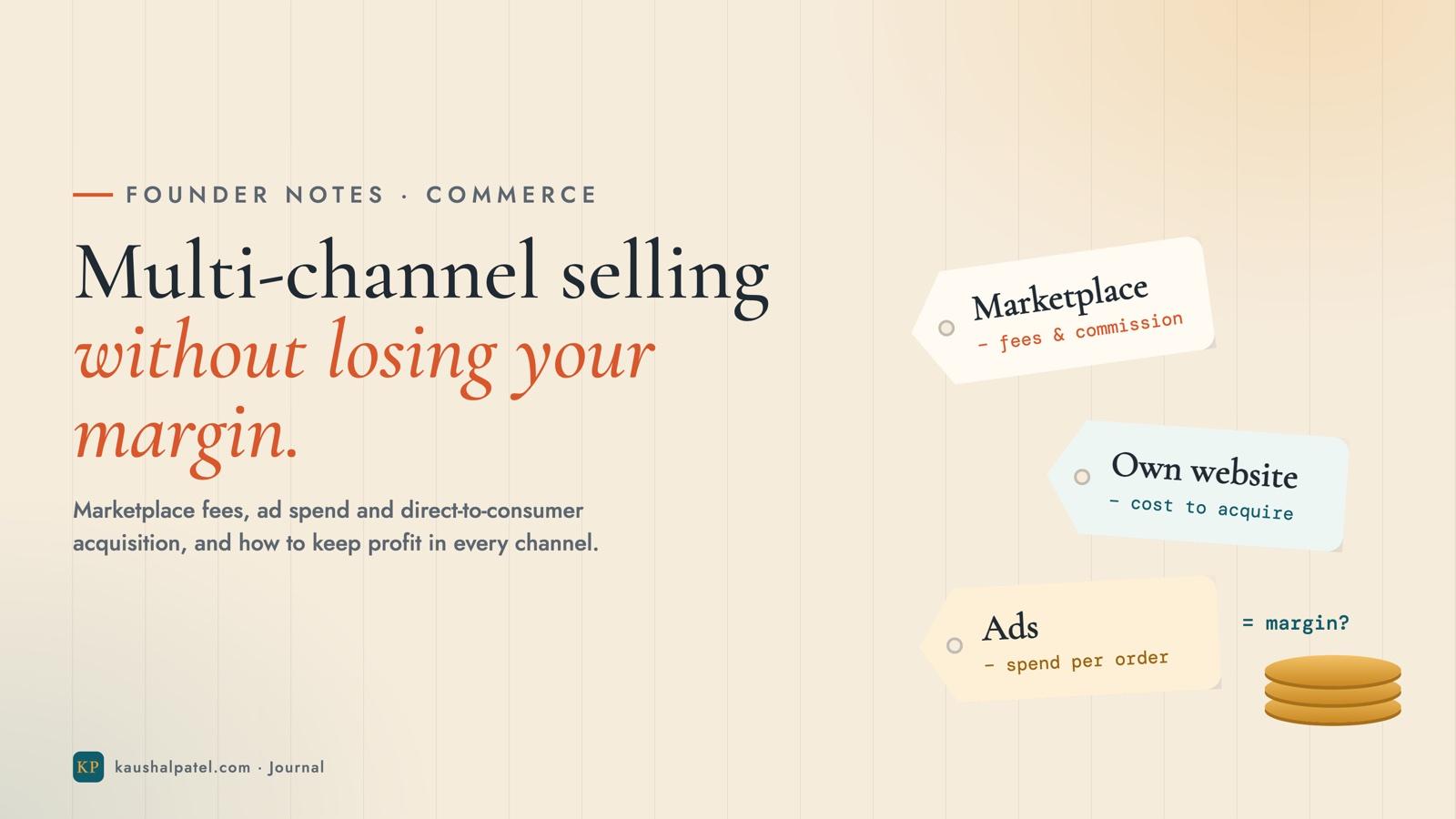
Marketplace fees, ad spend and D2C acquisition: how to see your true profit per order in every channel, with a margin calculator, break-even ROAS and a roadmap.