The “Boring” Startup Advantage: Why Solving Unglamorous Operational Problems Beats Chasing Consumer AI Hype
By Kaushal Patel10 min read
Every few weeks a new consumer AI app goes viral: a chatbot with a personality, an AI photo filter, a “second brain” that summarises your life. Launch threads fill up, waitlists explode — and a few months later most of them are gone, out-built by the next model release or forgotten by users who were only curious.
Meanwhile, somewhere in a textile market, a wholesaler is re-typing WhatsApp orders into billing software at 11 p.m. A clinic is running its day from a paper diary. A distributor is phoning three transporters to find one parcel. Nobody is writing launch threads about these problems. That is exactly why they are some of the best businesses you can build.
Hype spikes, boring compounds
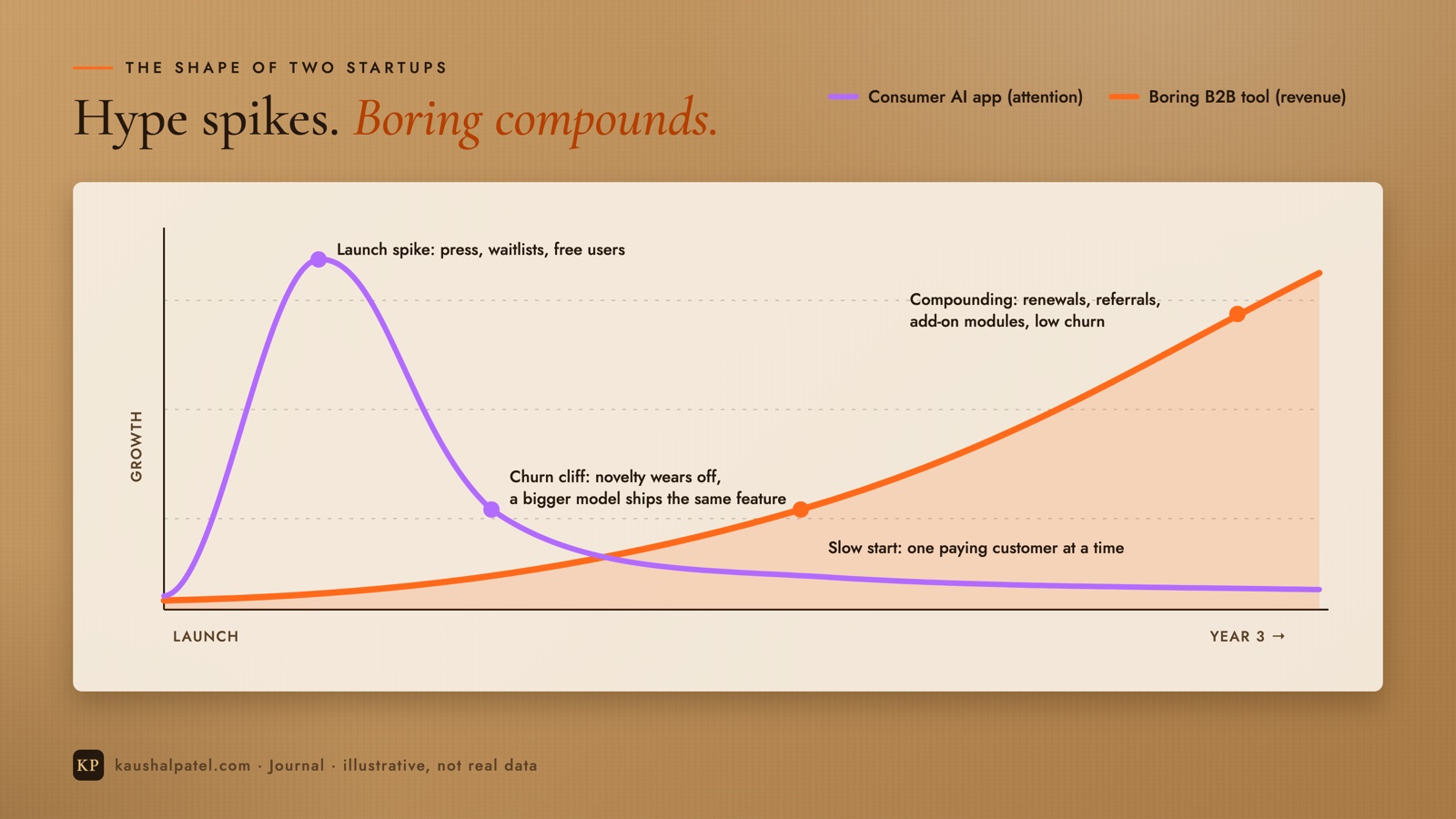
Most hype-driven products follow the same arc: a huge launch spike of curious free users, a churn cliff when the novelty wears off, and constant pressure from bigger platforms shipping the same feature. A tool that fixes a real operational problem usually looks slow at first — one paying customer at a time — and then quietly compounds through renewals, referrals and add-ons.
The shape of two startups (illustrative, not real data): a launch spike versus a compounding curve.
What “boring” actually means
“Boring” doesn’t mean easy or small. It means a problem that is:
Frequent — it happens every day or every week, not once a year.
Expensive — mistakes cost stock, orders, customers or compliance.
Operational — it lives in how a business runs, not in how people feel.
Paid for — a business owner with a budget feels the pain personally.
Invisible to outsiders — you only see it if you sit inside the business.
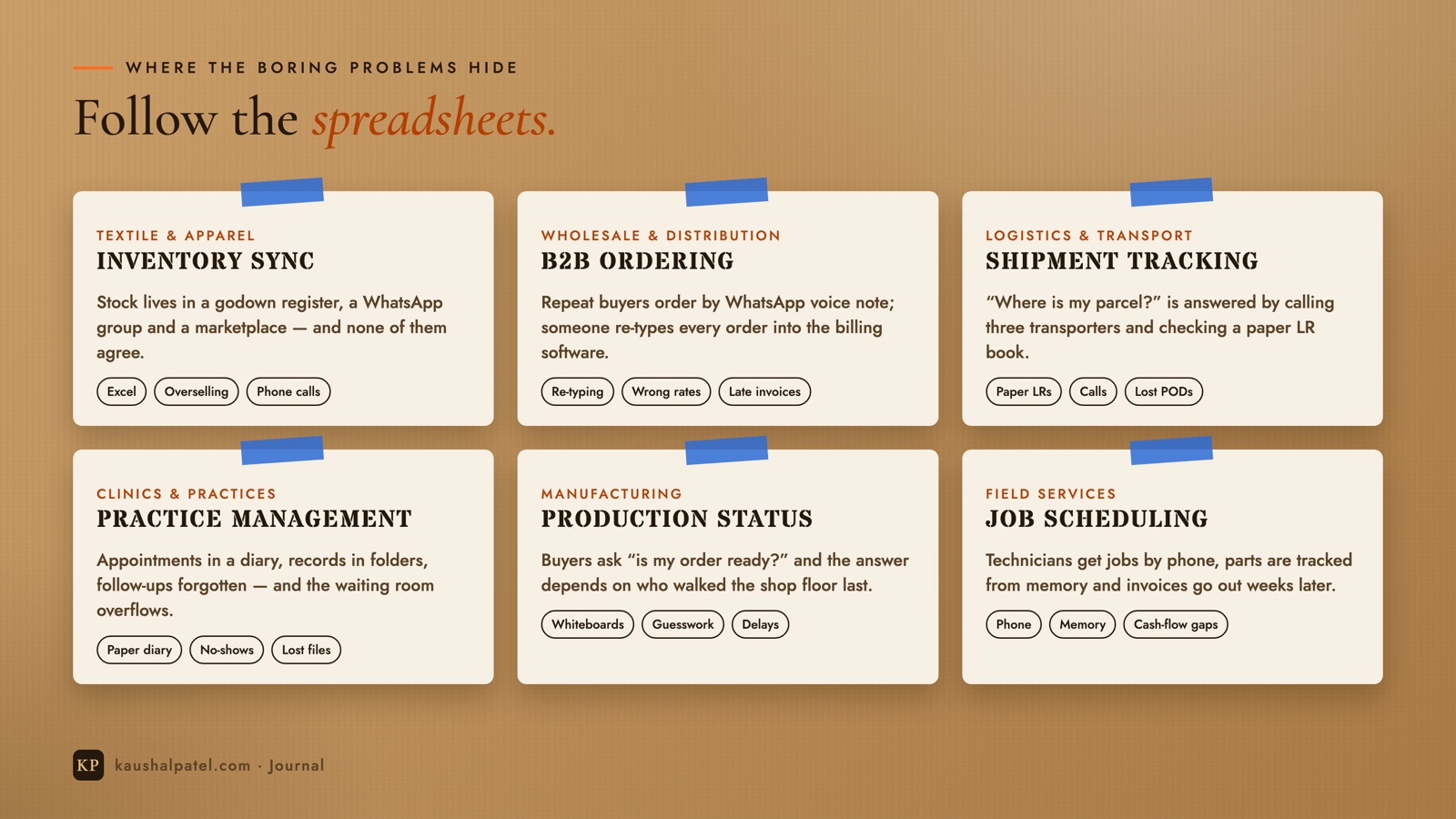
The easiest way to find these problems is to follow the spreadsheets, paper registers and WhatsApp groups. Every one of them is a workaround for software that doesn’t exist yet — or doesn’t fit.
Follow the spreadsheets: six places unglamorous, expensive problems hide.
Consumer AI app vs boring B2B tool
Consumer AI app
Boring B2B tool
Who pays
Individuals — often expecting it free
Businesses that already spend on the problem
Getting customers
Viral moments, ads, constant novelty
Word of mouth inside a trade, direct sales
Retention
Drops once the novelty wears off
Sticky — daily workflow and years of data
Competition
Hundreds of lookalikes, plus the model makers
A few old incumbents and spreadsheets
Moat
Thin — the same model is available to everyone
Workflow, data, integrations and trade know-how
Role of AI
The whole product
A feature that removes real work
Quick game · Hype or boring?
Guess first, then reveal
Five startup ideas. Decide which ones have a boring advantage, then open each card.
An AI app that writes funny captions for your selfies
Hype. Fun, viral, and free everywhere — any photo app or model provider can add it tomorrow, and users won’t pay for long.
Stock sync between a wholesaler’s godown, Shopify store and B2B buyers
Boring — and valuable. Overselling and dead stock cost real money every week, and once the stock data lives in your tool, switching is painful.
Appointment, records and follow-up software for small clinics
Boring — and valuable. Practice management is used all day by staff, holds years of patient history and comes with compliance rules most generalists avoid.
An AI “life coach” chatbot with a cute personality
Hype. Easy to copy, hard to differentiate, and engagement usually fades after the first few weeks.
Reading WhatsApp order messages and turning them into invoices automatically
Boring, with AI where it belongs. AI does real work inside a painful, paid-for workflow — the AI is the feature, the workflow is the product.
Why boring wins
1. The money is already flowing
A business with a messy process is already paying for it — in staff hours, mistakes, lost orders and late invoices. You are not asking for a new budget; you are moving an existing cost onto a better tool. That makes “yes” much easier than convincing a consumer to pay for something they enjoyed for free.
2. Once it works, nobody wants to leave
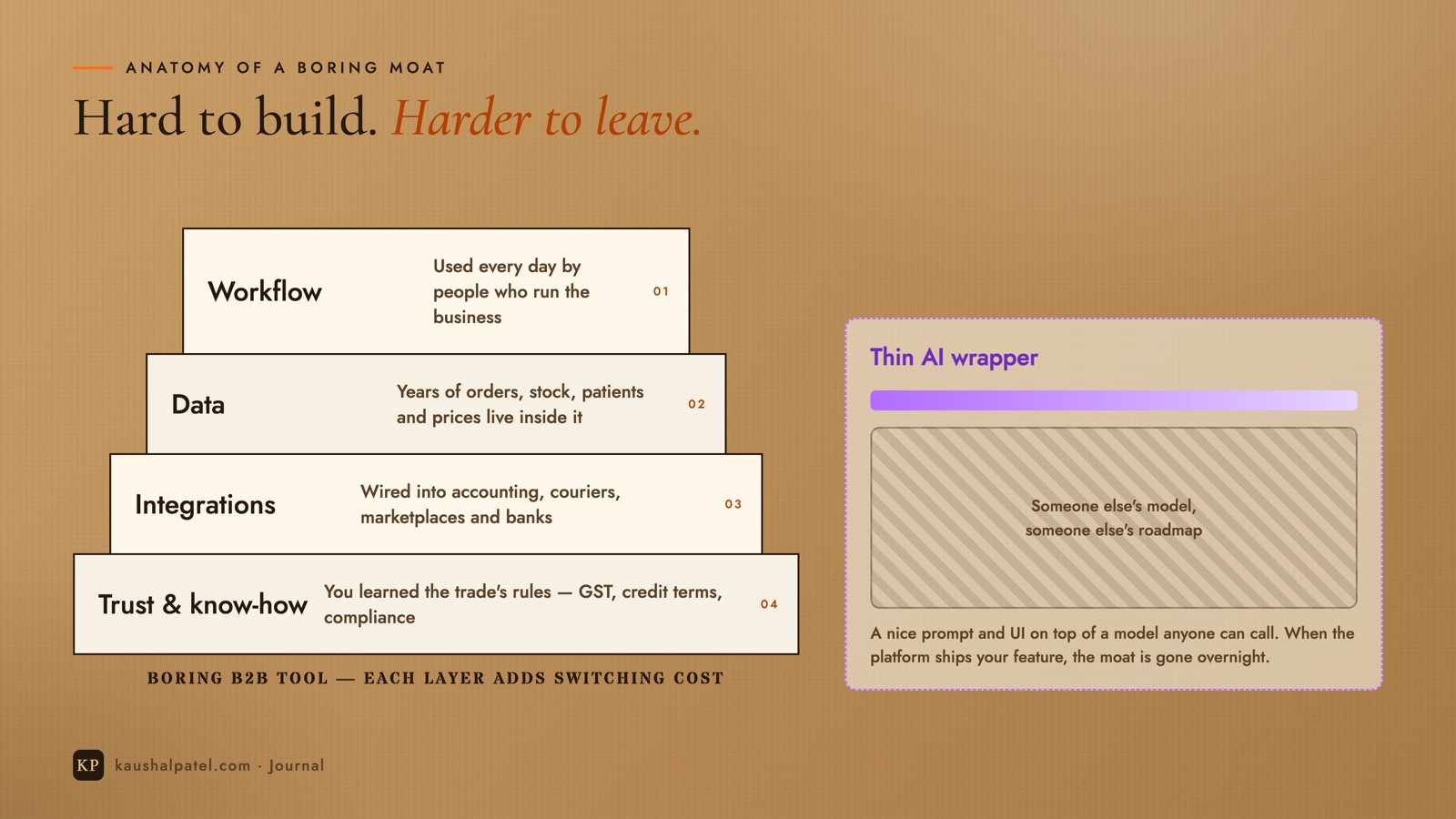
A tool used every day by the people who run the business, holding years of orders, prices or patient records and connected to accounting, couriers and marketplaces, is genuinely hard to replace. Each layer adds switching cost — and that is your moat.
Each layer of a boring product adds switching cost; a thin AI wrapper has almost none.
3. Less competition, better customers
Investors and builders crowd toward what is visible and exciting. Very few want to learn GST invoicing rules, transporter workflows or how a clinic runs its day. If you are willing to, you often compete with old desktop software and Excel — not with a hundred funded startups.
4. Trades talk to each other
Textile traders, clinic owners and distributors know each other. When something saves them real money, they tell people. Distribution inside a trade network is slower than going viral, but it is far more durable.
5. AI becomes a feature, not the business
The best use of AI is often invisible: reading a messy order message, matching an invoice to a payment, predicting which stock will run out. Inside a boring product, AI removes real work — and the product survives even when models change.
Interactive · Calculator
Put a price on the mess
Estimate what a manual process — re-typing orders, reconciling stock, chasing shipments — really costs a business each year.
Hours lost a year
936
Cost of that time
₹3,74,400
Cost of mistakes
₹2,40,000
Total cost a year
₹6,14,400
A tool that removes even 70% of this is worth up to ₹35,840 a month to this one customer — before counting happier staff and customers.
Real companies built on “boring” problems
Some of the most durable software companies started with deeply unglamorous workflows: Veeva Systems (CRM and compliance software for life-sciences companies), Procore (construction project management), Samsara (fleet and operations data) and ServiceTitan (software for plumbing, HVAC and other home-service trades). All four became public companies by going deep on one industry’s daily operations rather than chasing consumer attention.
I see the same pattern at a smaller scale in my own work:
Mahavir Fashion’s B2B wholesale portal — OTP logins for buyers, a wholesale catalogue, order and production status, invoices and a shipping & transport module. Nothing about it would trend online; every part of it saves the business time and mistakes every week.
Genetic, a hospital management system — role-based portals for admins, doctors, receptionists and patients, built around appointments and daily clinical operations. Practice management is the definition of boring — and of essential.
Garvista Enterprise, my textile trading business, runs in an industry where orders, stock and payments still move through registers, phone calls and WhatsApp. Living inside that workflow is the fastest way to see what is worth building.
Boring problem → product → where AI actually helps
Boring problem
What to build
Where AI genuinely helps
Stock out of sync across godown, store and marketplaces
One inventory source of truth with channel sync
Forecasting re-orders and flagging slow movers
Orders arriving by WhatsApp, voice notes and calls
A B2B ordering portal with buyer-specific rates
Turning messages into draft orders automatically
“Where is my parcel?” calls
Shipment tracking across transporters with proof of delivery
Reading LR photos and predicting delays
Clinic diaries, no-shows and lost files
Appointments, records and reminders in one system
Summarising notes and drafting follow-ups
Invoices matched to payments by hand
Billing with payment reconciliation
Matching bank entries to invoices
Interactive · Boring Idea Scorecard
Does your idea have a boring advantage?
Answer six questions honestly. Each answer scores 0–3.
0/18
Answer all six questions to see your verdict.
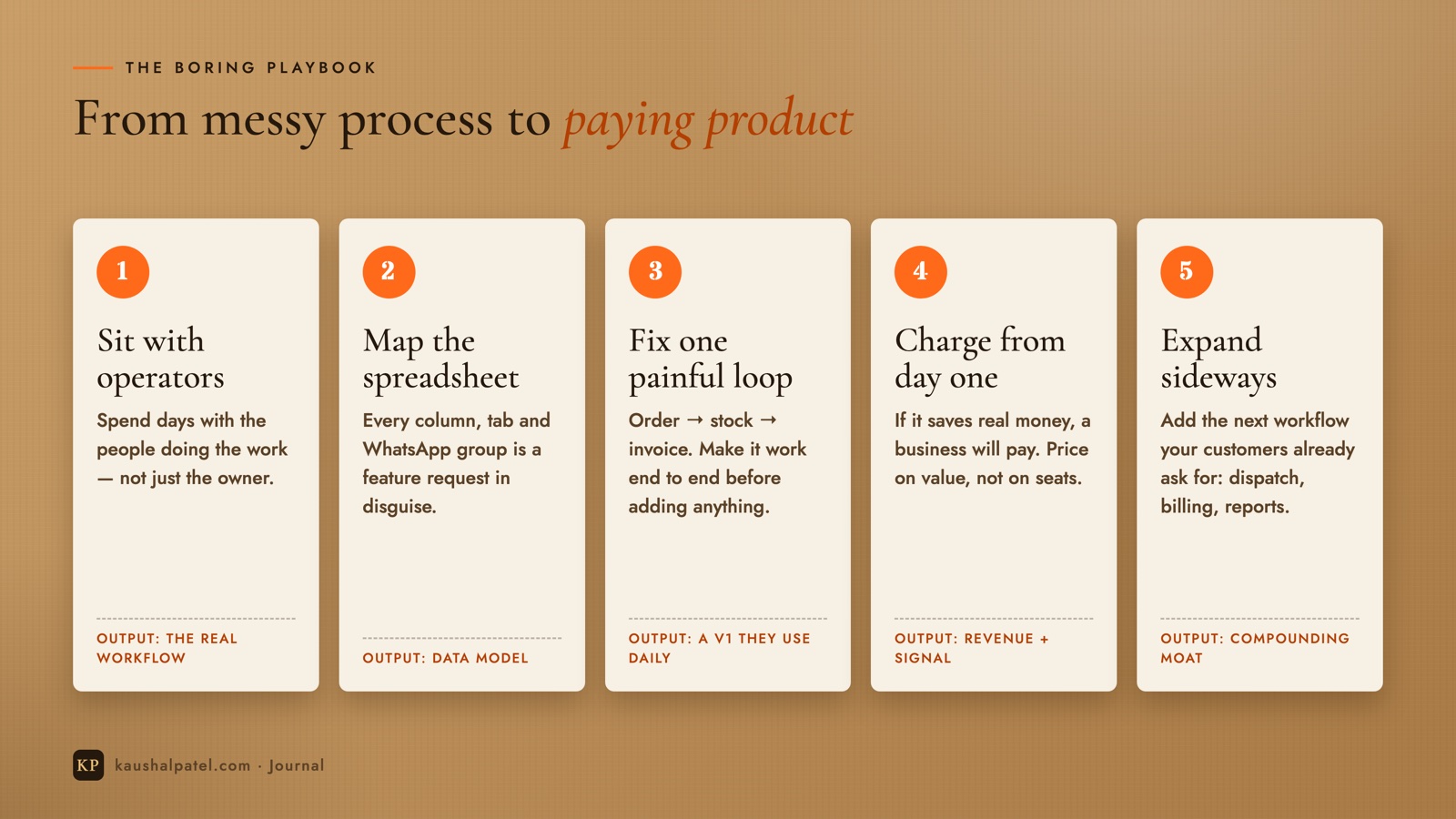
The boring playbook
From messy process to paying product in five steps.
Sit with operators. Spend days with the people doing the work, not just the owner. The real workflow is rarely the one you are told about.
Map the spreadsheet. Every column, tab and WhatsApp group is a feature request in disguise — and a ready-made data model.
Fix one painful loop. For example: order → stock → invoice. Make that loop work end to end before adding anything else.
Charge from day one. If it saves real money, a business will pay. Price on the value you create, not on the number of seats.
Expand sideways. Add the next workflow your customers already ask for — dispatch, billing, reports — and the moat grows with every module.
Before you build, check
You have spoken to at least ten people who live with this problem every week.
They can tell you what it costs them — in hours, mistakes or lost sales.
Someone with a budget would pay to fix it this quarter.
Their data and workflow would live in your product.
You are willing to learn the industry’s rules better than any generalist.
Frequently asked questions
Isn’t a boring market too small?
Many “boring” niches are large once you add them up — and a focused product can expand into adjacent workflows and neighbouring industries. A small market you can win is worth more than a huge one where you are one of hundreds.
Should I avoid AI completely?
No. Use AI where it removes real work inside the workflow — reading documents, matching records, forecasting. Just don’t make a thin AI layer the whole business.
How do I find a boring problem if I don’t work in an industry?
Borrow one. Spend time with a family business, a local clinic, a distributor or a manufacturer. Ask what they do in Excel, on paper or on WhatsApp every week — and what goes wrong.
Boring problems sound slow. Can they grow fast?
The start is usually slower, but revenue from businesses tends to renew and expand. Slow and compounding often beats fast and leaking.
The bottom line
Hype is loud, and it is tempting to build where everyone is looking. But the businesses that last are often the ones fixing problems nobody tweets about: stock that doesn’t match, orders that get lost, appointments that slip. Find the spreadsheet, fix the loop, charge for the value — and let the boring advantage compound.
Running a business with a painful, manual process — or building a product for one? Let’s talk; this is exactly the kind of software I like to build.
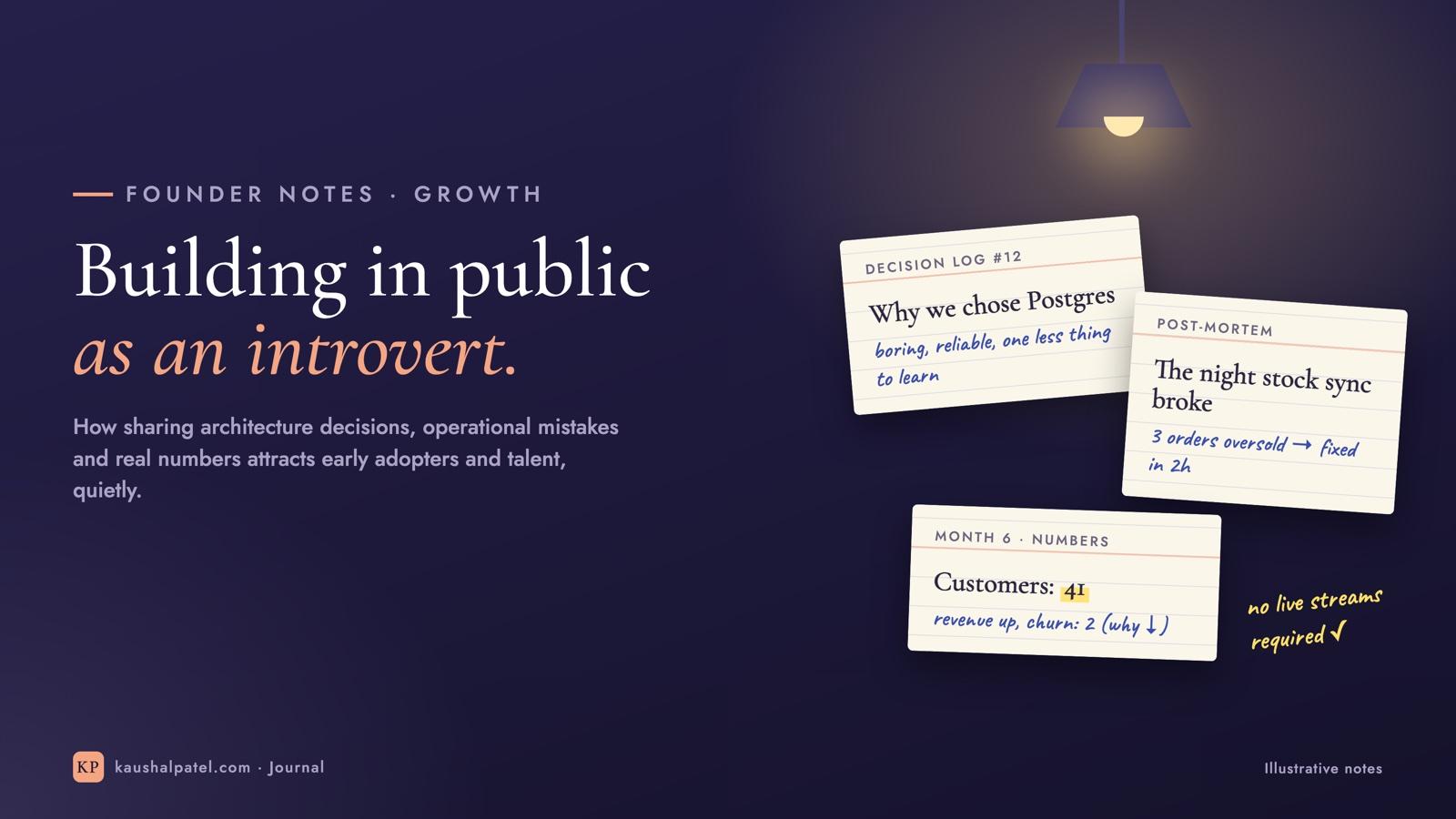
Quiet, written building in public: share architecture decisions, mistakes and real numbers to attract early adopters and talent, with an update builder.
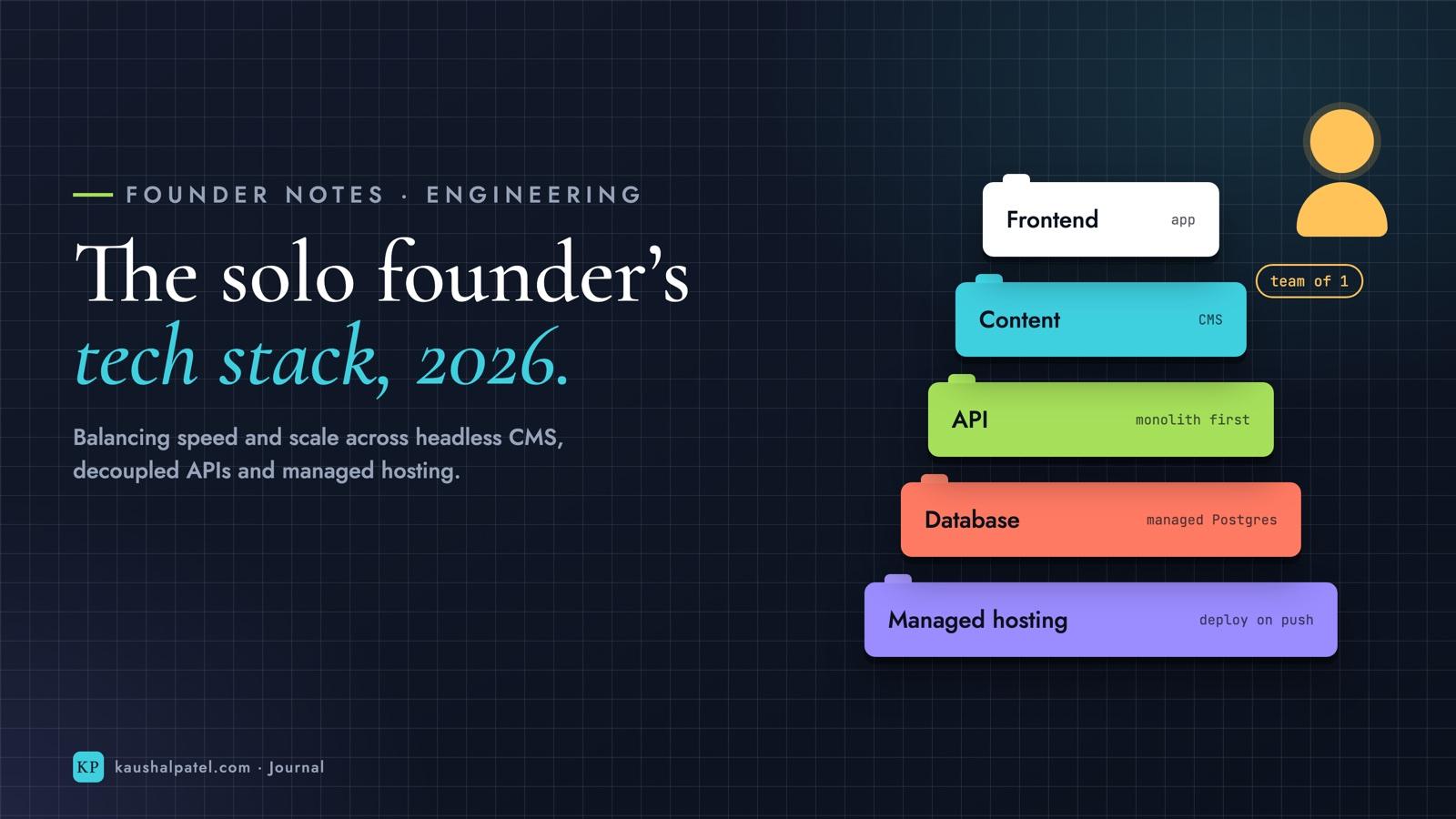
Headless CMS, decoupled APIs or a monolith, managed hosting or a VPS: how to pick a 2026 stack one person can run, with a hosting cost calculator and checklist.
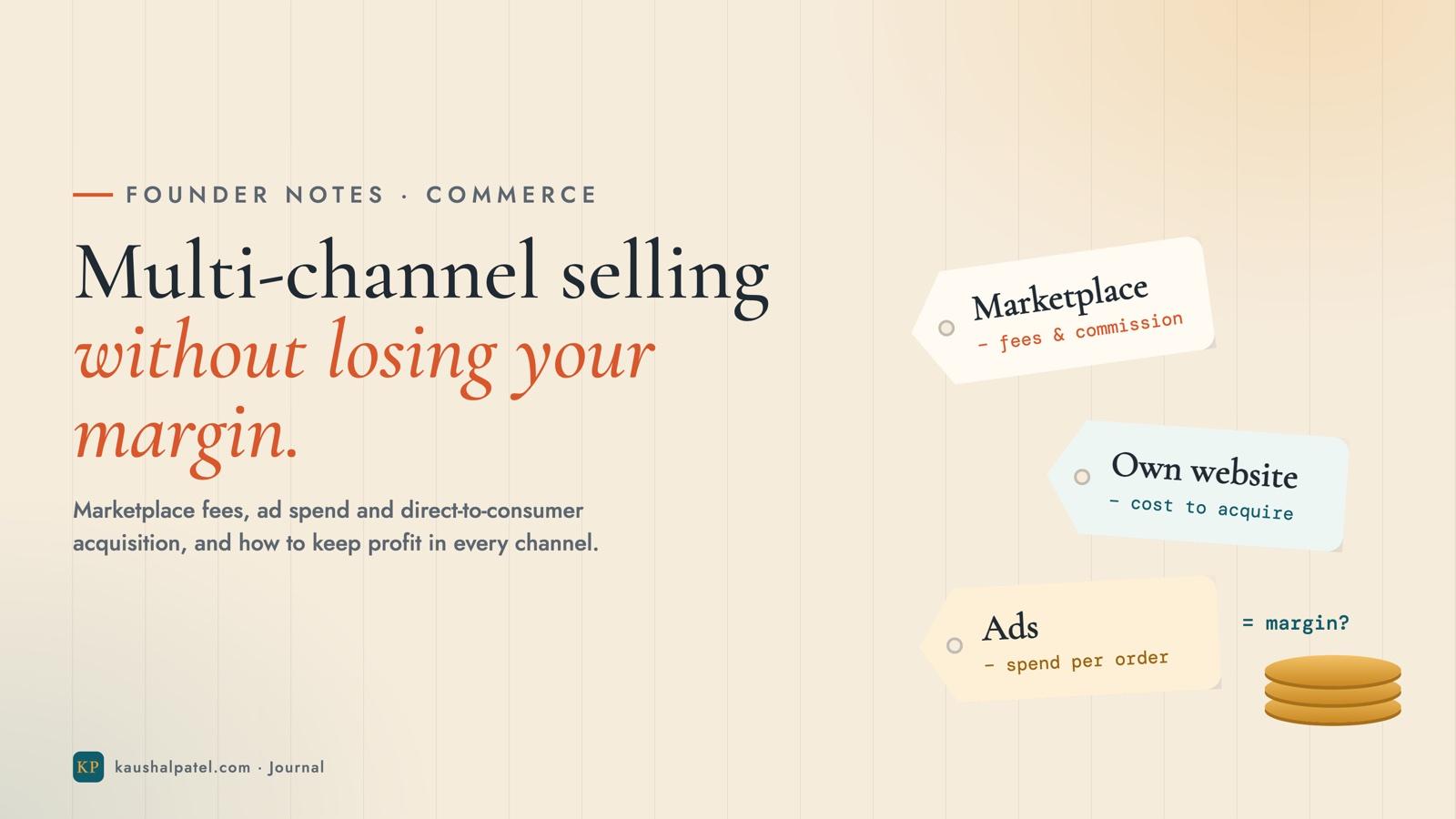
Marketplace fees, ad spend and D2C acquisition: how to see your true profit per order in every channel, with a margin calculator, break-even ROAS and a roadmap.