Bootstrapping vs. Raising Early: How Cash Flow from a Commerce or Service Business Changes the Way You Build Software Products
By Kaushal Patel11 min read
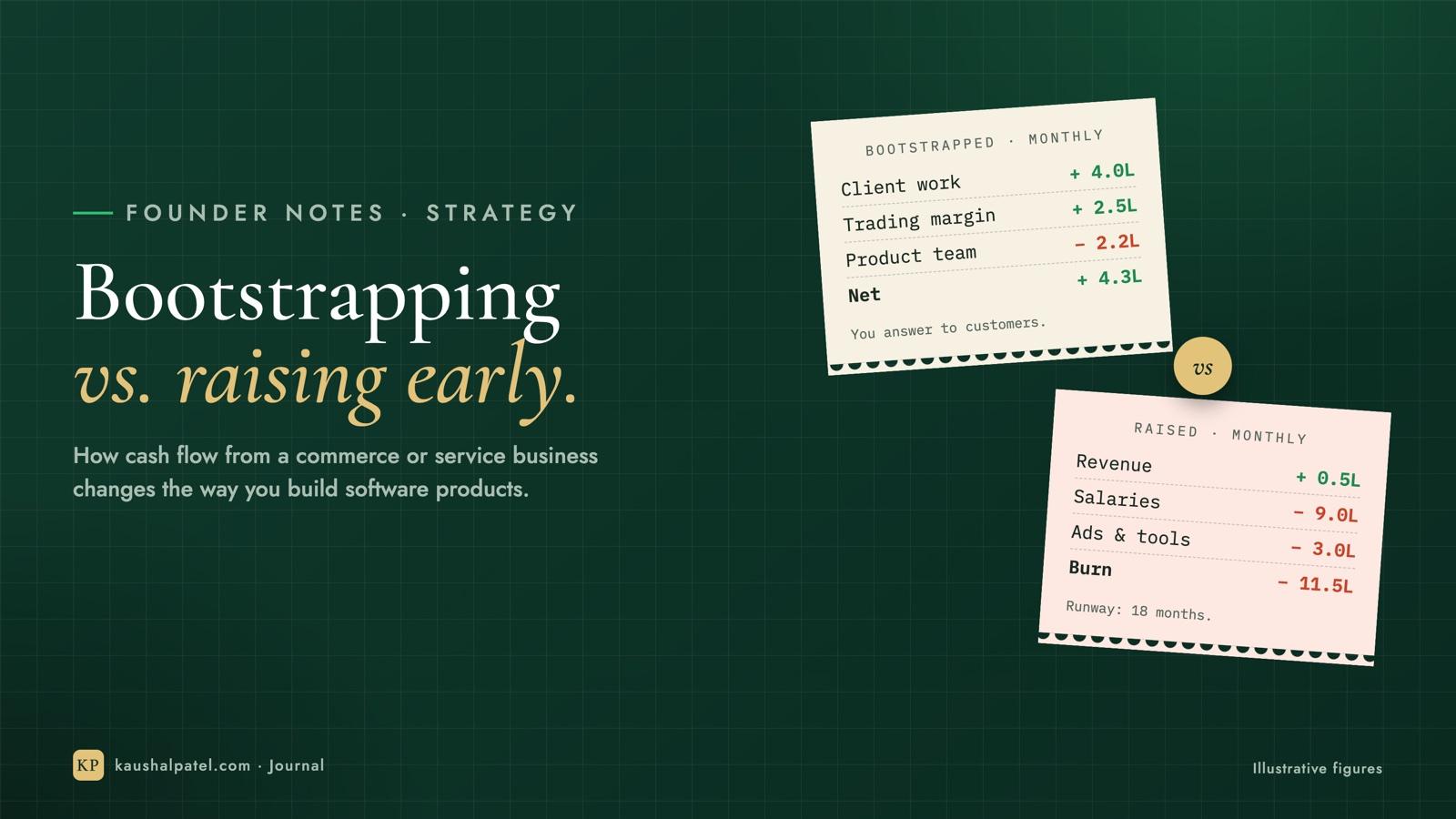
There are two classic ways to fund a software product. You can raise money early: sell investors a vision, hire a team, and race to prove it before the runway runs out. Or you can bootstrap: earn money first, often from a service or commerce business, and let that cash flow pay for the product.
Most startup advice is written by and for the first group. But a lot of very good software is built the second way, by agencies that turned an internal tool into a product, traders who automated their own back office, and consultants who noticed every client asking for the same thing. The money you build with changes far more than your bank balance. It changes what you build, how fast, and for whom.
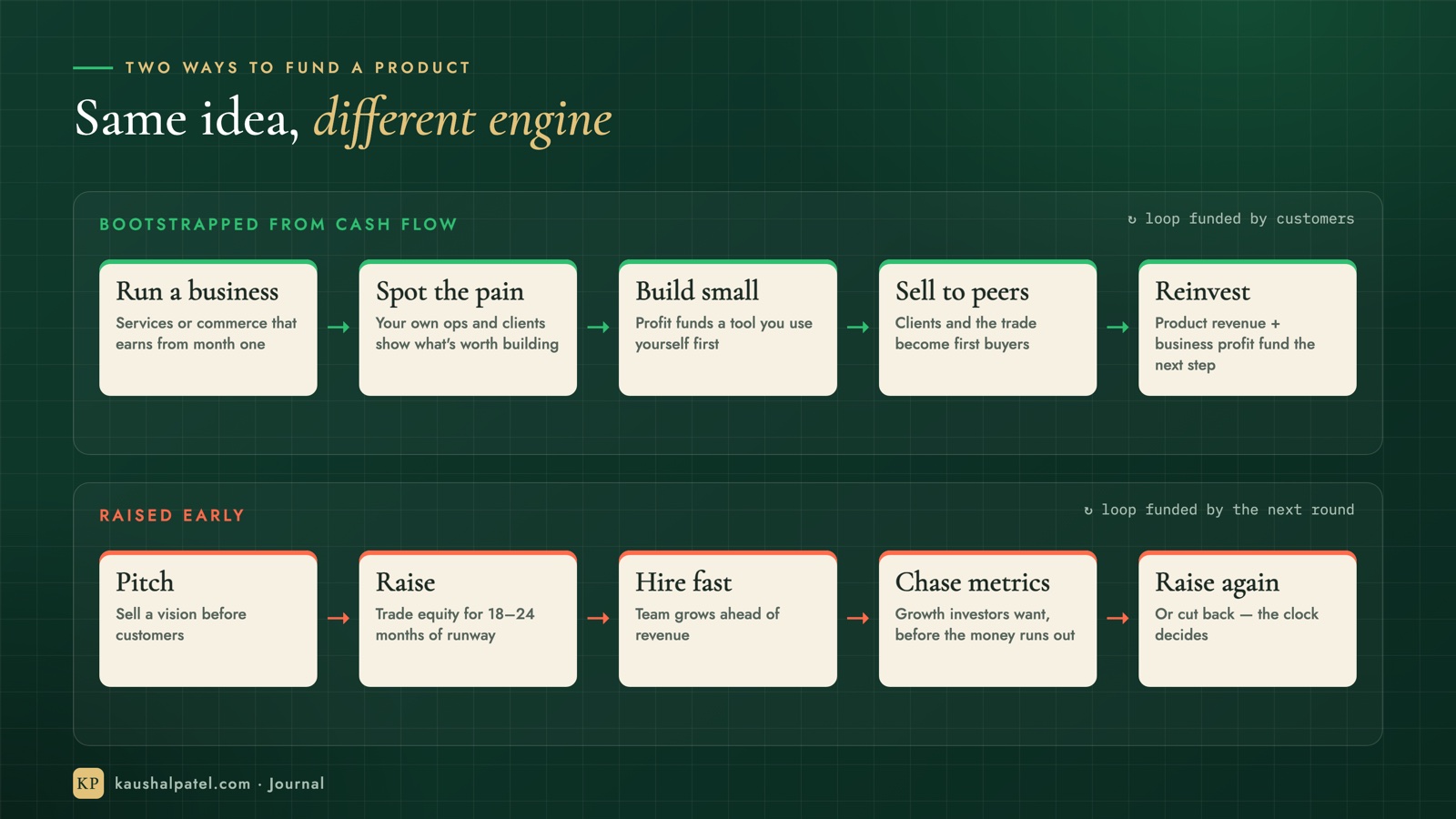
Same idea, different engine: customers fund one loop, the next round funds the other.
Two engines, side by side
Bootstrapped from cash flow
Raised early
Who you answer to
Customers and your own P&L
Investors and the next round
Speed
Steady, limited by profit and time
Fast, limited by runway
First users
Existing clients and your own team
Early adopters found through launches and ads
Pricing
Charge from day one
Often free or cheap to grow usage
Scope
Small, practical, one painful workflow
Ambitious platform, built ahead of demand
Hiring
When revenue allows
Ahead of revenue, to hit milestones
Biggest risk
Growing too slowly while others race ahead
Running out of money before finding fit
Ownership
You keep it
Shared, and diluted with every round
How cash flow changes the way you build
1. You build what someone pays for now
When product money comes from your own profit, every feature has to earn its keep. That pressure is healthy. It pushes you toward problems customers already pay to solve and away from “nice to have” ideas that only look good in a pitch deck.
2. Your first customer is you
A service or commerce business is a ready-made test lab. An agency feels the pain of client onboarding. A trader feels the pain of orders, stock and payments. Build the tool for your own team first and you get daily, honest feedback, with no recruiting of beta users needed.
3. You price from day one
Bootstrapped products rarely have the luxury of “free now, monetise later”. That turns out to be an advantage: paying customers give clearer feedback than free users, and you learn early whether the value is real.
4. Scope stays small, and that’s a feature
Limited money forces you to fix one loop end to end, such as order → stock → invoice, instead of building a sprawling platform. Small, finished products are easier to sell, support and improve.
5. You can afford patience
There is no 18-month clock. If a market takes three years to warm up, a business with its own income can wait. A funded startup often can’t. Patience lets you go deep into one niche and earn trust there.
6. The trade-off: your time is split
The honest downside is focus. Running a business and building a product at the same time is hard, and the product can stay a side project forever. The fix is to ring-fence it: a fixed share of profit, a dedicated person or team, and goals measured separately from the core business.
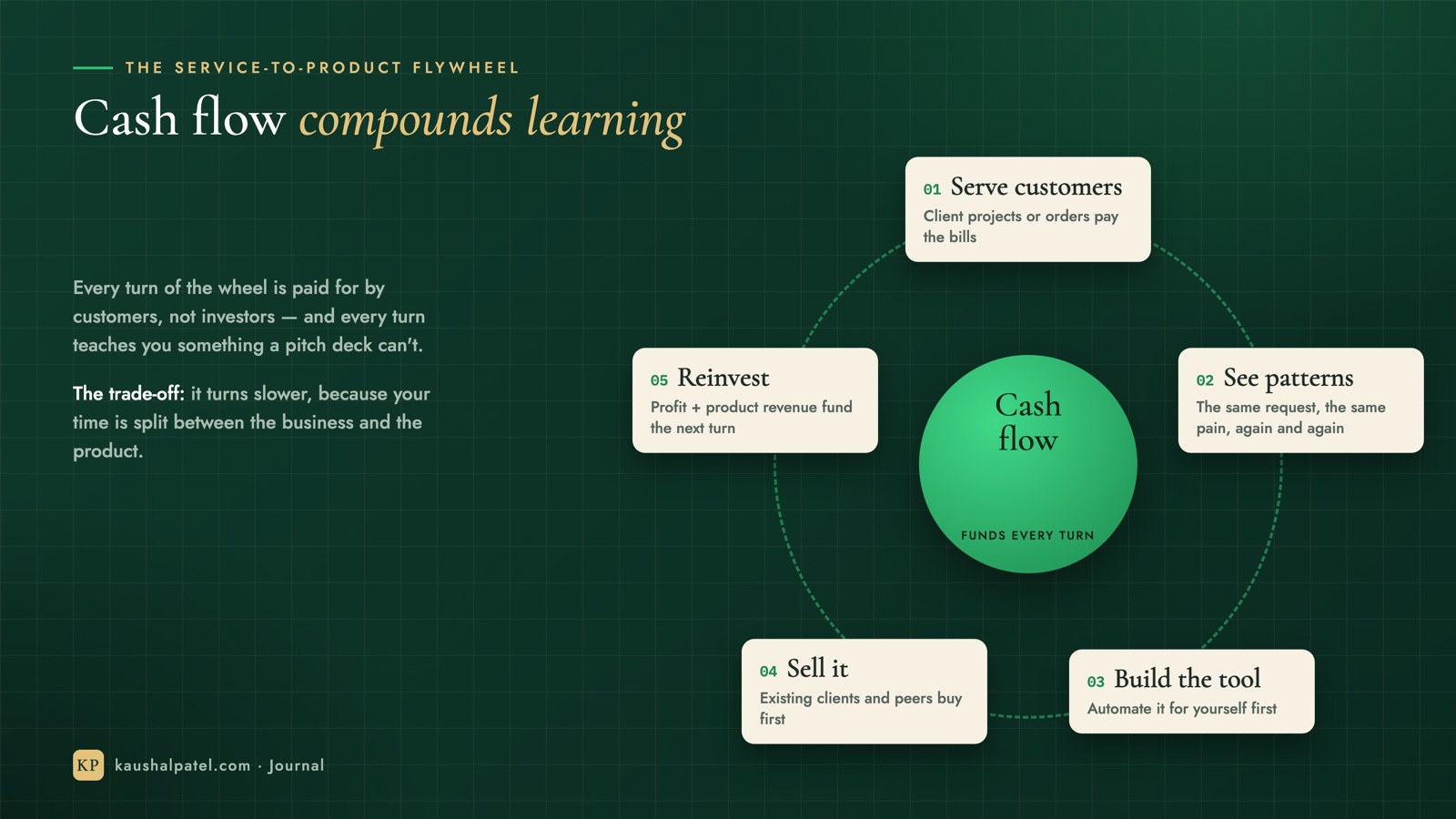
The service-to-product flywheel: every turn is paid for by customers and teaches you something new.
Interactive · Self-funded runway
How much product can your business fund?
Put in your business’s monthly profit and the share you’re willing to reinvest. See what that buys, and what you’d have to raise to get the same.
Product budget / month
₹1,40,000
Product budget / year
₹16,80,000
Developers it pays for
1.2
Equivalent raise
₹33,60,000
Reinvesting 35% of profit funds the same product work as raising ₹33,60,000 for 24 months, without giving up any equity, and it keeps coming as long as the business does.
What “raising early” really costs
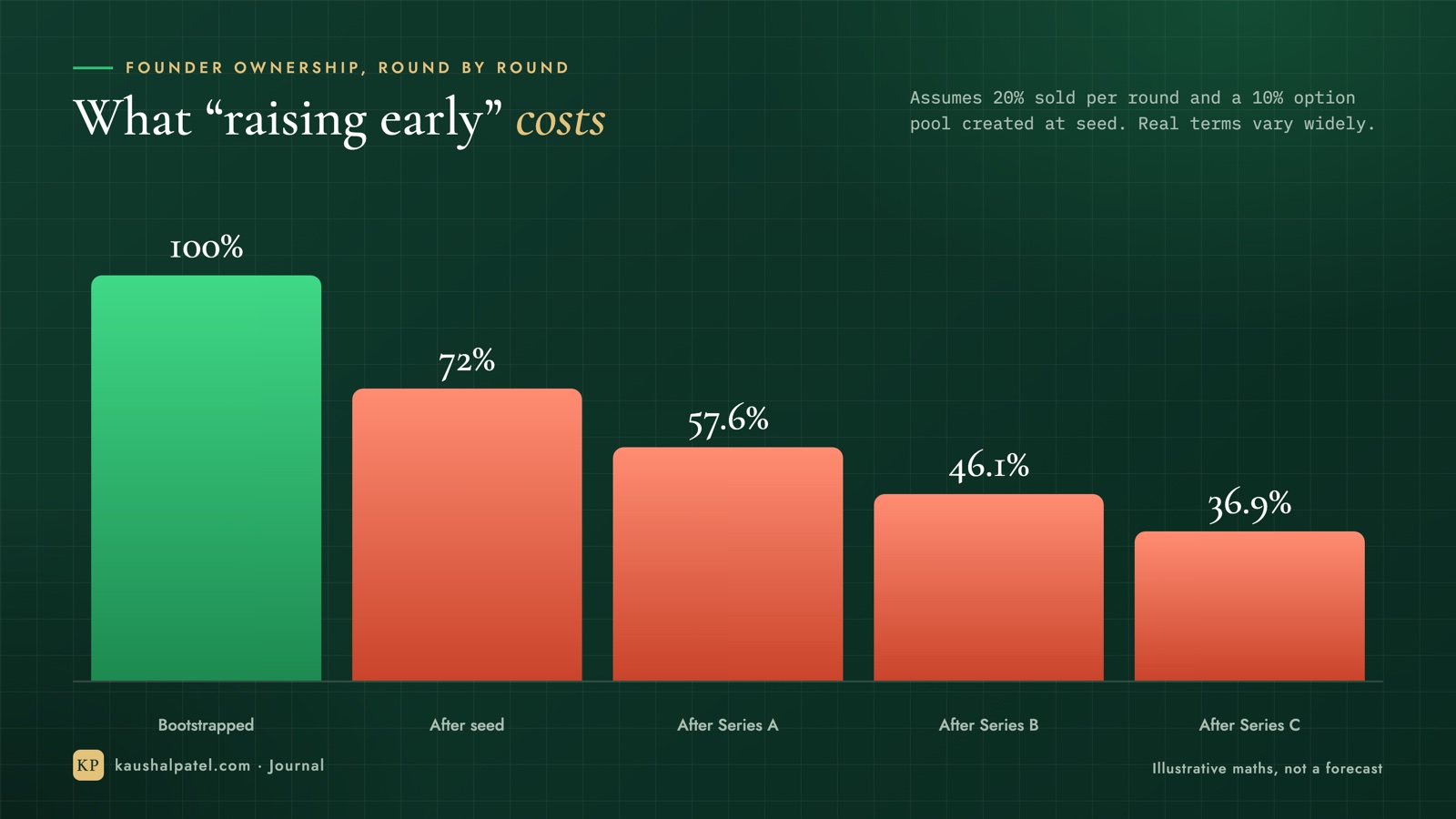
Raising money isn’t free. You pay for it with ownership, and every round takes another slice. The numbers below are simple maths, not a forecast: real rounds vary a lot. They show why founders who raise early often own far less of the company by the time it succeeds.
Illustrative maths: 20% sold per round plus a 10% option pool at seed.
Interactive · Dilution
Play with the rounds
Drag the sliders to see how much of your company you’d keep.
Today100%
After Seed72%
After Series A57.6%
After Series B46.1%
Founders keep 46.1%. 53.9% is sold or set aside for the team.
Dilution isn’t automatically bad. Owning 40% of something large beats owning 100% of something that never grew. The point is to raise because the market demands speed, not because raising is what startups are “supposed” to do.
Companies that grew from cash flow
Basecamp began inside 37signals, a web design consultancy, as a tool for managing its own client projects. It became popular enough that the company stopped doing client work to focus on software.
Mailchimp started as a side project of a web design agency and grew for about two decades without venture capital until Intuit acquired it in 2021.
Zoho, from Chennai, grew from its earlier company AdventNet into a large suite of business software without taking venture funding.
Zerodha, the Indian stock broker, built its trading platform and tools without outside investors and stayed profitable as it grew.
Two of these four started exactly the way this post describes: a service business that built software for itself first.
My own path: services and trade first
This is how I think about my own ventures. Ecourge Innovations builds custom software for clients, which is a service business, and Garvista Enterprise runs import–export and textile trading, which is commerce. Both earn from real customers, and both show me the same kinds of problems again and again: orders arriving on WhatsApp, stock in three places, payments matched by hand.
Four founders, four situations. Make your call, then open each card.
A web agency keeps building the same booking system for clinic clients
Bootstrap. The demand is proven, the first customers already exist, and client fees can fund a productised version. No race to win.
A two-sided marketplace connecting truck owners with shippers across India
Raise early, probably. Marketplaces live or die by network effects: whoever gets enough of both sides first tends to win. Speed costs money.
A textile trader who built an internal stock-and-orders tool that other traders want
Bootstrap, then maybe raise. Sell it to peers with trading profits behind you. If demand grows faster than you can serve it, raise on strong terms.
A medical device that needs two years of R&D and regulatory approval
Raise selectively. There’s a big upfront cost before any revenue. Look at grants, strategic partners or a focused round, because cash flow alone won’t carry it.
So when should you raise?
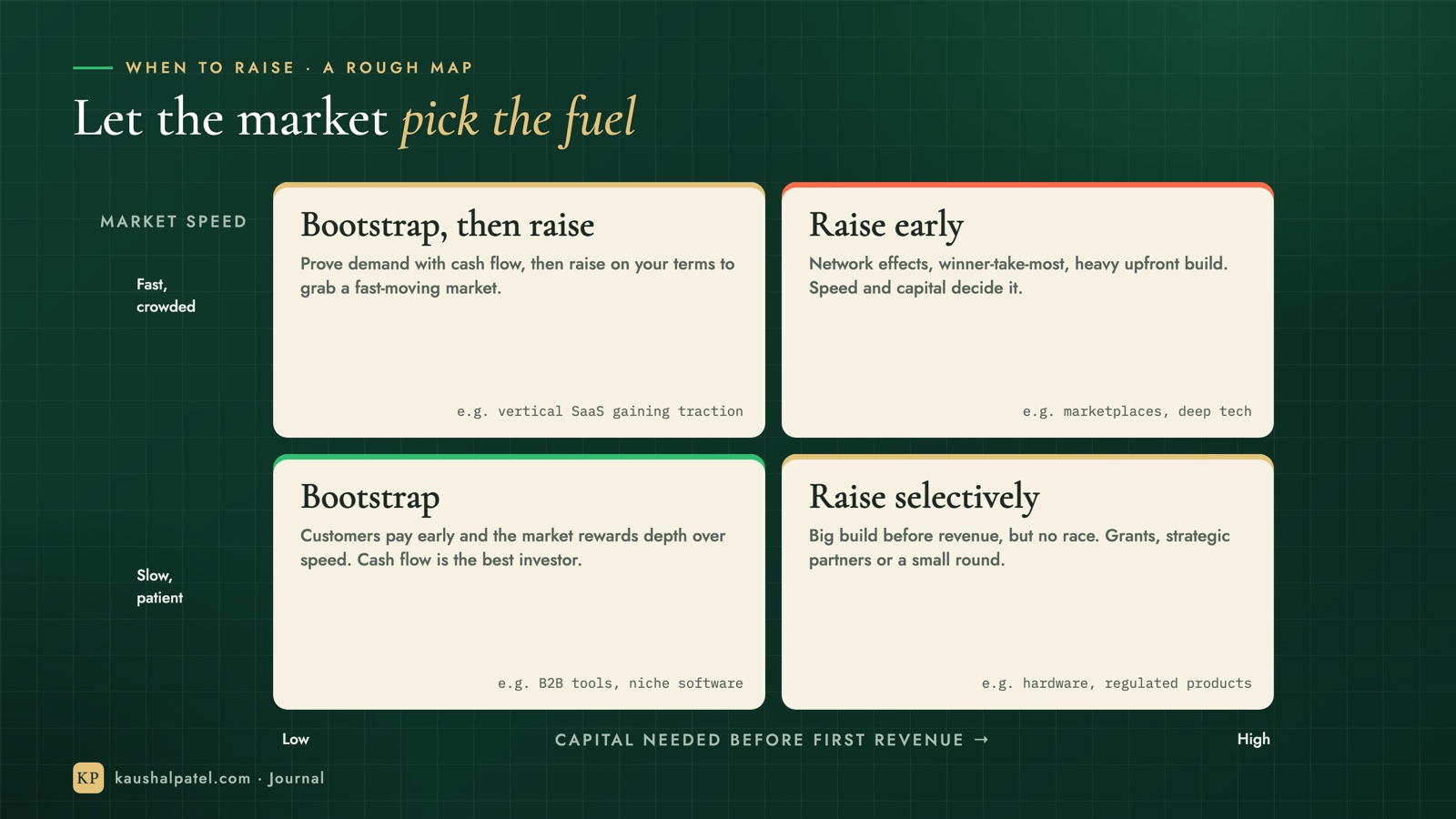
Bootstrapping isn’t a moral position. It’s a fit. Two questions do most of the work: how fast is the market moving, and how much money do you need before the first rupee of revenue?
A rough map: market speed against capital needed before first revenue.
Stage
Bootstrapped move
If you raised
Idea
Notice the pain inside your own business or clients
Research the market and pitch the vision
First version
Internal tool, used by your own team every day
MVP launched to early adopters
First customers
Existing clients, suppliers and peers in the trade
Launches, content and paid ads
Pricing
Paid from the first customer
Free tier or discounts to grow usage
Team
One ring-fenced developer, funded by profit
A full team hired ahead of revenue
Growth
Referrals and expansion into nearby workflows
Spend to grow, then raise the next round
Interactive · Funding fit
Which path fits your product?
Six questions, each scored 0–3. A higher score means bootstrapping fits better.
Raise early. The market rewards speed and capital, and cash flow alone won’t get you there in time.
Hybrid. Bootstrap until you have proof of demand, then raise on your terms to grow faster.
Bootstrap. Customers can fund the product, and patience is an advantage here.
Bootstrap with confidence. Cash flow is your best investor, so keep the control and the upside.
0/18
Answer all six questions to see which path fits.
The service-to-product playbook
Keep the core business healthy. It funds everything, so don’t starve it to feed the product.
Write down repeated pain. Track the requests, workarounds and mistakes you see in your own operations and your clients’.
Ring-fence a budget. Commit a fixed share of profit, for example 20–40%, and at least one person whose job is the product.
Build for yourself first. Run your own business on the tool for a few months, and fix what annoys your team.
Sell to the people you already know. Clients, suppliers and peers are your first customers. Charge them.
Measure the product separately. Give it its own revenue, costs and goals, so it doesn’t stay a side project.
Decide about funding with evidence. Once demand outruns what cash flow can fund, raising becomes a choice made from strength.
Before you choose, check
You know whether customers will pay for an early, small version.
You’ve worked out how much money you need before the first revenue.
You know whether your market rewards speed or depth.
You’ve decided how much profit, and whose time, goes into the product.
You know how much ownership and control you’re willing to give up, and why.
Frequently asked questions
Isn’t bootstrapping just slower?
At the start, usually yes. But bootstrapped products often spend less time building things nobody pays for, so the path to a profitable product can be shorter than it looks.
Won’t running a service business distract me from the product?
It can, which is why the product needs its own budget, person and goals. Treat it as a separate business unit, not something you do “when there’s time”.
Can I raise money later if I bootstrap first?
Yes, and often on better terms. Revenue, paying customers and a profitable parent business make for a much stronger negotiating position than an idea and a deck.
What kind of business is best for funding a software product?
One that sits close to the problem you want to solve. An agency, a trading business or a consultancy in the same industry gives you both the cash flow and the customer insight.
The bottom line
Raising early buys speed. Bootstrapping from cash flow buys time, focus on paying customers, and control. If your market is a race, take the fuel. If it rewards depth, let a real business pay for the product, build for yourself first, and let every turn of the flywheel make the next one easier.
Running a service or trading business and thinking about turning a repeated problem into a product? Let’s talk. This is exactly the kind of software I like to build.
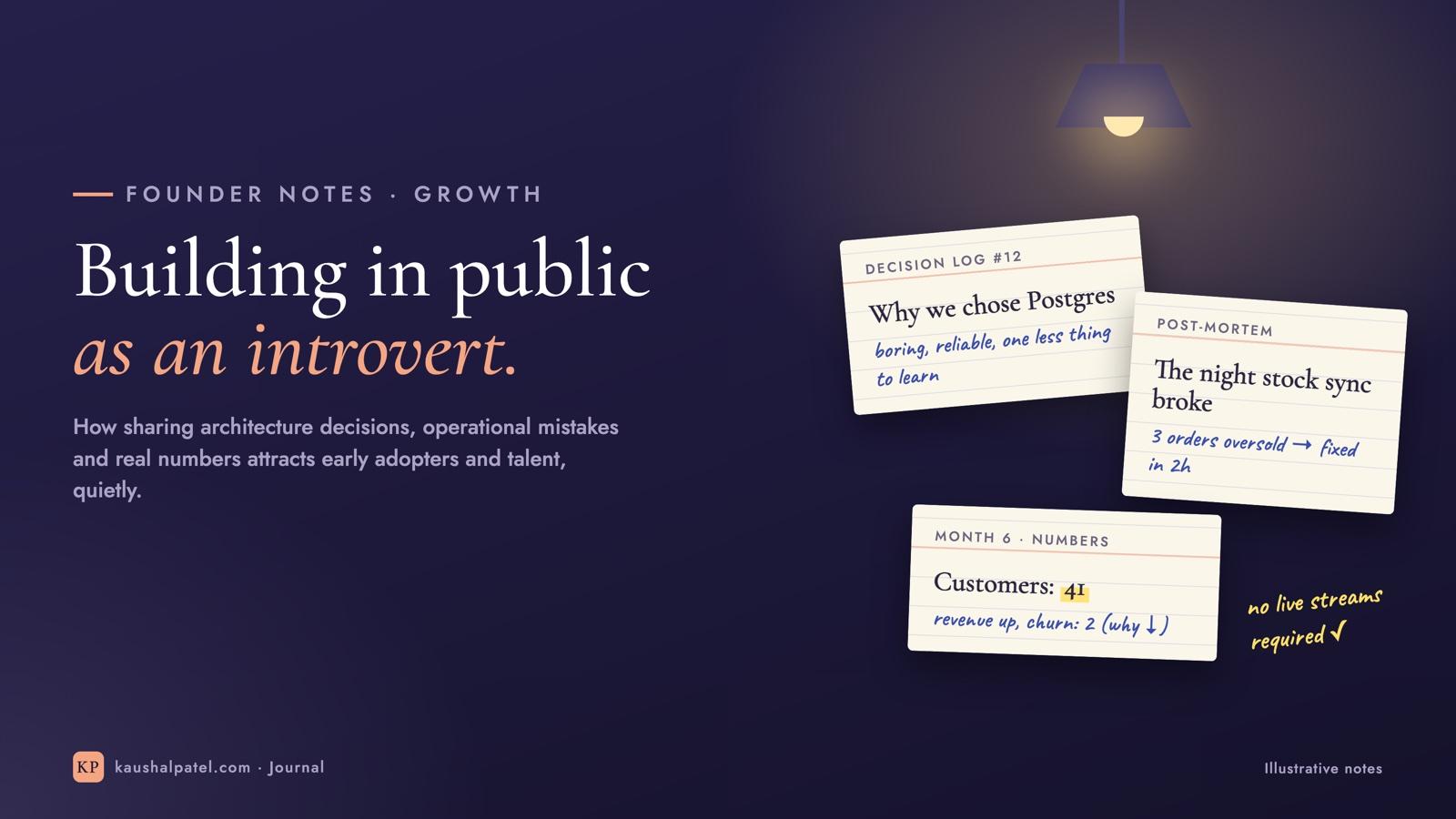
Quiet, written building in public: share architecture decisions, mistakes and real numbers to attract early adopters and talent, with an update builder.
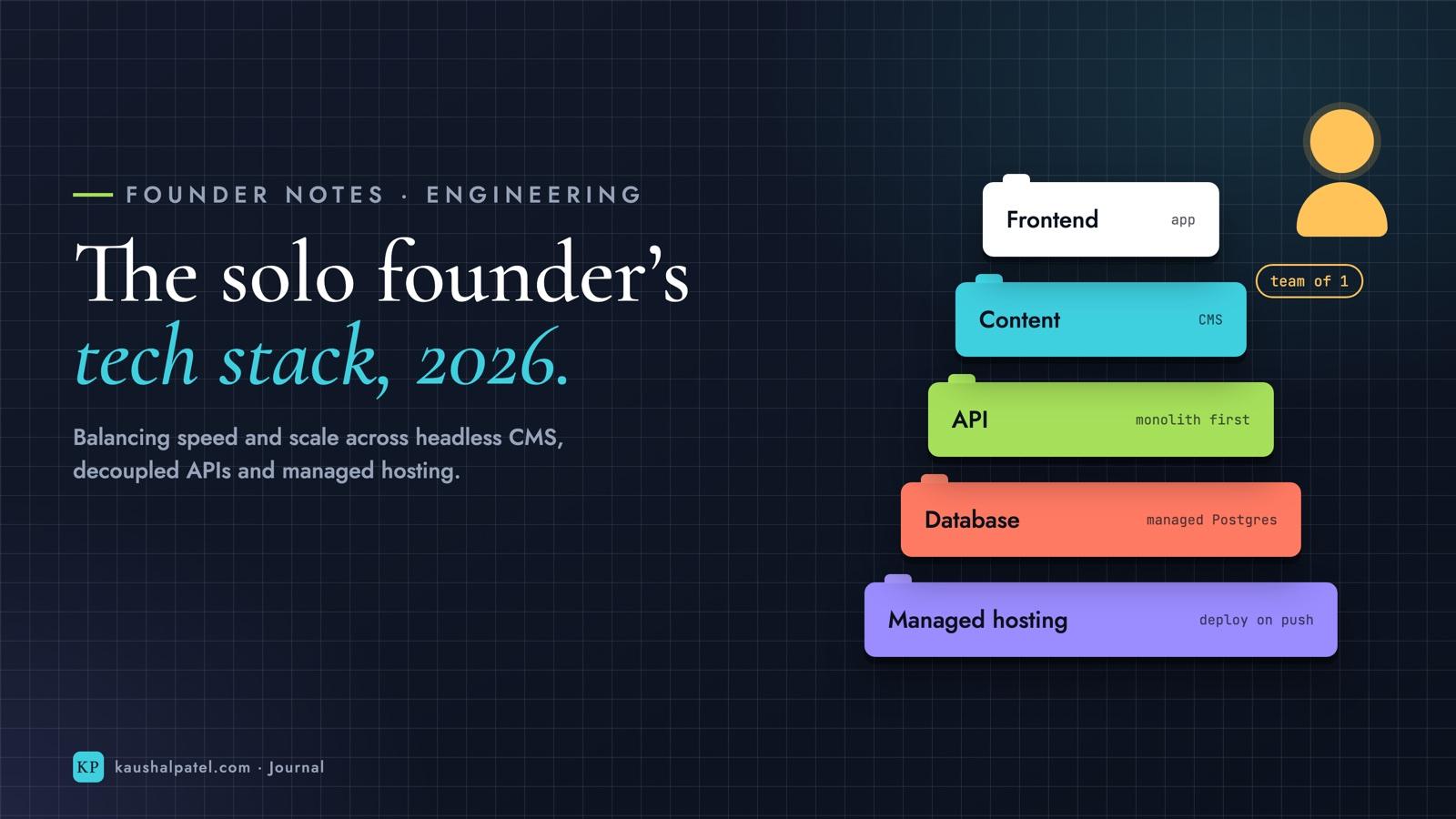
Headless CMS, decoupled APIs or a monolith, managed hosting or a VPS: how to pick a 2026 stack one person can run, with a hosting cost calculator and checklist.
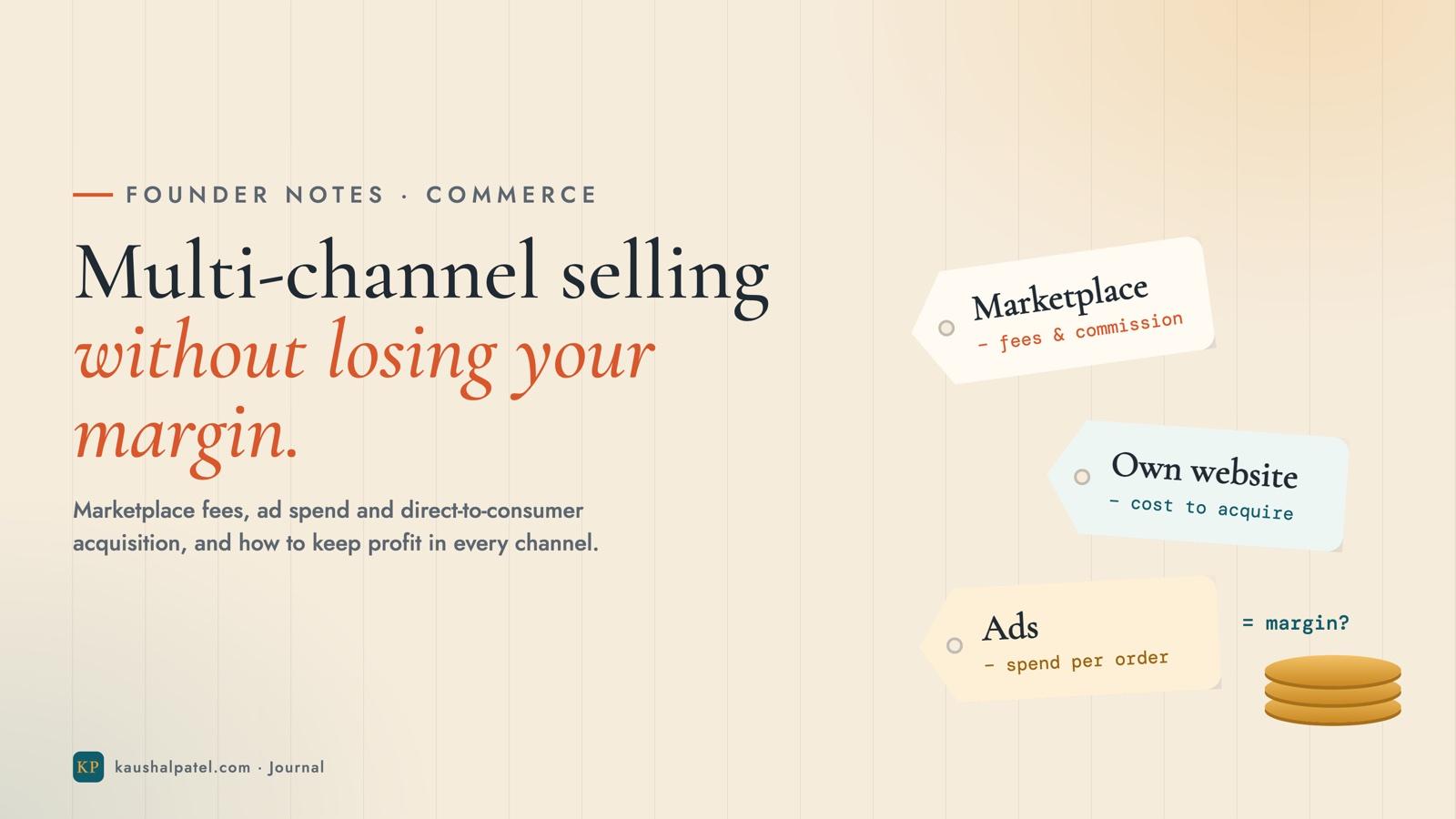
Marketplace fees, ad spend and D2C acquisition: how to see your true profit per order in every channel, with a margin calculator, break-even ROAS and a roadmap.