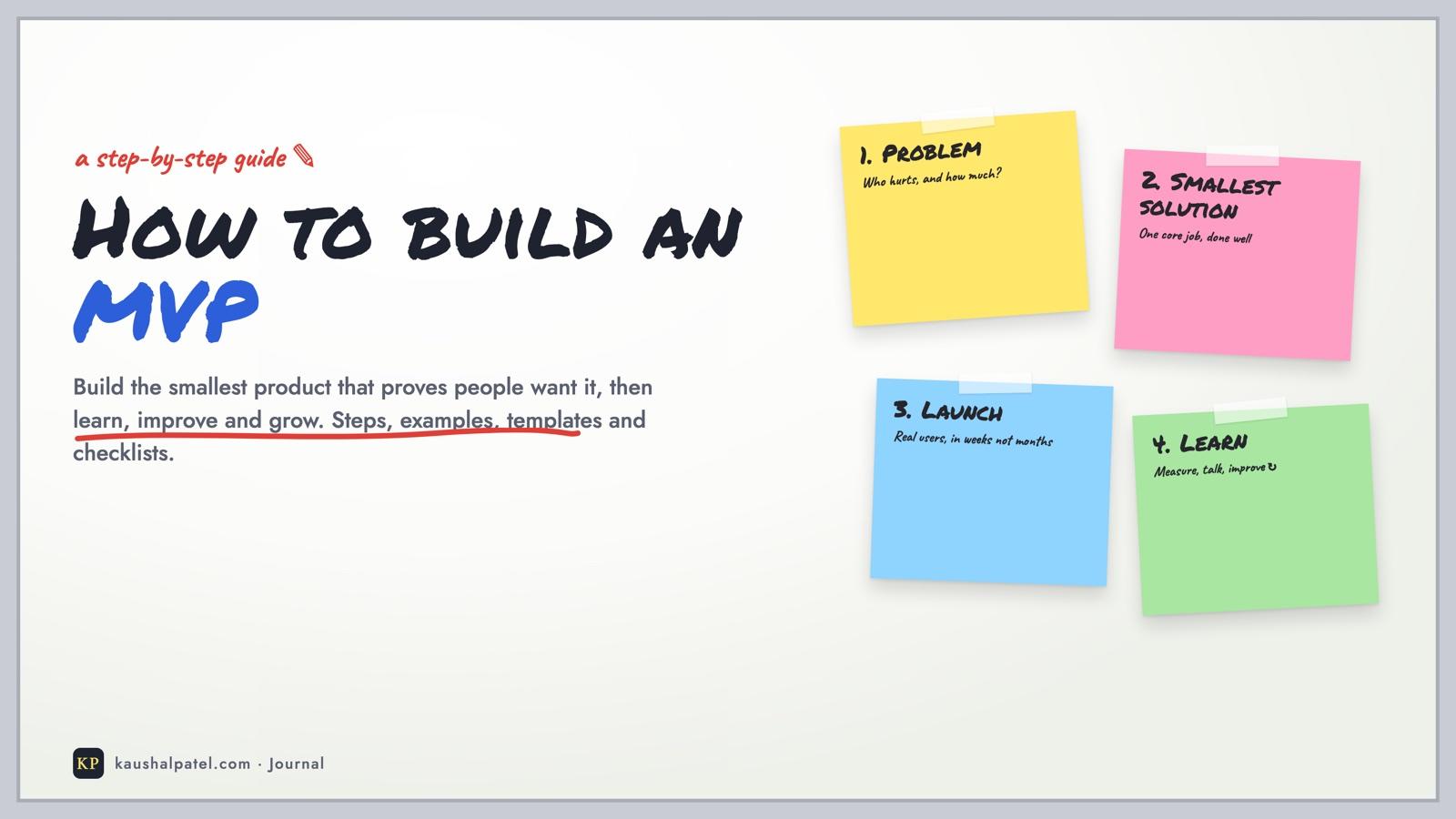
Most new products don’t fail because they were badly built. They fail because they were built for a need that wasn’t real, or wasn’t big enough. A minimum viable product (MVP) is how you avoid that: you build the smallest version of your idea that real users can use, put it in front of them quickly, and learn what to build next from what they actually do.
This guide explains how to build an MVP step by step: what an MVP really is (and isn’t), the different types of MVP, how to choose MVP features, a realistic MVP development timeline, what drives cost, which metrics to track, and famous MVP examples you can learn from. You’ll also find copy-ready templates and an MVP checklist.
What is a minimum viable product (MVP)?
A minimum viable product is the simplest version of a product that delivers real value to early users and lets you learn whether your idea works. The term was coined by Frank Robinson in 2001 and popularised by Steve Blank and Eric Ries, whose book The Lean Startup made it a core idea in modern product development.
The key word is viable. An MVP isn’t a broken, half-finished product. It’s a small product that does one job properly.
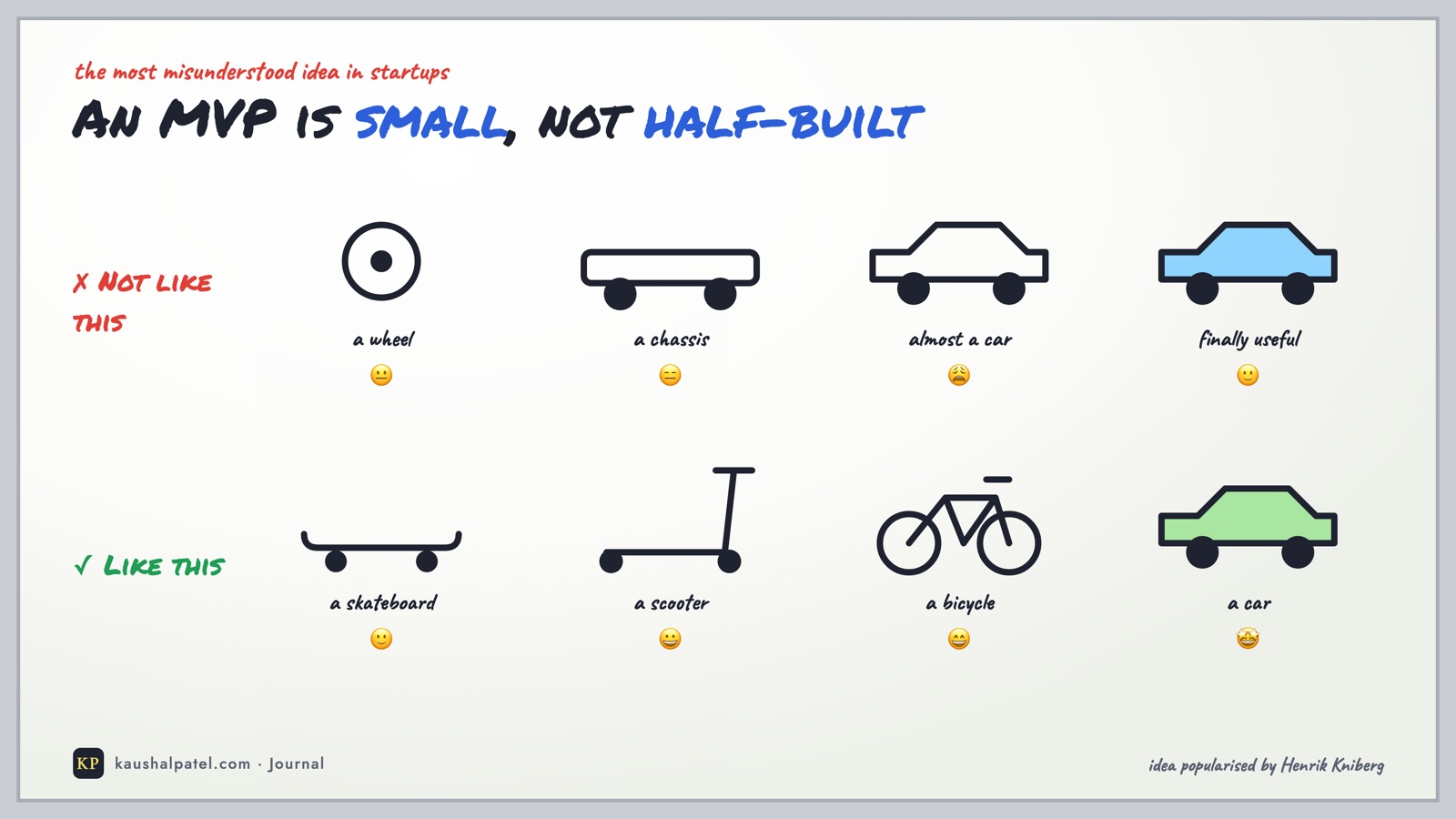
An MVP is small, not half-built. Every version should be usable on its own (idea popularised by Henrik Kniberg).
MVP vs prototype vs proof of concept
Proof of concept
Prototype
MVP
MLP / full product
Question it answers
Can it be built?
How will it look and work?
Will people use and pay for it?
Will people love and recommend it?
Who sees it
The internal team
Testers and stakeholders
Real early users
The whole market
Works for real?
Partly, technically
Usually not (clickable mock-up)
Yes, for the core job
Yes, with polish and extras
Typical time
Days
Days to two weeks
Weeks to a few months
Months and ongoing
An MLP, or “minimum lovable product”, is a popular next step: once the MVP proves demand, you add the polish and delight that turn early users into fans.
The Build-Measure-Learn loop
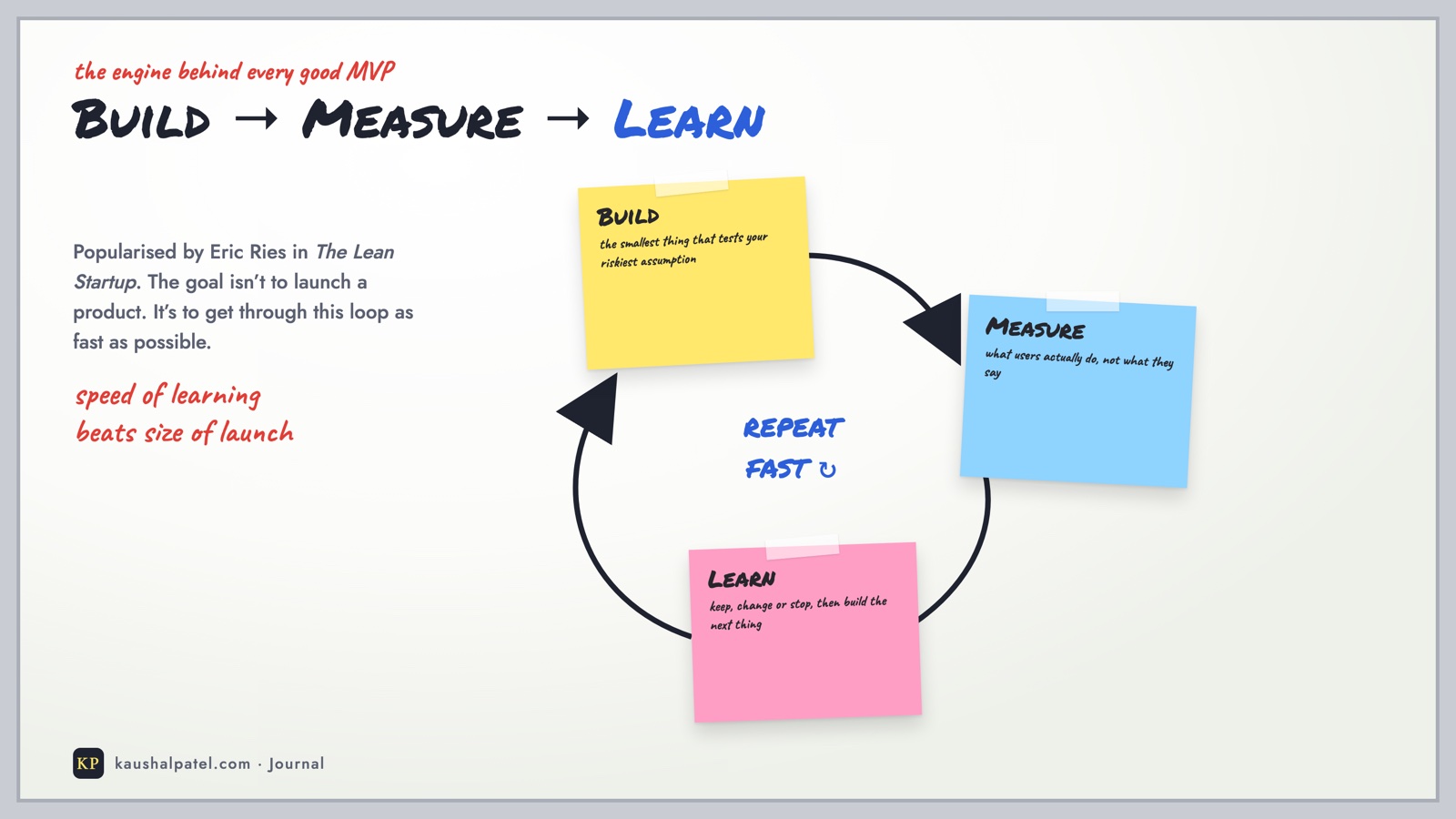
The goal of an MVP isn’t the launch. It’s getting through this loop as fast as possible.
Every MVP is one turn of this loop. You build something small to test an assumption, measure how real users behave, and learn whether to keep going, change direction (pivot) or stop. The faster each loop, the less money and time you risk on a wrong idea.
How to build an MVP in 10 steps
1. Define the problem, not the product
Write one sentence: “[Specific user] struggles to [job] because [reason], which costs them [time, money or risk].” If you can’t fill it in from real conversations, you’re not ready to build yet. Talk to at least 15–20 potential users first. I covered how in Distribution First, Product Second.
2. Pick one target user
“Small businesses” is not a user. “Textile wholesalers in Surat who take orders on WhatsApp” is. A narrow first user makes every decision easier, from features to design to marketing. Unglamorous, specific niches are often the best place to start, as I explain in The Boring Startup Advantage.
3. Find your riskiest assumption
List what must be true for the idea to work: people have this problem, they’ll switch from their current workaround, they’ll pay this price, we can reach them. The one you’re least sure about, and that would kill the idea if wrong, is what your MVP should test first.
4. Choose the right type of MVP
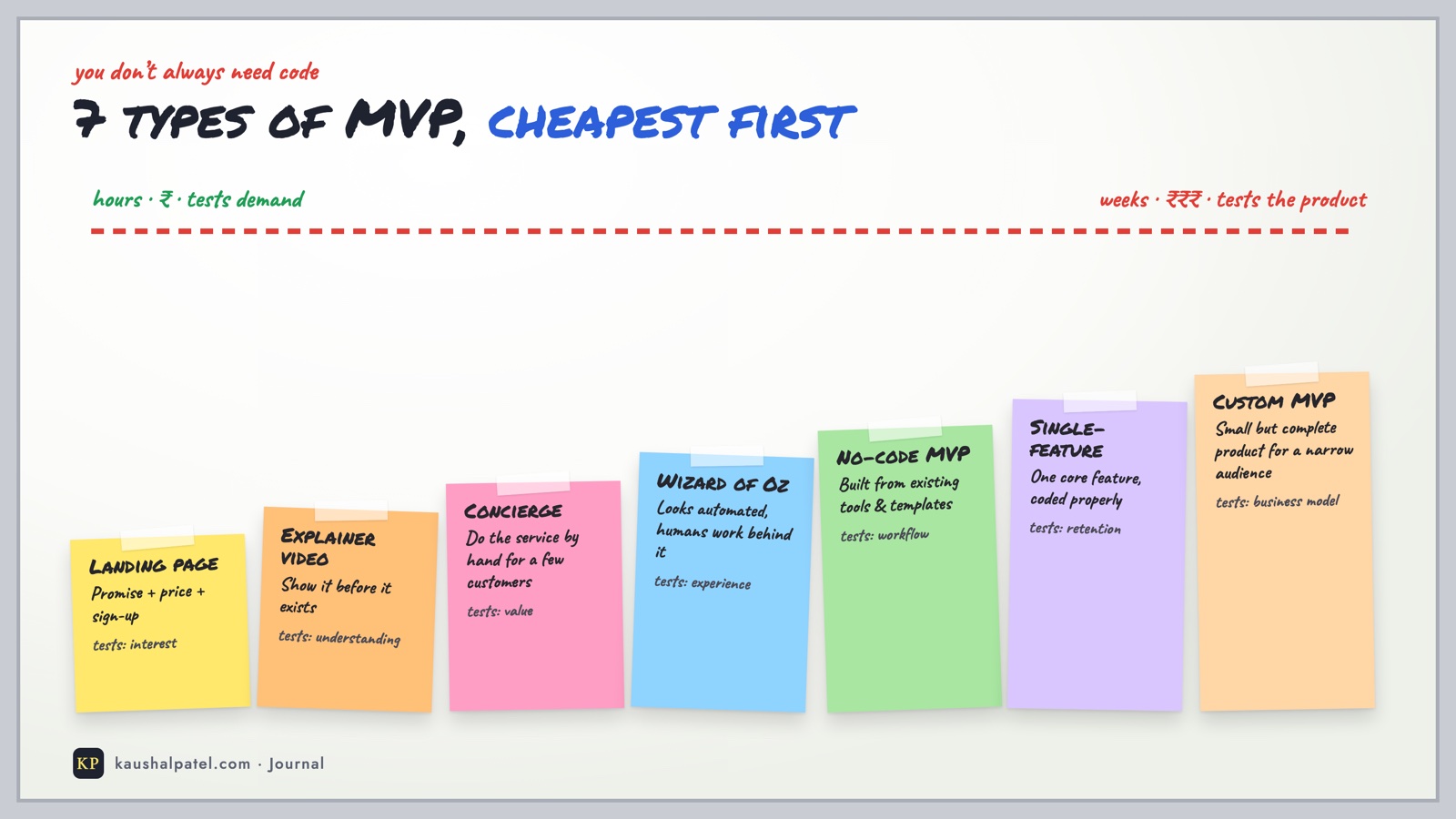
Not every MVP needs code. Choose the cheapest format that tests your riskiest assumption:
Seven types of MVP, cheapest first.
Type of MVP
What you build
Time
Best for testing
Landing page
One page with the promise, a price and a sign-up
Hours to days
Interest and messaging
Explainer video
A short demo of how it would work
Days
Whether people understand and want it
Concierge MVP
You deliver the service by hand for a few customers
Days to weeks
Whether the outcome is valuable
Wizard of Oz MVP
Looks automated to users, people work behind the scenes
1–3 weeks
The user experience before automating
No-code MVP
A product assembled from existing tools and templates
1–4 weeks
The workflow and early retention
Single-feature MVP
One core feature, properly built
3–6 weeks
Retention and willingness to pay
Custom MVP
A small but complete product for a narrow audience
8–12 weeks
The business model at small scale
5. Map the user journey
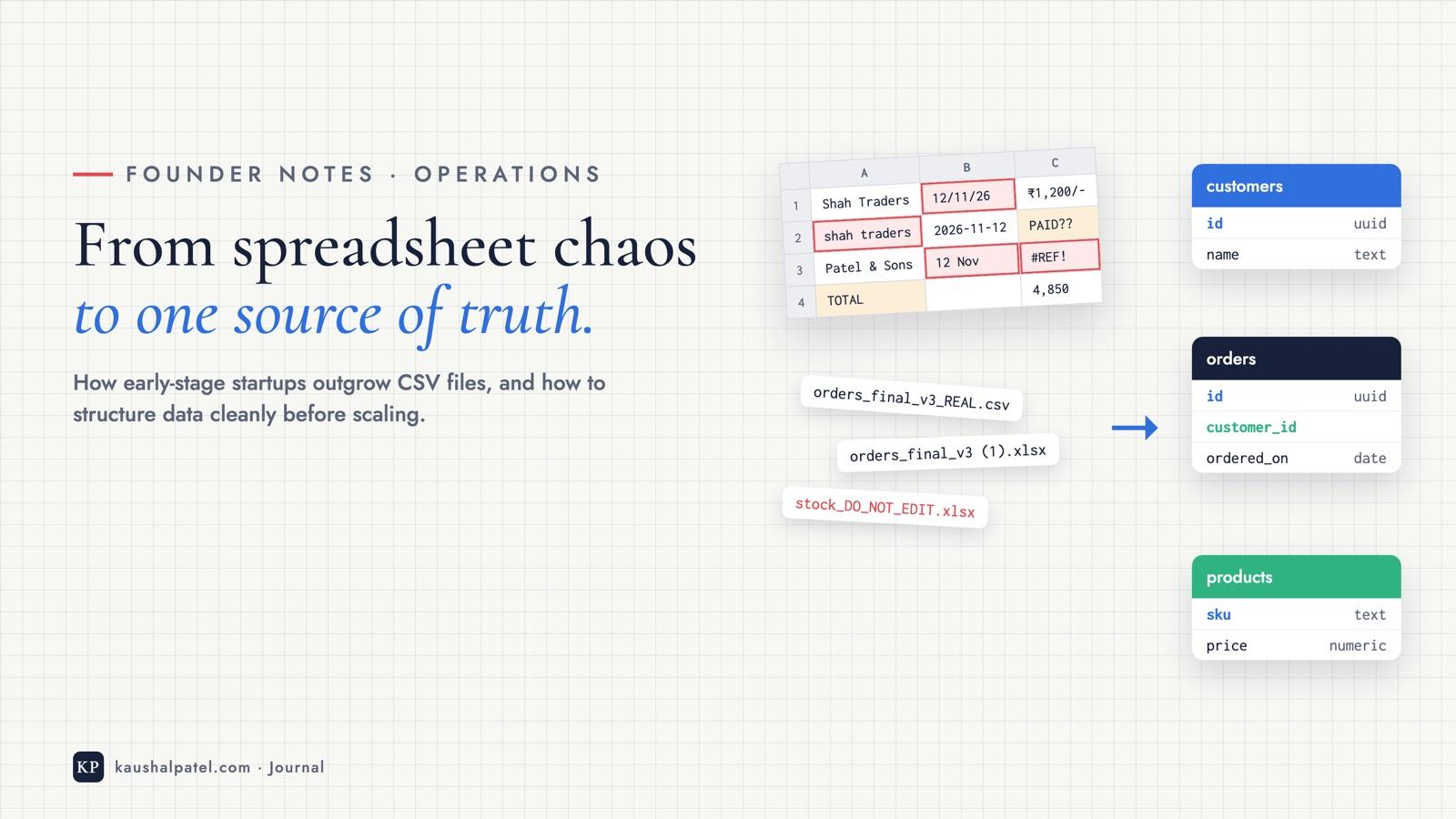
Sketch the shortest path from “I have the problem” to “problem solved”. For example: sign up → add products → share a link → receive an order → mark it paid. Every screen that isn’t on this path is a candidate to cut. If users currently do this job in spreadsheets, map that workflow first: it often is your MVP spec (see From Spreadsheet Chaos to Single Source of Truth).
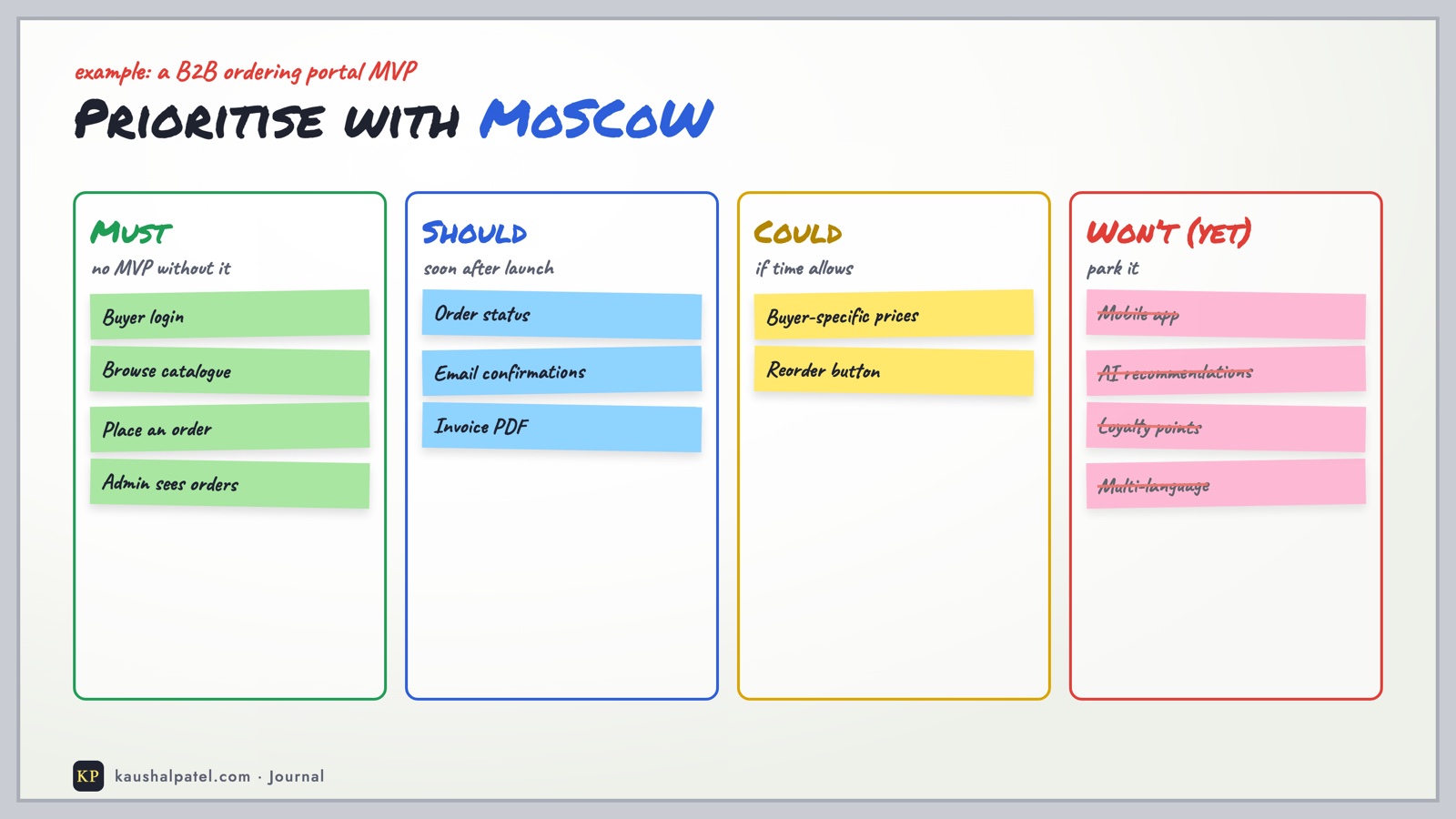
6. Prioritise MVP features with MoSCoW
List every feature idea, then sort them ruthlessly. Only the Must column goes into the MVP:
MoSCoW in action: Must, Should, Could, Won’t (yet).
A useful test for each feature: “If we launched without this, could a user still complete the core job?” If yes, it’s not a Must.
7. Design a clickable prototype first
Before writing code, build a clickable prototype in a design tool and test it with five or six target users. You’ll catch most usability problems in a few hours, when changes cost almost nothing.
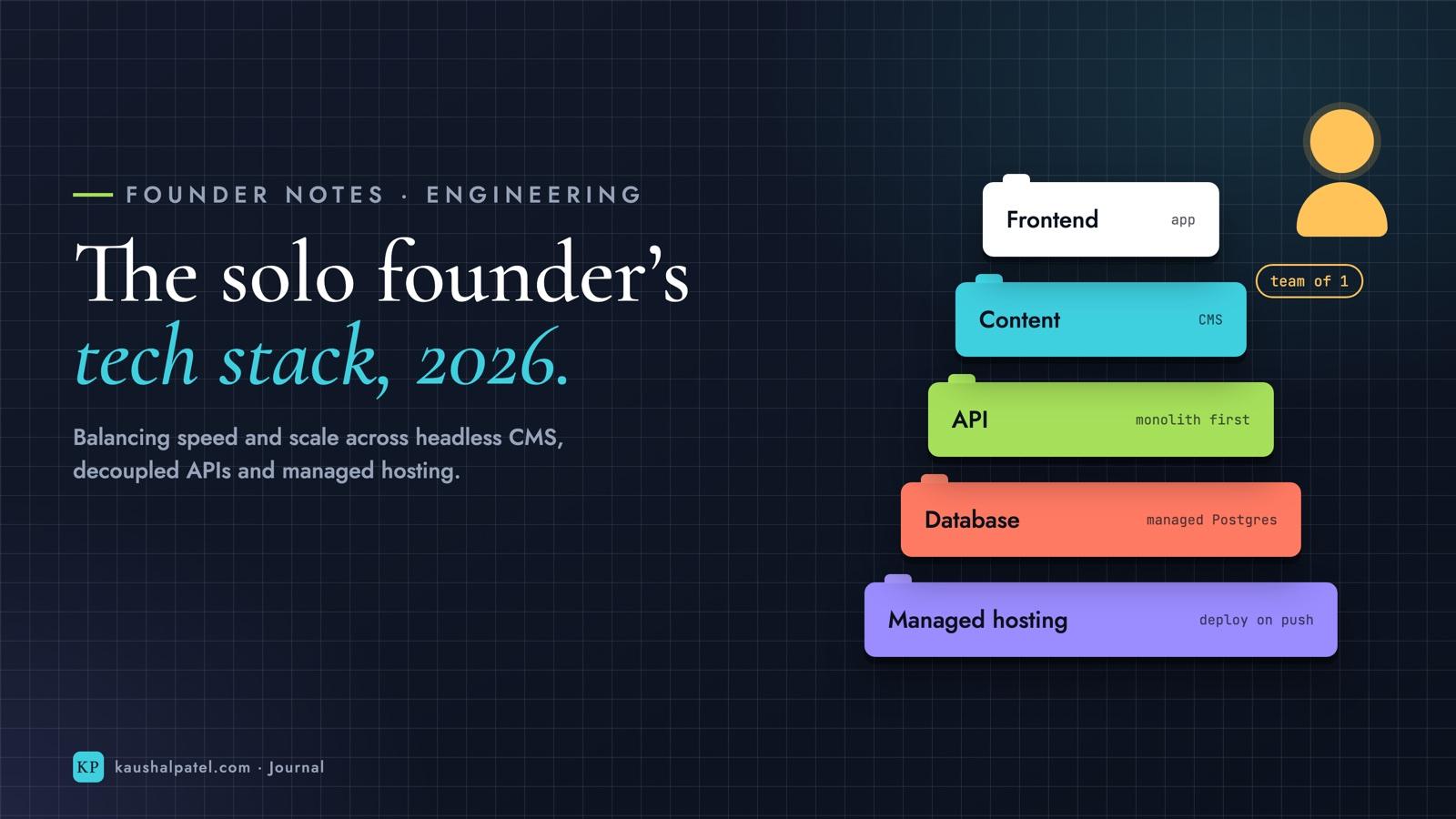
8. Choose a simple, proven tech stack
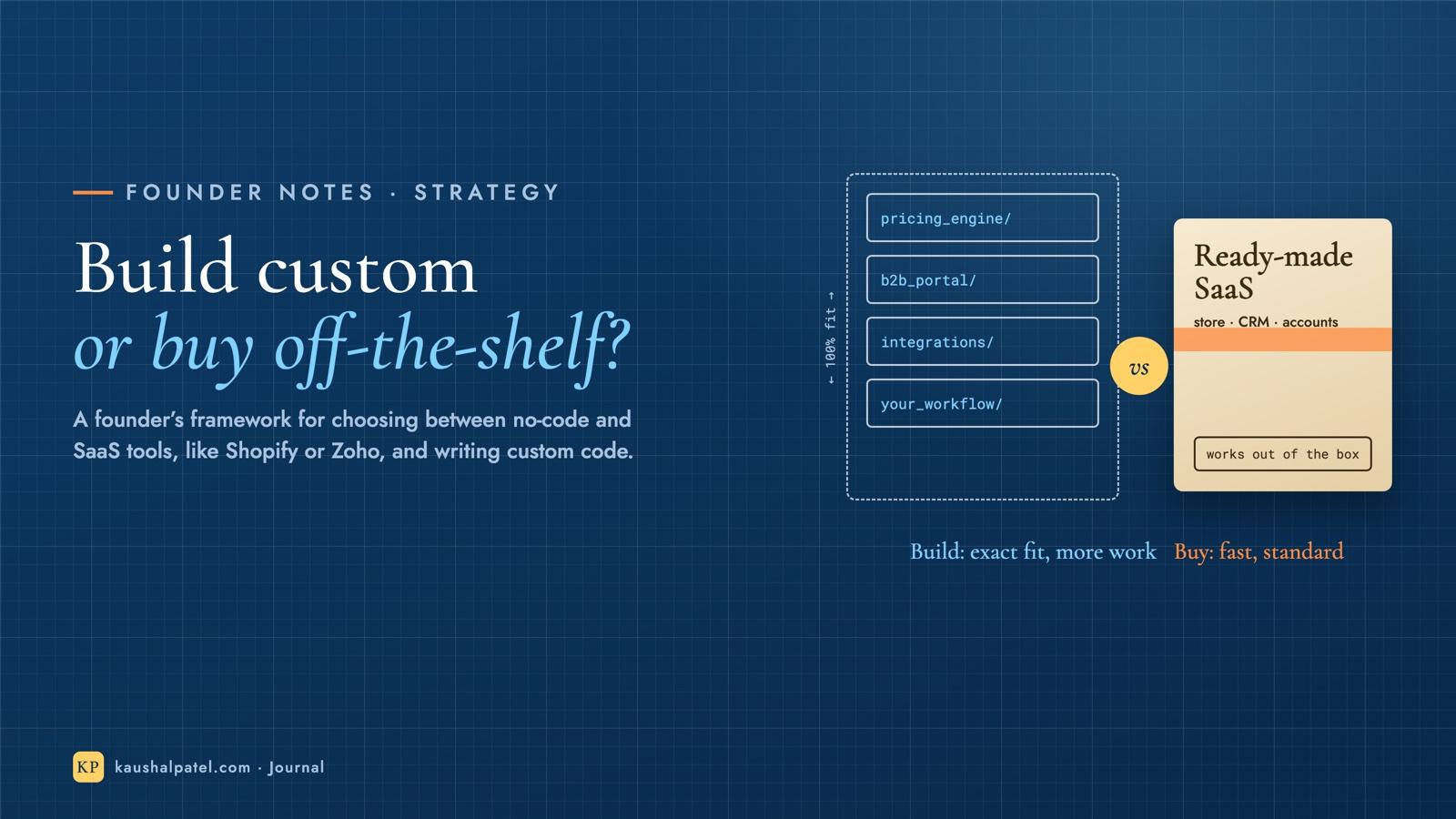
For a custom MVP, use popular, well-supported tools: one full-stack framework, a managed database and managed hosting. Buy authentication, payments and email instead of building them. If speed matters more than control, a no-code MVP may be enough to start. I covered this in detail in The Solo Founder’s Tech Stack in 2026 and Build vs Buy.
No-code MVP
Custom-coded MVP
Speed to launch
Days to a few weeks
Usually 8–12 weeks
Upfront cost
Low
Higher
Flexibility
Limited by the tools
Built exactly for your workflow
Scaling
Can hit limits as you grow
Designed to grow with you
Best when
Testing demand and the workflow
The product itself is your advantage
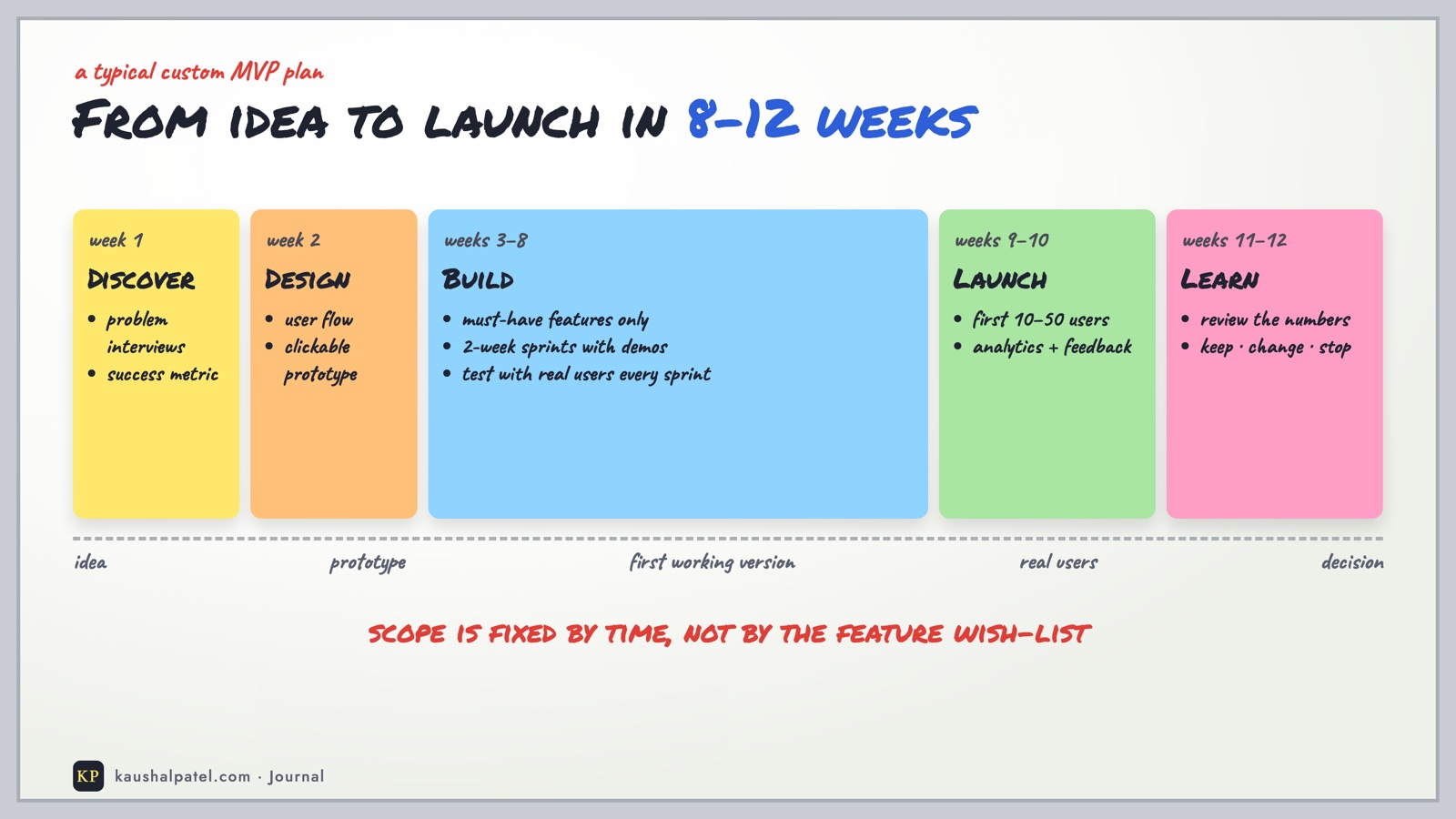
9. Build in short sprints, and timebox the whole MVP
A typical custom MVP plan: scope is fixed by time, not by the feature wish-list.
Work in two-week sprints and demo working software at the end of each one. Most importantly, fix the deadline and let scope flex. When time runs short, cut features, not the launch date. In my work at Ecourge Innovations, a focused custom MVP usually takes about 8–12 weeks from discovery to launch.
10. Launch small, measure, and decide
Launch to a small group, often 10 to 50 real users, rather than the whole world. Watch what they do, talk to them every week, and compare the results with the success metric you set in step 1. Then make a clear decision: keep building, change direction, or stop.
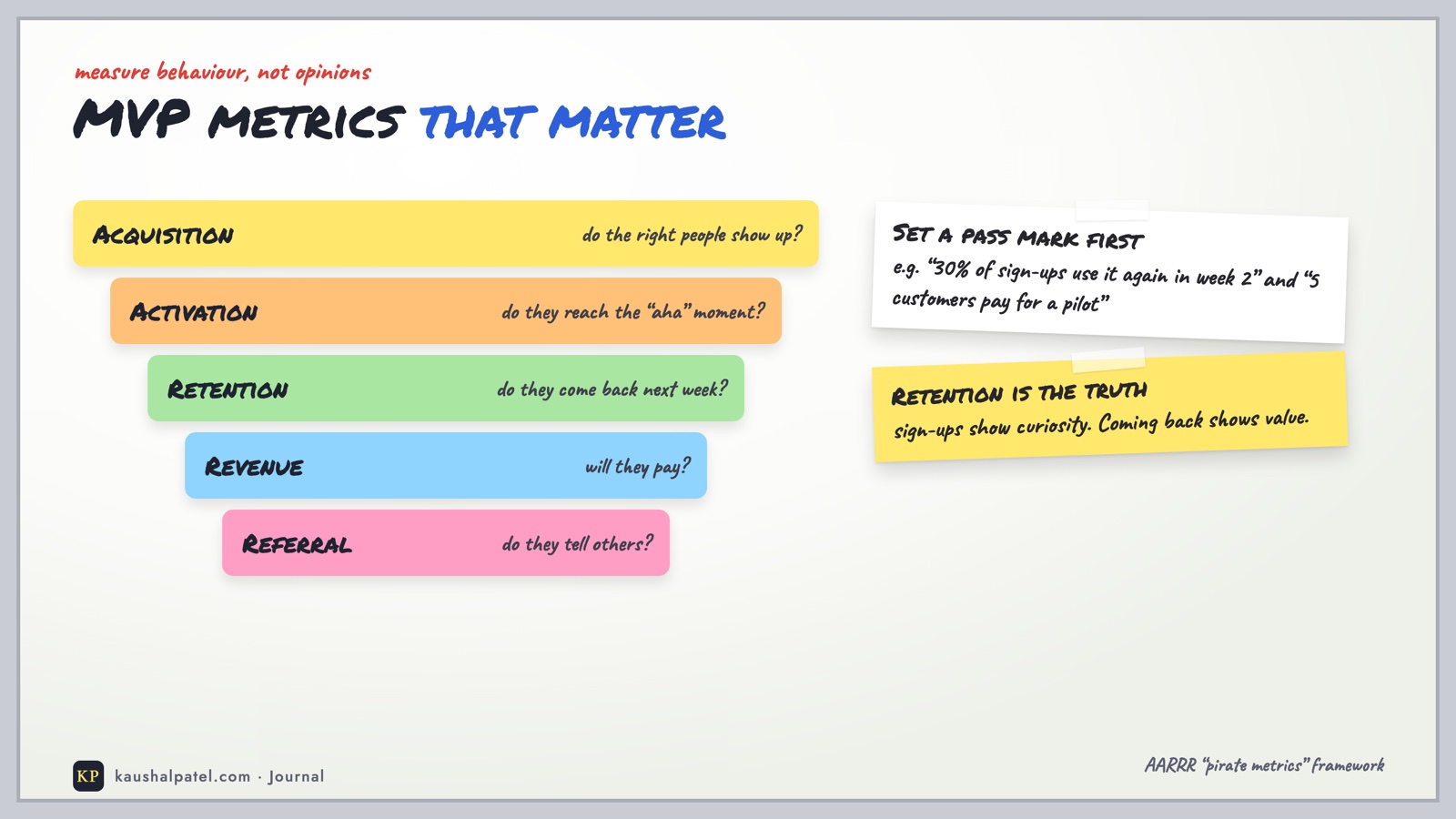
MVP metrics that matter
Measure behaviour, not opinions. Retention is the strongest signal.
Metric
What it tells you
Example pass mark
Activation rate
Do new users reach the core “aha” moment?
Half of sign-ups complete the core task
Week-2 retention
Do people come back after the novelty?
A third of activated users return in week 2
Conversion to paid
Will they pay for it?
Five customers pay for a pilot
Time to value
How fast do users get the benefit?
Under 10 minutes from sign-up
Qualitative feedback
Why users behave the way they do
Users describe the problem in their own words
These pass marks are examples. Set your own before launch, based on your market, so the data makes the decision rather than your hopes.
What does it cost to build an MVP?
MVP cost varies enormously, from almost nothing for a landing-page MVP to a significant investment for a custom product. Rather than trust a generic price list, look at what drives the cost:
Cost driver
Keeps cost lower
Pushes cost higher
Scope
One core job, must-haves only
Many features and user types
Platforms
One web app that works on mobile
Separate iOS, Android and web apps
Integrations
Few, using standard APIs
Many, or legacy systems
Design
Clean, standard components
Custom illustrations and animations
Compliance
No sensitive data
Health, finance or regulated data
Approach
No-code or existing tools first
Everything custom from day one
Famous MVP examples
Dropbox: before the product was widely available, a short demo video showing how file syncing would work brought tens of thousands of people to its beta waitlist, proving demand without a full launch.
Airbnb: in 2007, the founders put air mattresses in their San Francisco apartment and rented them to conference visitors through a simple website.
Zappos: the founder photographed shoes in local stores and posted them online; when someone ordered, he bought the pair and shipped it. That was a concierge MVP with no inventory.
Groupon: started on a basic WordPress blog, with deals sent to subscribers as PDF coupons by email.
Buffer: a two-page website explained the idea and then showed pricing plans, to test whether people would pay before the app was built.
Amazon: started by selling only books online, one category done well before expanding.
Quick game · Lean MVP or too much?
Would you put this in your MVP?
Six feature ideas for a first version. Decide, then tap to check.
A mobile app and a web app at launch
Too much. Start with one platform, usually a mobile-friendly web app, and add native apps once users ask for them.
The one feature that solves the core problem
Lean MVP. This is the heart of your MVP. Build it properly.
A custom admin dashboard with charts
Usually too much. Early on, a simple list, a spreadsheet export or a basic admin panel is enough.
A way for users to pay
Often worth it. If willingness to pay is a risk, test it early. Even a simple payment link counts.
AI-powered recommendations
Too much, unless AI is the core value. Prove the basic workflow first; add AI where it clearly removes work.
A simple way for users to send feedback
Lean MVP. A feedback link or WhatsApp number is cheap and gives you the learning an MVP exists for.
MVP templates you can copy
Use this one-page MVP brief to align your team (or your developer) before anyone writes code:
MVP BRIEF: [Product name]

Problem:      [Specific user] struggles to [job] because [reason],
              costing them [time / money / risk].
Target user:  [Narrow description, e.g. "textile wholesalers in Surat
              with 20+ retail buyers"]
Riskiest assumption: [What must be true, that we're least sure of]
MVP type:     [Landing page / concierge / no-code / custom]
Core job:     [The one thing a user must be able to do]
Must-haves:   1. ... 2. ... 3. ...
Not in v1:    [Parked features]
Success metric (set before launch):
              [e.g. 30% of activated users return in week 2;
               5 customers pay for a pilot]
Timebox:      [e.g. 10 weeks] · Launch to: [first 20 users]
And write every MVP feature as a simple user story, so it stays focused on value:
As a [type of user],
I want to [action],
so that [benefit].

Done when: [clear, testable condition]

Example:
As a wholesale buyer, I want to reorder my last order in one tap,
so that I don't have to message the seller every week.
Done when: the reorder appears in the seller's order list.
Common MVP mistakes to avoid
Building too much. If you’re not a little embarrassed by v1, you probably launched too late.
Building for “everyone”. A product for everyone is a product for no one in particular.
Skipping customer conversations. Analytics show what happens; conversations explain why.
No success metric. Without a pass mark set in advance, every result looks “promising”.
Confusing minimum with low quality. Small scope is fine; a broken core experience isn’t.
Ignoring distribution. A great MVP nobody hears about teaches you nothing.
Never deciding. An MVP that drifts on for a year without a keep, change or stop decision has stopped being an experiment.
MVP checklist: before you launch
You can describe the problem and target user in one sentence each.
You’ve spoken to at least 15–20 potential users.
You know which assumption this MVP tests.
Every feature in v1 is a Must for the core job.
A real user can complete the core job end to end without help.
Analytics and a simple feedback channel are in place.
You’ve written your success metric and decision date.
You know exactly how you’ll reach your first 10–50 users.
Frequently asked questions
What is an MVP in simple terms?
An MVP (minimum viable product) is the smallest version of a product that solves a real problem for early users, so you can learn whether people want it before investing in the full product.
How long does it take to build an MVP?
It depends on the type. A landing-page or concierge MVP can take days, a no-code MVP a few weeks, and a focused custom-coded MVP typically 8–12 weeks. Timeboxing the build keeps it from growing.
How much does it cost to build an MVP?
Costs range from almost nothing for a landing page to a significant investment for a custom product. The biggest cost drivers are scope, number of platforms, integrations, design and compliance needs. Cutting scope is the most effective way to cut cost.
What is the difference between an MVP and a prototype?
A prototype shows how a product will look and work, usually without being fully functional. An MVP is a working product that real users can use for the core job, so you can measure real behaviour.
How many features should an MVP have?
As few as possible, often just the features needed for one core job end to end. If a feature isn’t required for a user to get the main benefit, leave it for later.
Should I build my MVP with no-code tools or custom code?
Use no-code when you mainly need to test demand and the workflow quickly. Choose custom code when the product itself is your competitive advantage, or when no-code tools can’t handle the core job.
The bottom line
Building an MVP isn’t about building less for the sake of it. It’s about learning faster with less risk. Start from a real problem, test your riskiest assumption with the cheapest MVP that works, build only what the core job needs, launch to real users within weeks, and let their behaviour decide what comes next.
Have an idea and want help turning it into a focused MVP: scope, design and build? Let’s talk. Planning and building MVPs is exactly what I do.
Headless CMS, decoupled APIs or a monolith, managed hosting or a VPS: how to pick a 2026 stack one person can run, with a hosting cost calculator and checklist.
Build vs buy software: when to use no-code and SaaS tools like Shopify or Zoho and when to write custom code, with a decision tree, cost guide and matrix.