Cybersecurity Threats Everyone Should Know About
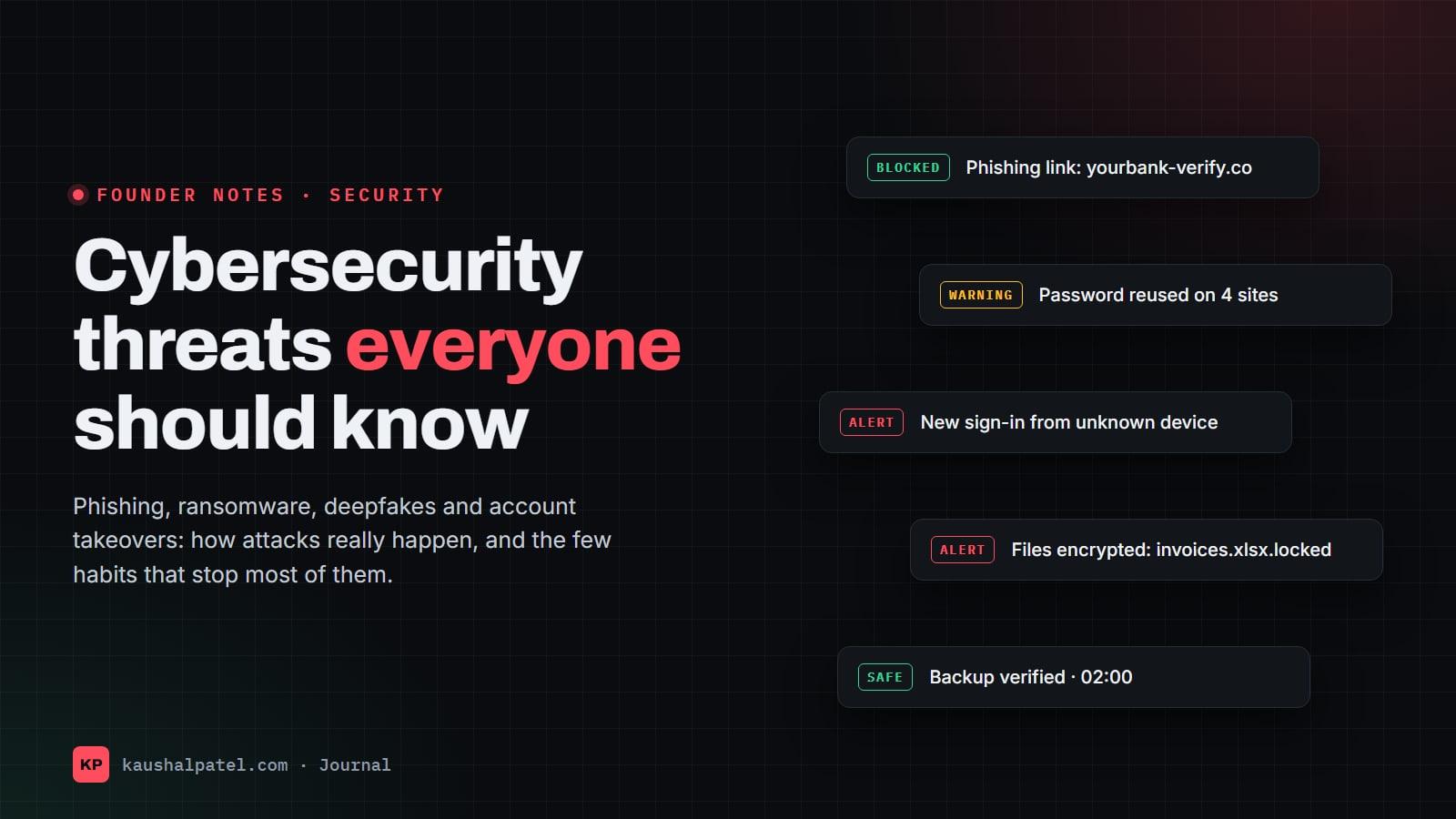
The cybersecurity threats everyone should know: phishing, passwords, ransomware, deepfakes, QR scams and more, with warning signs and simple defences.
18 min read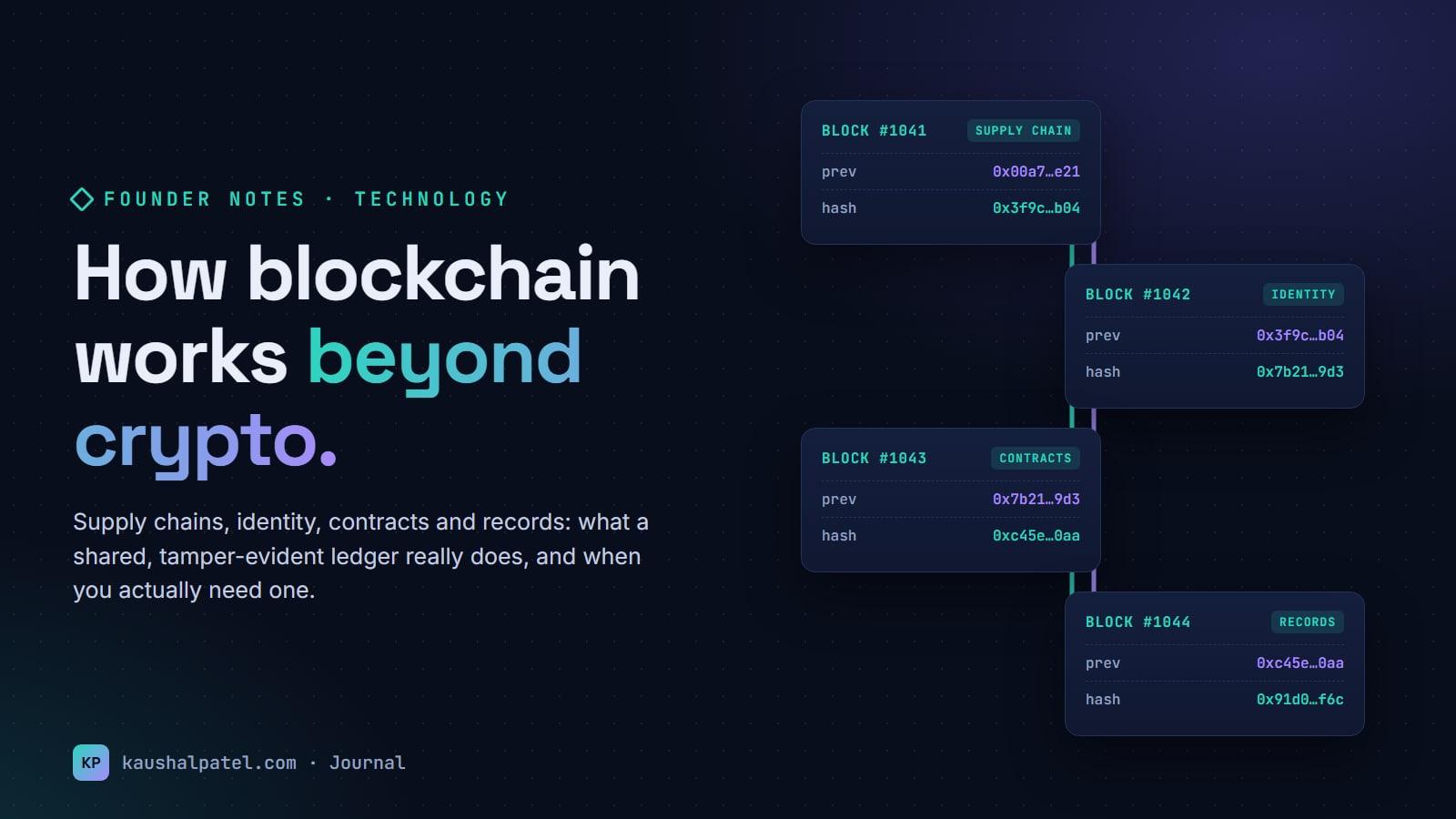
Say “blockchain” and most people think of Bitcoin price charts, crypto exchanges and overnight millionaires. But the technology underneath cryptocurrency solves a much more ordinary problem: how can several organisations that don’t fully trust each other keep one shared record, without handing control of it to any single one of them?
This guide explains how blockchain technology works in plain language: blocks, hashes, nodes and consensus. It then looks at blockchain use cases beyond cryptocurrency, from supply chains and digital identity to smart contracts and public records. It also covers where blockchain is the wrong tool, and gives you a simple test for deciding whether your project needs one. You’ll find diagrams, comparison tables, a quick myth-or-fact game and a copy-ready checklist along the way.
A blockchain is a type of distributed ledger: a list of records (a ledger) that is copied across many computers (a distributed network) instead of living on one company’s server. Three properties make it different from an ordinary database:
Cryptocurrency was simply the first big application. In 2008 a person or group using the name Satoshi Nakamoto published the Bitcoin white paper, and the Bitcoin network went live in January 2009. Bitcoin used a blockchain to record who owns which coins without a bank in the middle. In 2015 Ethereum widened the idea: its blockchain can store and run small programs, called smart contracts. That made blockchain a platform for applications, not just payments.
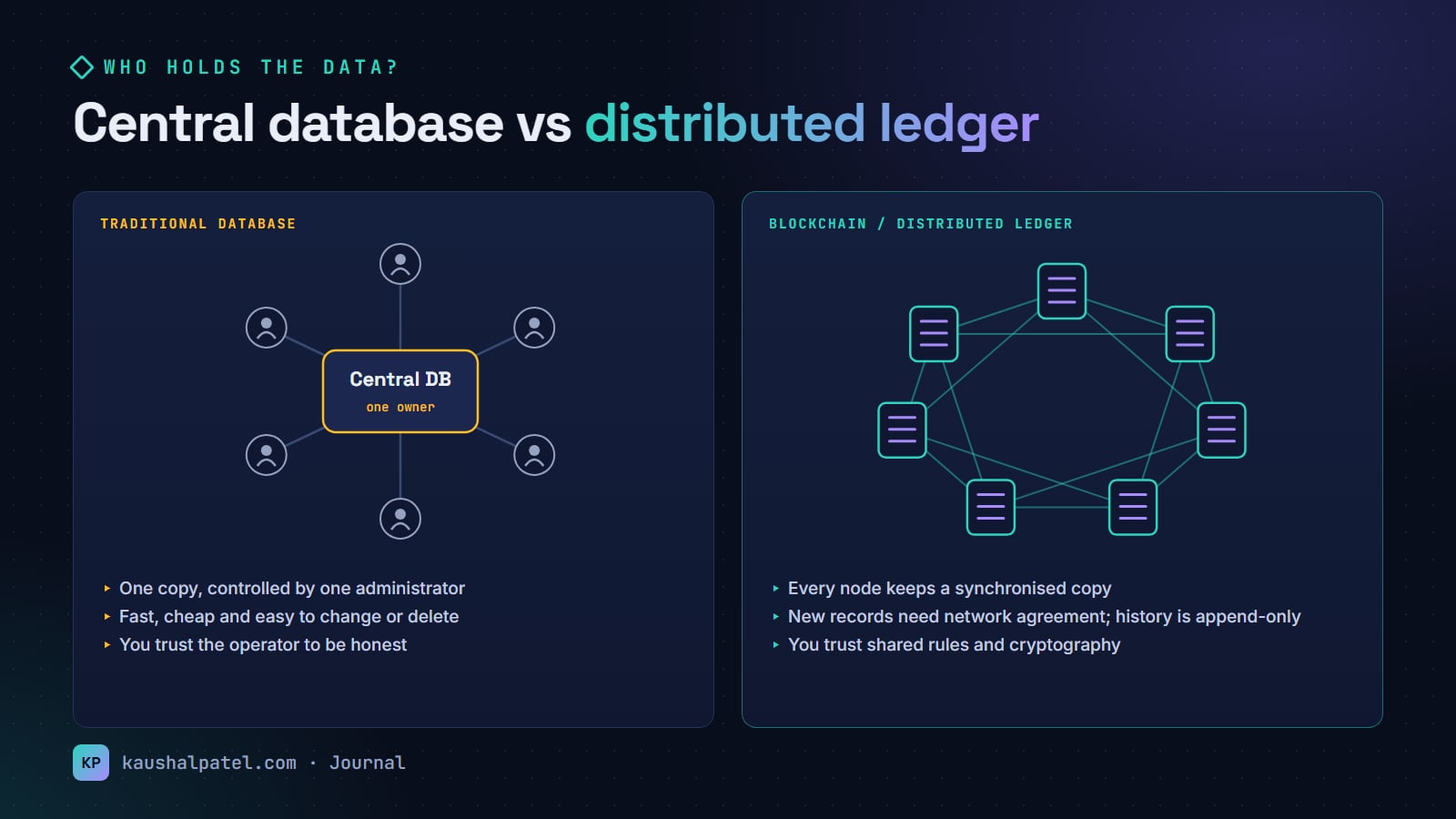
Most software you use runs on a centralised database. Your bank, your email provider and your company’s ERP each keep one master copy of the data, and you trust them to keep it accurate. That works well, and it’s the right design for the vast majority of applications.
A blockchain becomes interesting when there is no obvious party everyone is willing to trust with the master copy: competing companies in a supply chain, banks in different countries, or citizens and a government that want an independent check on public records.
| Feature | Traditional database | Blockchain |
|---|---|---|
| Who controls it | One organisation or administrator | Shared among participants by agreed rules |
| Copies of the data | One master copy (plus backups) | Every node keeps a full copy |
| Changing past records | Possible: update and delete | Append-only: corrections are new records |
| Speed and cost | Fast and cheap | Slower and costlier because nodes must agree |
| Trust model | Trust the operator | Trust the rules, the cryptography and the network |
| Best for | Almost all business applications | Shared records between parties who don’t fully trust each other |
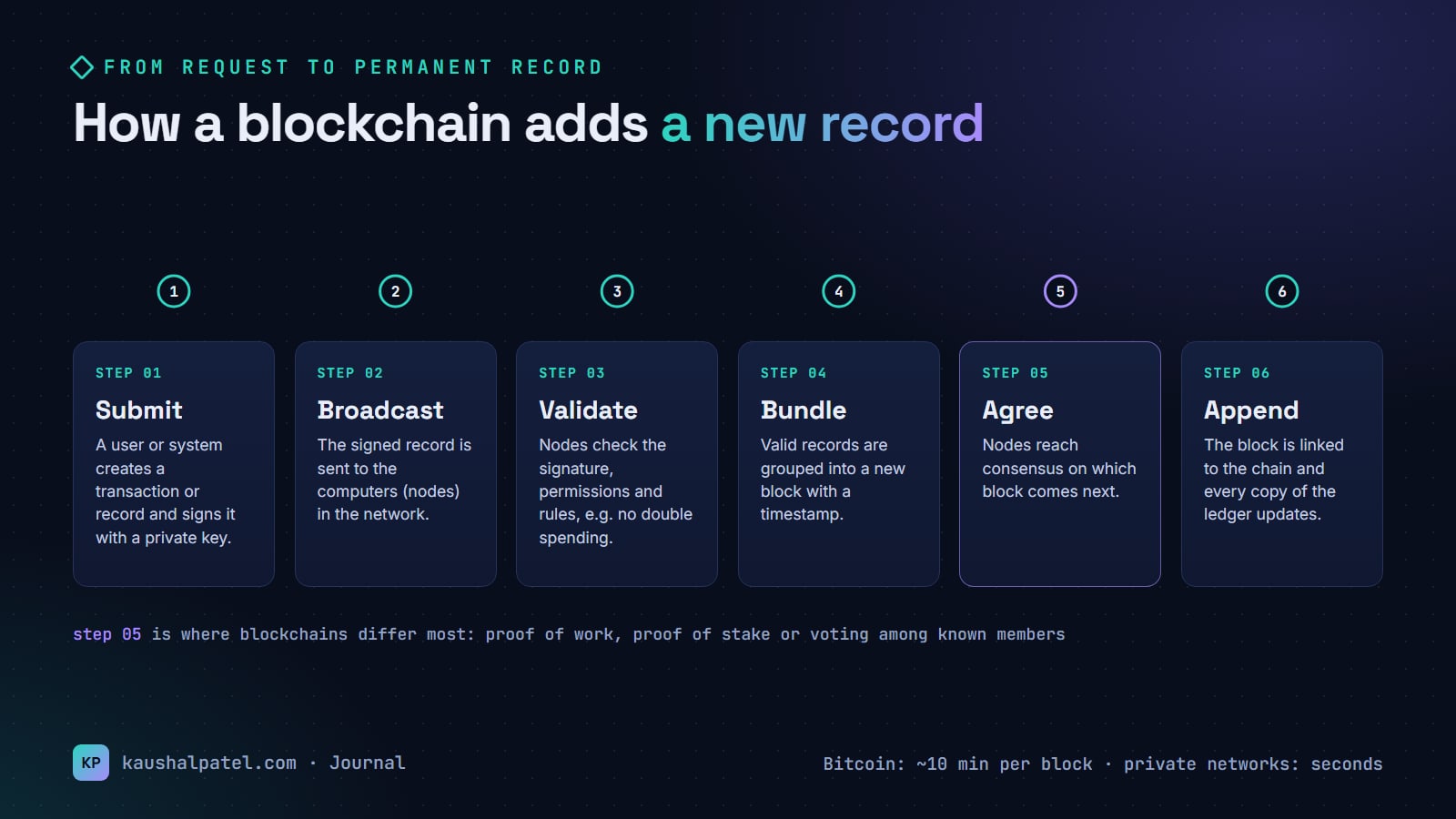
Whether it records a payment, a shipment or a university degree, almost every blockchain follows the same basic process:
How long this takes depends on the network. Bitcoin is designed to add a block roughly every ten minutes. Private business networks, where all the members are known, can often confirm records in seconds.
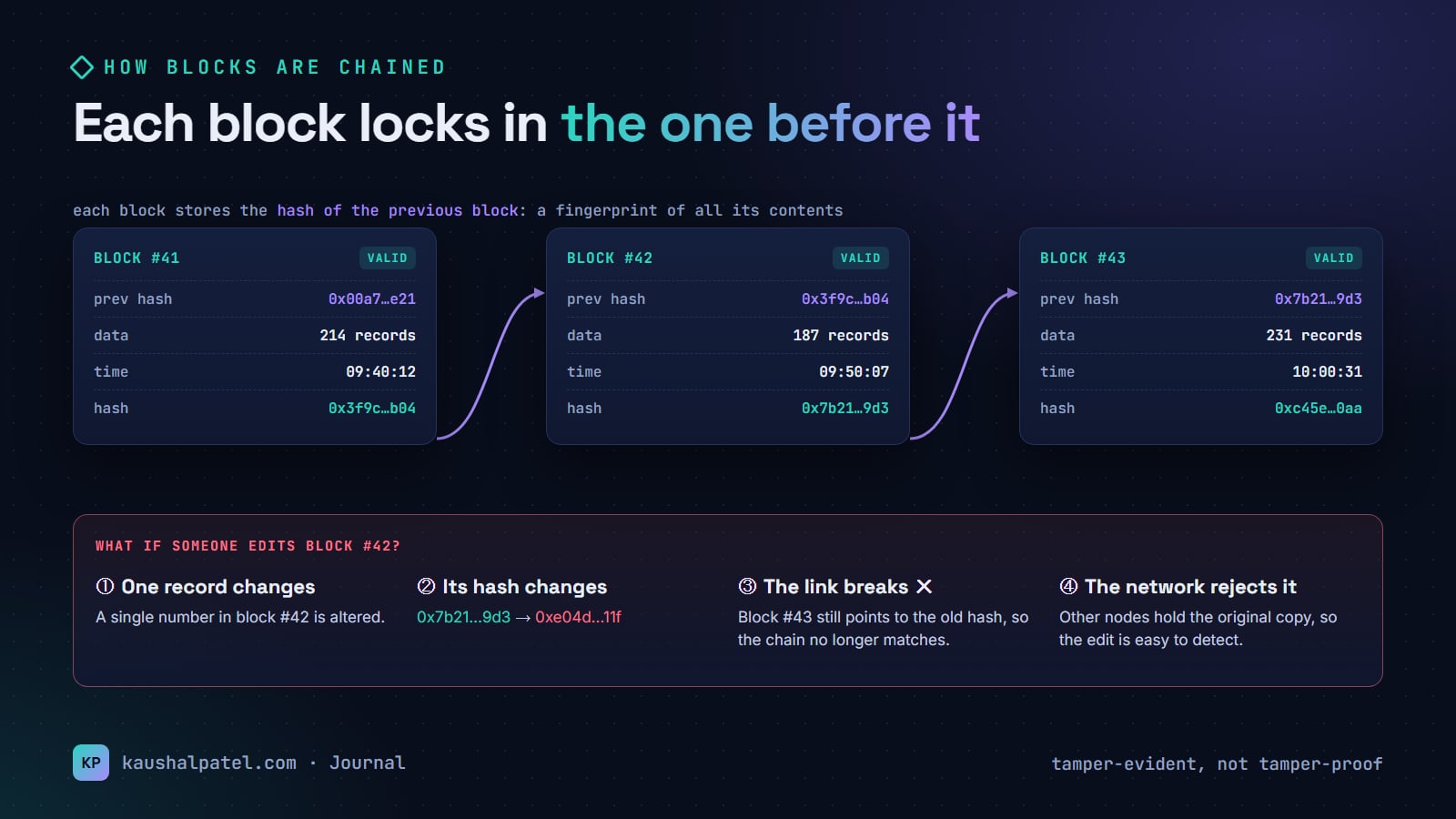
The “chain” in blockchain comes from a piece of cryptography called a hash function. A hash function such as SHA-256, the one Bitcoin uses, turns any input into a short, fixed-length fingerprint. Two properties matter:
Every block stores the hash of the block before it. So if someone tries to change an old record, that block’s hash changes, the next block’s “previous hash” no longer matches, and the chain visibly breaks. To hide the edit, an attacker would have to rewrite every later block and convince most of the network to accept the rewritten version, while honest nodes still hold the original.
That’s why blockchains are better described as tamper-evident than “tamper-proof” or “unhackable”. The ledger’s history is extremely hard to rewrite quietly. But the apps, wallets and data feeds around it can still be attacked, and wrong data entered correctly stays wrong forever.
If thousands of computers each keep a copy of the ledger, who decides which new block is valid? That’s the job of the consensus mechanism. Here are the main approaches:
| Mechanism | How it works | Used by | Trade-offs |
|---|---|---|---|
| Proof of work (PoW) | Computers compete to solve a costly puzzle. The winner adds the next block. | Bitcoin | Very secure and battle-tested, but uses large amounts of electricity |
| Proof of stake (PoS) | Validators lock up (“stake”) funds and are chosen to propose blocks. Cheating costs them their stake. | Ethereum (since 2022) and many newer networks | Far lower energy use. Security depends on how stake is spread |
| Voting among known members (e.g. BFT-style or Raft ordering) | A set of approved organisations or ordering nodes agree on blocks. | Permissioned networks such as Hyperledger Fabric | Fast and efficient, but members must be known and trusted to a degree |
The energy question is one reason businesses hesitated about blockchain. That picture has changed: when Ethereum switched from proof of work to proof of stake in September 2022 (“the Merge”), the Ethereum Foundation estimated its energy use fell by around 99.95%. Most enterprise blockchains never used proof of work at all.
Not every blockchain is open to the world. Before you discuss use cases, it helps to know the three main types:
| Type | Who can join and write | Who can read | Typical uses |
|---|---|---|---|
| Public (permissionless) | Anyone | Anyone | Cryptocurrencies, public verification, tokenized assets, open apps |
| Private (permissioned) | Members approved by one organisation | Usually members only | Internal audit trails and record-keeping between departments |
| Consortium | Members approved by a group of organisations | Members, sometimes with public proofs | Supply chains, trade finance, banking and industry networks |
Most real business projects beyond cryptocurrency use permissioned or consortium blockchains. Platforms such as Hyperledger Fabric, an open-source project hosted by the Linux Foundation, and R3’s Corda were built for exactly this: known participants, private data and fast agreement.
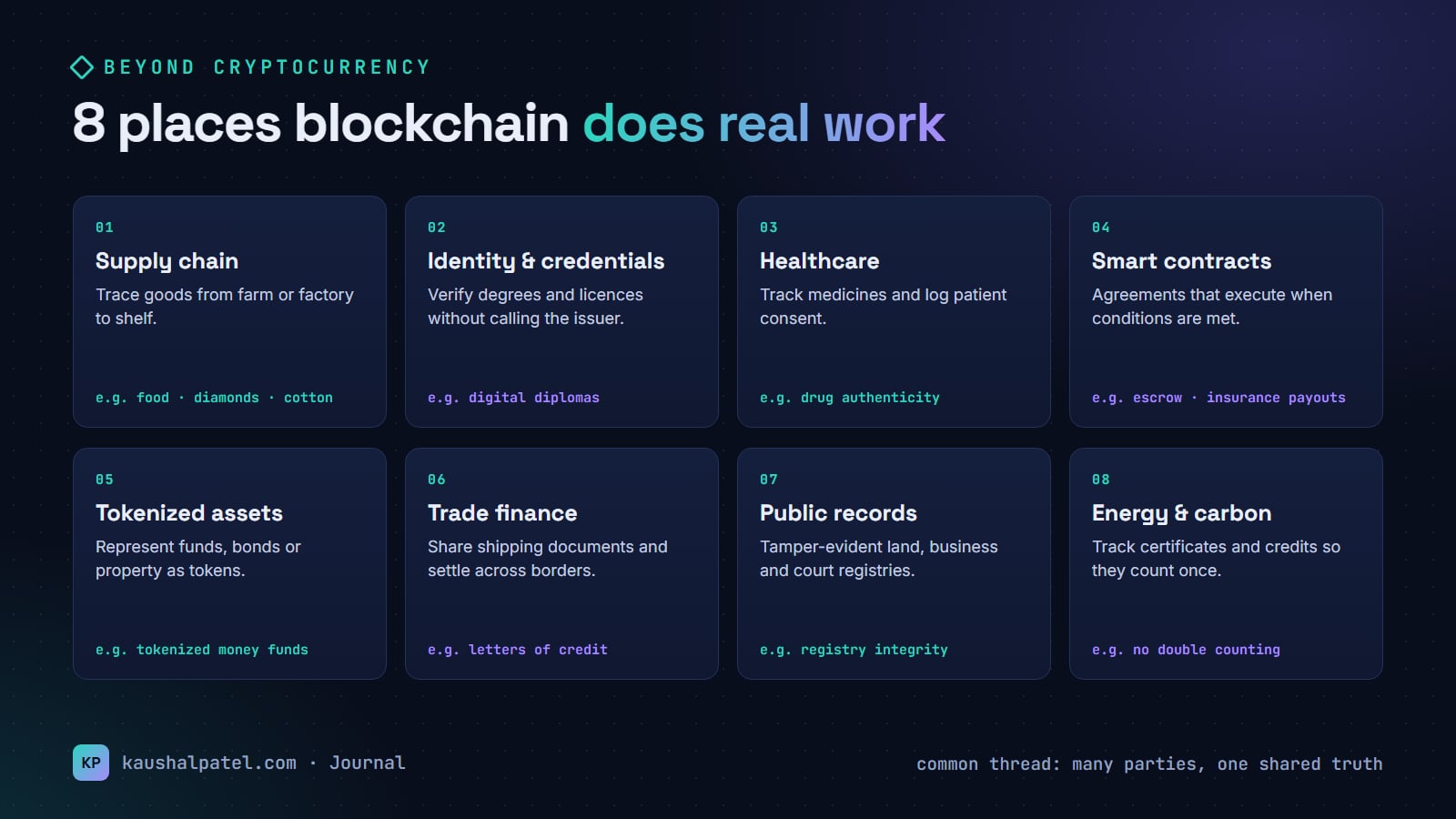
Supply chains are the classic blockchain use case: many companies, many hand-offs and very little shared visibility. Each step, whether harvest, processing, shipping or retail, can write a record that later participants can check. In a widely reported 2018 pilot with IBM, Walmart showed that tracing the origin of a package of mangoes took about 2.2 seconds, down from nearly seven days. Luxury and commodity sectors use the same idea: De Beers’ Tracr platform records a diamond’s journey from the mine, and textile brands are experimenting with tracing cotton from farm to finished garment.
Today, checking a degree certificate or professional licence often means emailing the issuer and waiting. With verifiable credentials, the issuer signs a digital credential that the holder keeps in a wallet. Anyone can then check that it’s genuine and hasn’t been revoked, often by looking up the issuer’s keys or revocation list on a blockchain. MIT began issuing digital diplomas this way in 2017 using the open Blockcerts standard. Personal data itself should stay off the chain. Only proofs and public keys go on it.
Counterfeit medicines are a serious global problem. Pharmaceutical networks such as MediLedger have used blockchain to let manufacturers, distributors and pharmacies verify product identifiers without exposing their commercial data to each other. In healthcare more broadly, blockchains can keep a tamper-evident log of who accessed a record and when a patient gave consent. The medical records themselves stay in secure hospital systems.
A smart contract is code stored on a blockchain that runs automatically when its conditions are met. It can release escrow when goods arrive, pay an insurance claim when a flight is cancelled, or split royalties among several rights holders. Because every node runs the same code and records the result, no party has to trust the others to “press the button”. More on how they work below.
Tokenization means representing ownership of an asset, such as a fund share, a bond, a building or an invoice, as a digital token on a blockchain. Tokens can be transferred, split into smaller units and settled quickly. Large financial institutions are now active here: BlackRock, for example, launched a tokenized money market fund, BUIDL, on Ethereum in March 2024. Tokenization doesn’t remove the need for law and regulation. The token is only as good as the legal claim behind it.
International trade still runs on paper: bills of lading, letters of credit and certificates of origin passed between banks, shippers, insurers and customs. Shared ledgers let all these parties see the same documents and their status in real time, which reduces fraud such as the same invoice being financed twice. Banks are also testing blockchain-based settlement to move money across borders faster.
Land registries, company registers and court records are only useful if people trust they haven’t been altered. Estonia, one of the world’s most digital governments, has used a blockchain technology called KSI since 2012 to verify the integrity of its government registries and logs. Other governments have piloted land-title projects with mixed results, a reminder that technology can’t fix a registry whose underlying data is already wrong.
A carbon credit or renewable energy certificate must only be counted once. If two companies claim the same tonne of reduced CO₂, the market loses credibility. A shared registry can record each credit’s issue, transfer and retirement transparently, so double counting is easier to spot. Peer-to-peer energy trading between homes with solar panels is another area being piloted.
| Industry | Problem | What the blockchain records | Example |
|---|---|---|---|
| Food and retail | Slow recalls, unknown origin | Each hand-off from farm to shelf | Walmart’s 2018 mango traceability pilot |
| Luxury goods | Conflict or fake stones | A diamond’s journey from the mine | De Beers Tracr |
| Education | Slow, fakeable certificates | Issuer signatures and revocations | MIT digital diplomas (Blockcerts) |
| Pharmaceuticals | Counterfeit drugs | Product identifier checks | MediLedger network |
| Finance | Slow settlement, paper processes | Ownership of tokenized fund shares | BlackRock BUIDL fund |
| Government | Trust in public registries | Integrity proofs of registry data | Estonia’s KSI blockchain |
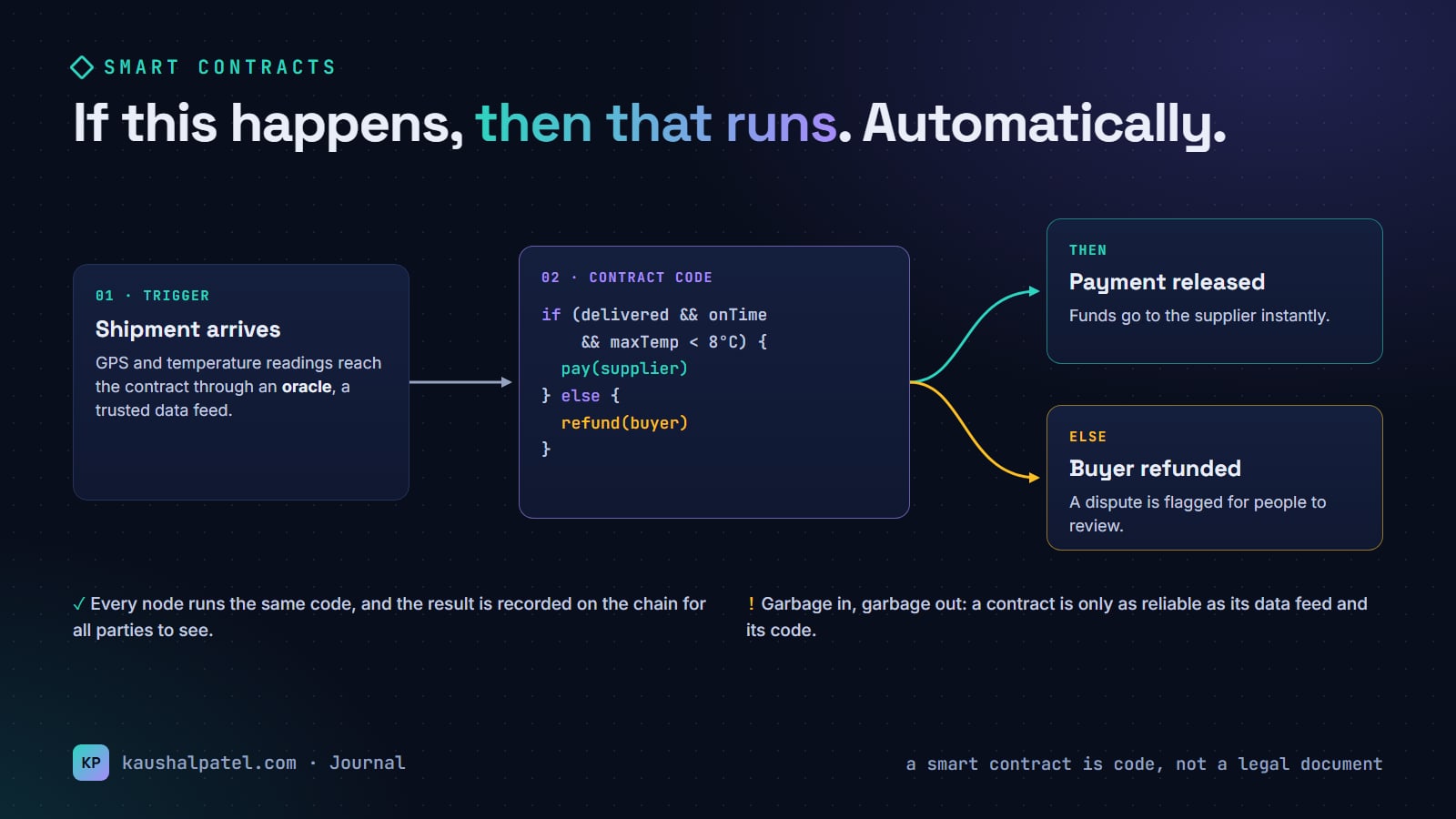
Despite the name, a smart contract isn’t a legal document. It’s a program. It sits on the blockchain, holds rules (and often funds), and runs exactly as written when a transaction triggers it. A simple example for a cold-chain shipment:
WHEN shipment status is updated:
  IF delivered = true
     AND delivered_on_or_before_due_date
     AND max_temperature_in_transit < 8°C
  THEN release payment to supplier
  ELSE refund buyer and flag for human review

Every node runs this check and records the result.
Nobody can quietly change the rules after signing.
Two limits are worth understanding before you rely on smart contracts:
| Benefits | Limitations |
|---|---|
| One shared record that all parties trust | Slower and more expensive than a normal database |
| Tamper-evident history and a built-in audit trail | Garbage in, garbage out: wrong data stays wrong |
| No single point of control or failure | Governance between members can be harder than the tech |
| Automation through smart contracts | Smart contract bugs can be costly and hard to fix |
| Faster reconciliation between organisations | Privacy: data on public chains is visible to everyone |
| Programmable ownership through tokens | Regulation is still evolving in many countries |
One limitation surprises people most: blockchains are a poor place to store personal data. Because records can’t be deleted, putting names, addresses or health details on a chain conflicts with privacy laws that give people the right to have their data erased, such as the EU’s GDPR and India’s Digital Personal Data Protection Act. Good designs keep personal data off-chain and store only hashes or proofs on the blockchain.
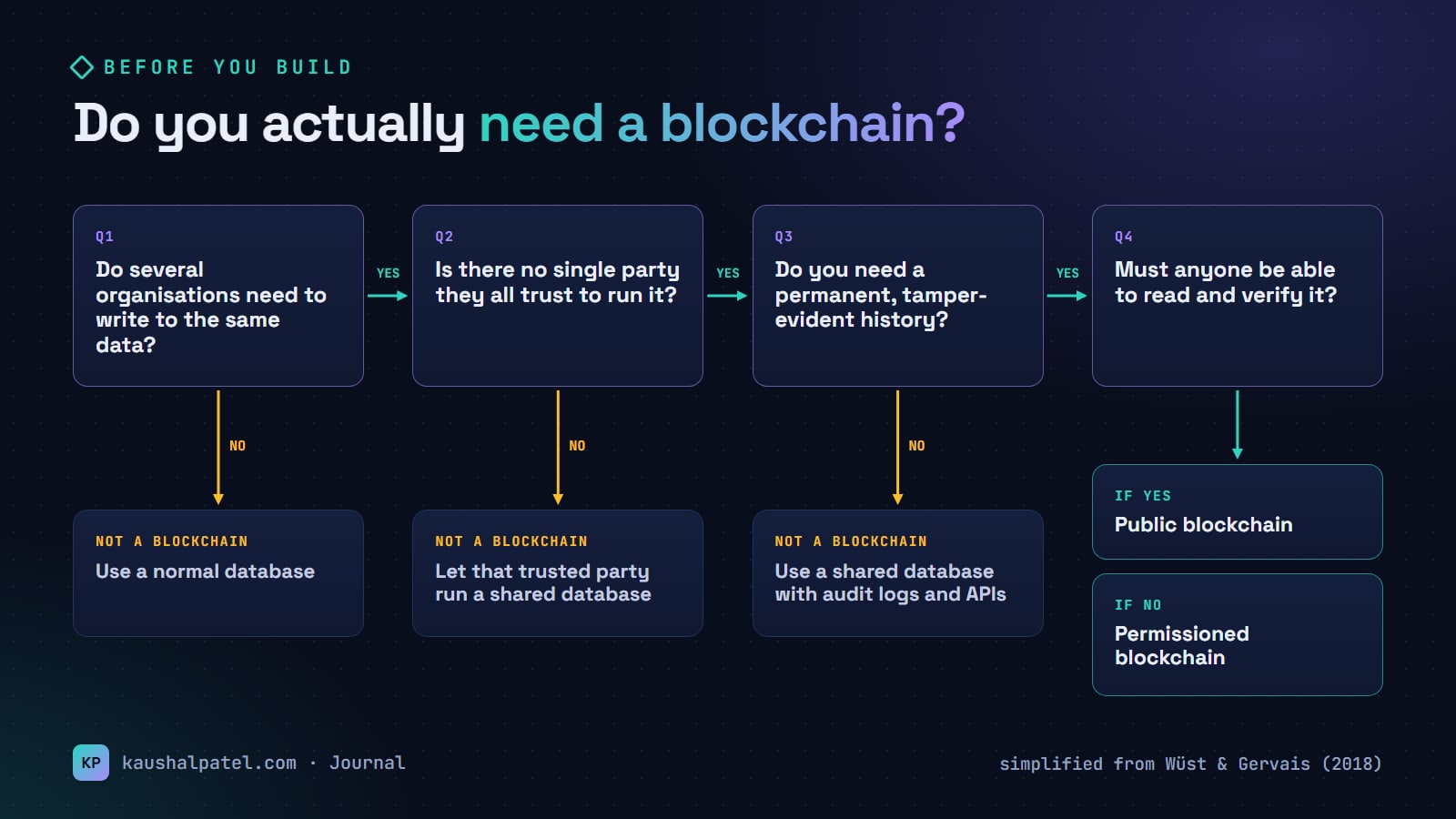
Many blockchain projects of the late 2010s quietly shut down. The technology usually worked. The problem was that the job didn’t need it. If one company owns the process, or all participants already trust a central operator, a well-designed database with access controls and audit logs will be faster, cheaper and easier to change. As discussed in building custom software vs buying SaaS, the right choice starts from the problem, not the trend.
A blockchain earns its place when all of these are true:
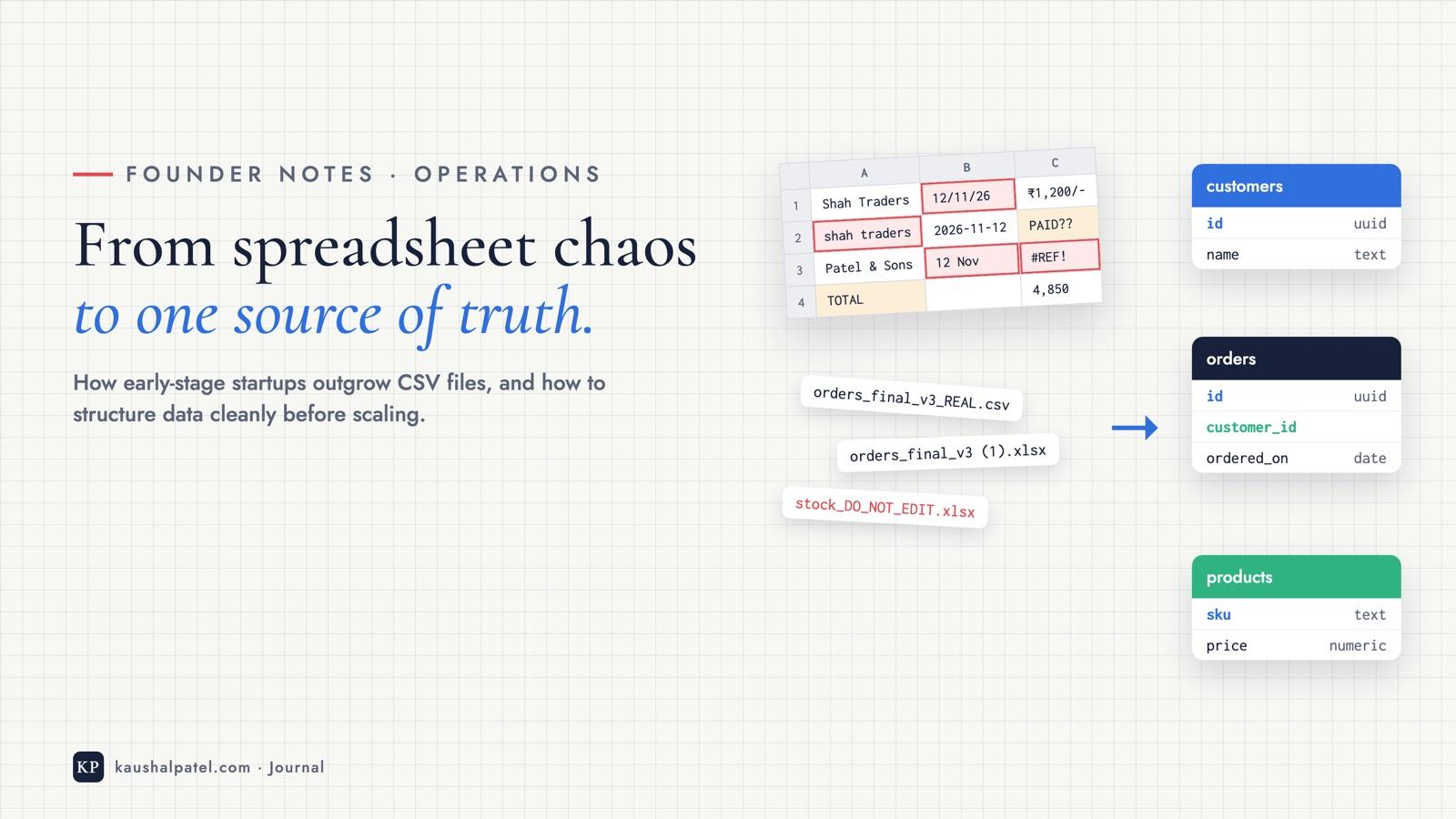
Often the real problem is simpler: data scattered across spreadsheets, emails and disconnected tools. Fixing that, as covered in from spreadsheet chaos to a single source of truth, delivers most of the value people hope blockchain will bring, at a fraction of the cost.
If the test above says yes, treat your first project like an MVP: narrow, measurable and built to learn.
| Step | What to do | Example |
|---|---|---|
| 1. Pick one shared pain point | Find a process where parties argue about whose records are right | Disputed delivery dates between a mill, a dyer and a buyer |
| 2. Get the partners on board | Agree who joins, who writes what, and who pays | A small consortium of 3–5 companies |
| 3. Choose the platform type | Public, permissioned or consortium, based on who must read and verify | A permissioned network for private trade data |
| 4. Design data on and off chain | Store proofs and status on-chain, documents and personal data off-chain | Hash of each invoice on-chain, the PDF in secure storage |
| 5. Pilot, measure and decide | Compare time, disputes and cost before and after | Days to reconcile shipments, number of disputes per month |
The hype cycle has moved on, and that’s good news for useful blockchain projects. A few trends are worth watching:
Expect blockchain to become less visible, not more: infrastructure that runs quietly behind supply chain apps, certificates and payments, much like databases and the cloud today.
A blockchain is a shared digital ledger copied across many computers. New records are grouped into blocks, checked by the network and linked to the previous block with a cryptographic hash. Because every participant holds a copy and every block depends on the one before it, past records can’t be changed without everyone noticing.
Common uses include supply chain traceability, verifying digital credentials and identity, tracking medicines, smart contracts that automate payments, tokenized financial assets, trade finance, tamper-evident government records and tracking carbon credits.
No. Bitcoin is a cryptocurrency that runs on a blockchain. Blockchain is the underlying technology, and it can record many kinds of data with no cryptocurrency involved.
The ledger itself is very hard to tamper with because changes break the chain of hashes and the network holds many copies. But blockchain systems can still be attacked through weak apps, stolen private keys, buggy smart contracts or bad data feeds, so overall security depends on the whole system.
A smart contract is a program stored on a blockchain that runs automatically when certain conditions are met, for example releasing a payment when a delivery is confirmed. Every node runs the same code and records the result.
Anyone can join, read and write to a public blockchain such as Bitcoin or Ethereum. A private or permissioned blockchain only lets approved members participate, which suits businesses that need privacy and known partners.
If a single organisation controls the data, if all participants already trust a central operator, if the data needs frequent edits or deletion, or if speed and low cost matter most, a traditional database is usually the better choice.
Blockchain technology is, at heart, a way for organisations that don’t fully trust each other to share one tamper-evident record. Cryptocurrency was its first big use. Supply chains, credentials, smart contracts, tokenized assets and public records are where it is quietly proving useful next. The winning projects aren’t the ones that add blockchain for the buzzword. They’re the ones that start from a real shared-data problem, keep most data off-chain, and use a normal database wherever it will do the job.
Wondering whether your idea needs a blockchain, a shared database or something simpler? Let’s talk.

Entrepreneur · Business Owner · IT Consultant — writing about startups, AI and building products.
Keep reading
The cybersecurity threats everyone should know: phishing, passwords, ransomware, deepfakes, QR scams and more, with warning signs and simple defences.
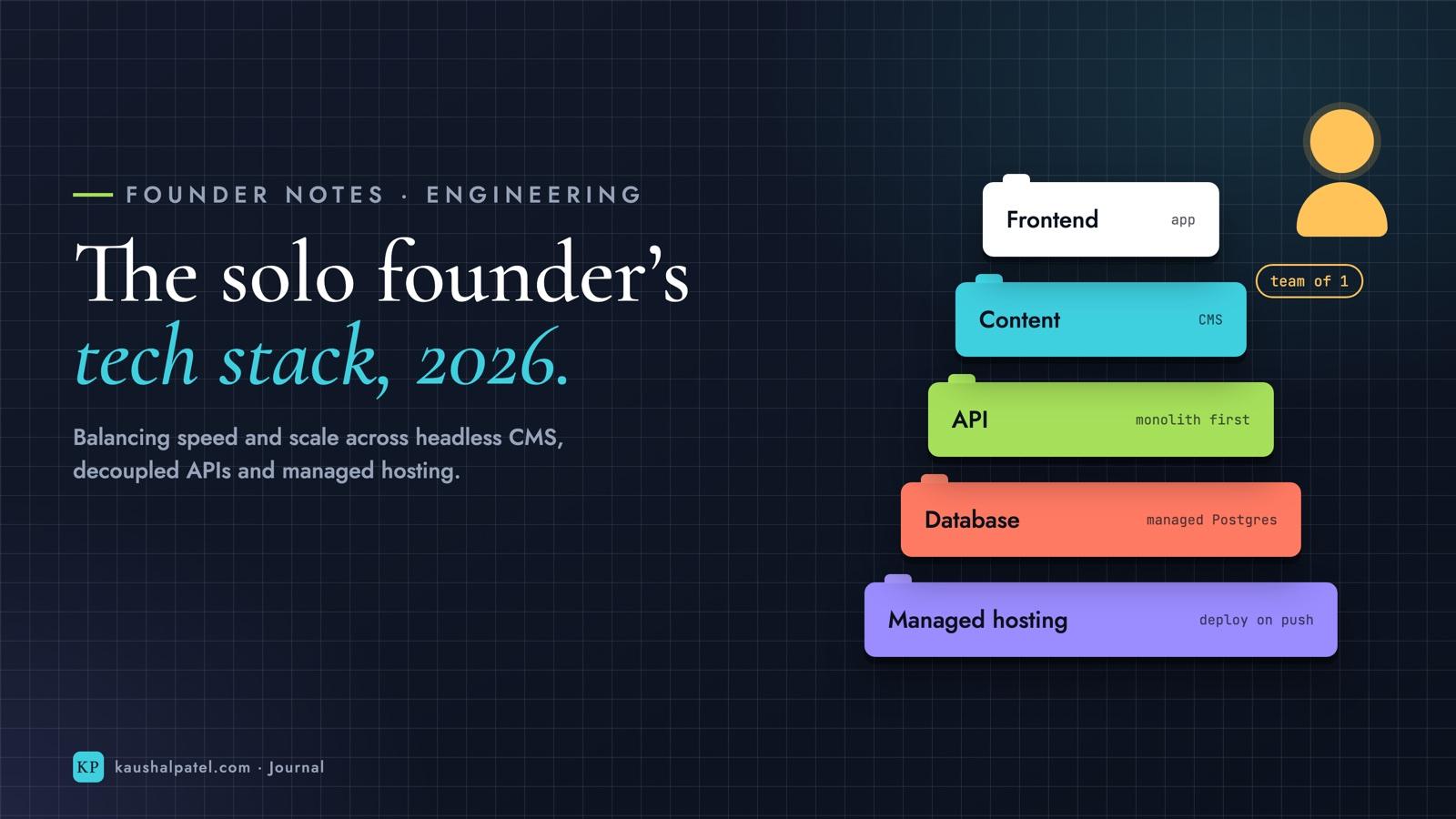
18 min readHeadless CMS, decoupled APIs or a monolith, managed hosting or a VPS: how to pick a 2026 stack one person can run, with a hosting cost calculator and checklist.
12 min readSigns you’ve outgrown spreadsheets, six rules for clean data, a five-table starting schema with SQL, and a safe five-step migration from CSV files.
14 min read