Robots used to live behind safety cages in car factories, repeating the same weld millions of times. Today they pick orders in warehouses, assist surgeons, inspect crops from the air and work shoulder to shoulder with people on small factory floors. And thanks to AI, they’re starting to understand what they see and hear.
This guide explores the future of robotics and automation: the types of robots shaping the next decade, the key robotics trends to watch, how AI in robotics is changing what machines can do, which industries will change most, what automation means for jobs, and how a small business can start automating today. It includes diagrams, comparison tables, a timeline and a copy-ready automation checklist.
What are robotics and automation?
Automation means using technology to perform tasks with little or no human effort. It can be purely digital (software that processes invoices) or physical (a machine that packs boxes). Robotics is the part of automation that deals with machines that sense their surroundings and physically act on the world: robot arms, mobile robots, drones and more.
In other words, every robot is a form of automation, but not all automation needs a robot. That distinction matters when you’re deciding what to automate first.
Where robotics stands today
According to the International Federation of Robotics (IFR) World Robotics report, there are now more than four million industrial robots operating in factories worldwide, with roughly half a million new ones installed each year. China is by far the largest market, accounting for more than half of new installations, while South Korea has the highest robot density, measured as robots per 10,000 manufacturing workers.
Those figures cover only factory robots. Add warehouse robots, service robots, drones, medical robots and software automation, and it’s clear that robotics is no longer a niche technology. It’s becoming part of how most physical work gets done.
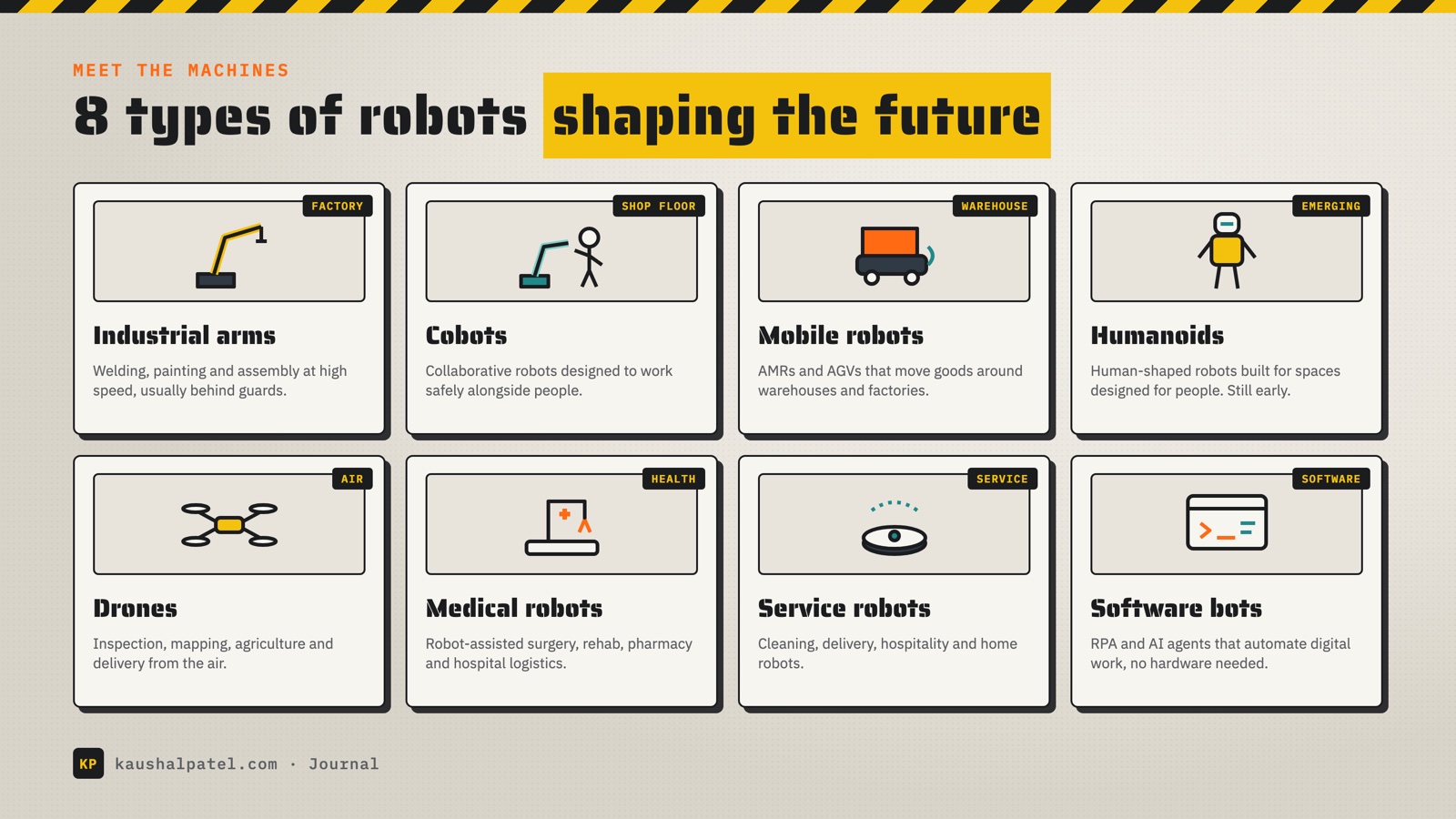
8 types of robots shaping the future
From factory arms to software bots: the robot family is growing fast.
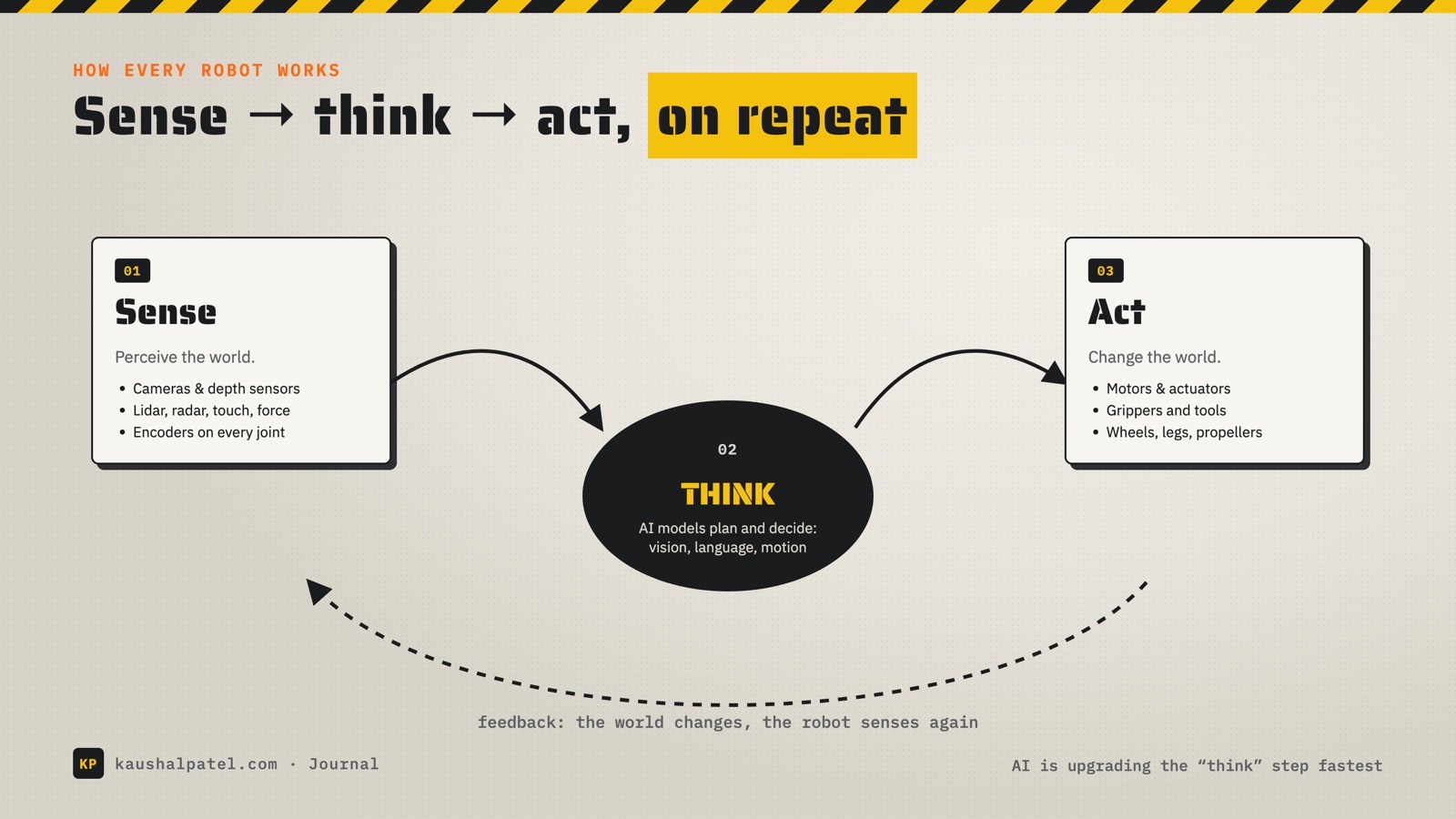
Every robot runs this loop. AI is upgrading the “think” step fastest.
Every robot, from a robot vacuum to a surgical system, follows the same basic loop. It senses its environment with cameras, depth sensors, lidar or touch. It thinks: interpreting that data and deciding what to do. Then it acts through motors, grippers or wheels. The world changes, and the loop starts again, many times per second.
For decades, the “think” step was the bottleneck. Robots had to be programmed precisely for each task and struggled with anything unexpected. That’s exactly what AI is changing.
10 robotics and automation trends to watch
1. AI-powered robots that learn instead of being programmed
The biggest shift in robotics is the arrival of AI models that connect vision, language and action. Research systems such as Google DeepMind’s RT-2 showed in 2023 that a model trained on web data and robot data could follow instructions it hadn’t been explicitly programmed for. The goal is robots you can teach by showing or telling, not by writing code for every movement. Read more about this shift in how AI is changing the future of technology.
2. Collaborative robots (cobots) go mainstream
Cobots are designed to work safely alongside people, using force limits, sensors and slower speeds near humans. Safety standards such as ISO 10218 and ISO/TS 15066 guide how they’re deployed. Because they’re smaller, easier to program and don’t always need fencing, cobots make automation realistic for small and medium-sized manufacturers.
3. Autonomous mobile robots in every warehouse
Unlike older guided vehicles that followed fixed tracks, autonomous mobile robots (AMRs) map their surroundings and plan their own routes. They bring shelves to pickers, move pallets and carry supplies through hospitals, and the warehouse is becoming one of the most automated workplaces.
4. Humanoid robots move from demos to pilots
Several companies are building humanoid robots designed to work in spaces built for people, and some have begun pilot projects in warehouses and factories. They’re promising for tasks that are hard to automate with fixed machines, but cost, reliability and safety still need to be proven at scale. Expect steady progress, and plenty of hype.
5. Robots-as-a-service (RaaS)
Instead of buying robots outright, more businesses rent them by the month or pay per task. Robots-as-a-service lowers the upfront cost and shifts maintenance to the provider, a similar trade-off to the one in building custom software vs buying SaaS.
6. Digital twins and simulation
Engineers increasingly design and test automation in a digital twin, a virtual copy of the factory or warehouse, before installing anything. Robots can also be trained in simulation, learning millions of attempts virtually before trying once in the real world.
7. AI vision for quality inspection
Cameras plus AI can spot defects in products, fabrics, welds or packaging faster and more consistently than tired human eyes on a long shift. For many factories, this is one of the most practical first steps into AI-powered automation.
8. Software automation and AI agents
Not all automation has arms. Robotic process automation (RPA) and newer AI agents handle digital work: entering orders, reconciling invoices, answering routine questions. For most small businesses, this is the cheapest and fastest automation win. See the top AI tools for productivity for practical starting points.
9. Drones for inspection, agriculture and delivery
Drones already inspect power lines, bridges and solar farms, map construction sites and spray crops precisely. Delivery drones are expanding more slowly, shaped by regulations and safety requirements.
10. Safety, regulation and trust
As robots get smarter and work closer to people, rules are catching up. In the European Union, for example, the new Machinery Regulation, which applies from January 2027, updates safety requirements for machinery, including machines with self-evolving behaviour, while the EU AI Act sets rules for AI systems. Safe, transparent and accountable automation will be a competitive advantage, not just a compliance task.
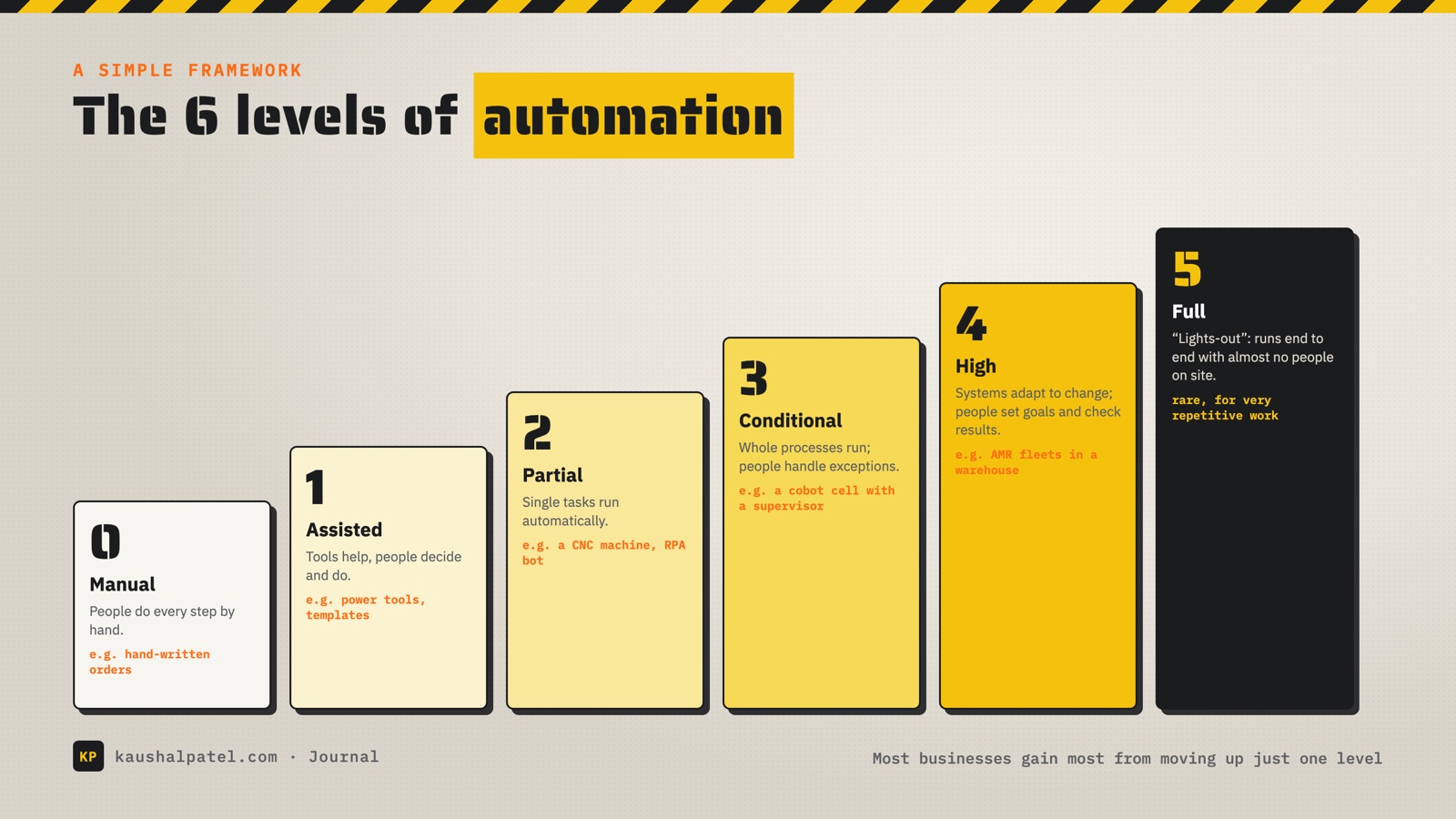
The 6 levels of automation
A simple framework: most businesses gain the most by moving up just one level.
A useful way to plan automation is to ask: what level are we at for this process today, and what would one level higher look like? Jumping straight from manual work to “lights-out” automation is expensive and risky. Moving from level 1 to level 2 or 3, for one process at a time, is how most businesses actually get results.
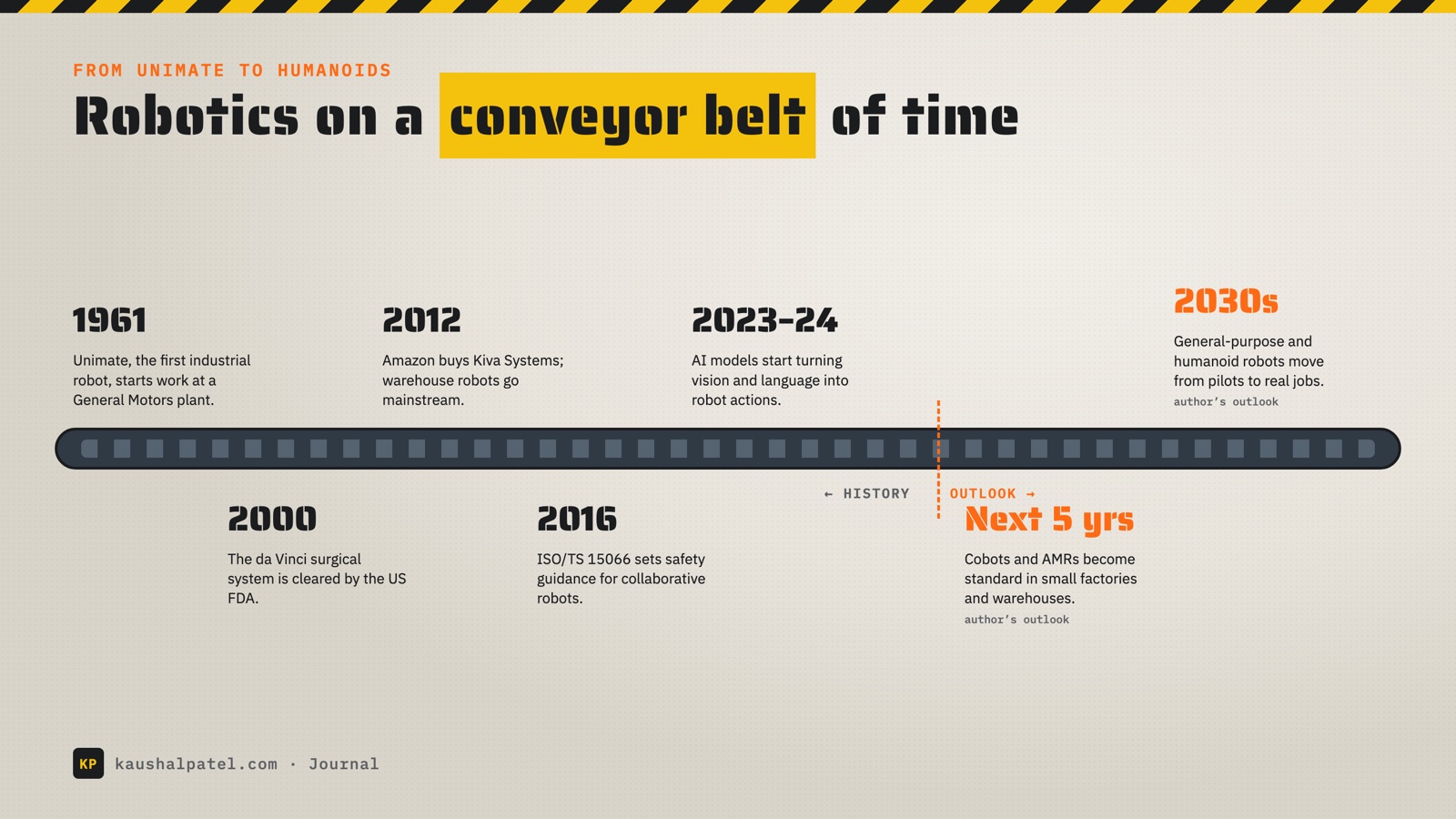
A short history, and what comes next
Six decades of robotics, plus the author’s outlook for the next decade.
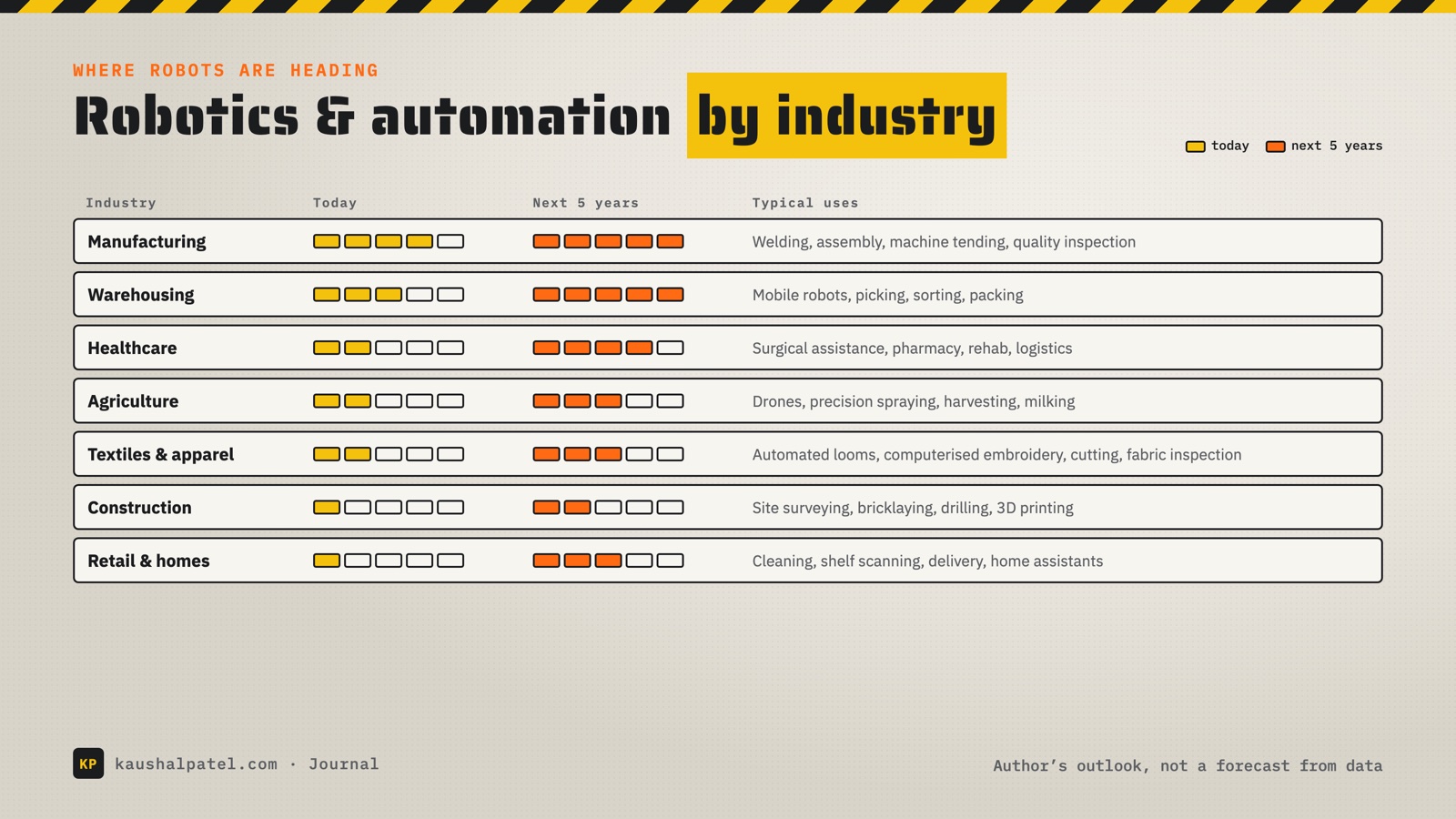
The future of robotics by industry
Where robots are heading. This is an outlook, not a data forecast.
Manufacturing: cobots for machine tending and packing, AI vision for quality checks, and flexible cells that can switch products quickly.
Warehousing and logistics: AMR fleets, automated picking and sorting, and robots that unload trucks.
Agriculture: drones for crop monitoring, precision spraying, robotic milking and harvesting robots for delicate produce.
Textiles and apparel: automated looms and computerised embroidery are already common; next come automated fabric inspection, cutting and material handling.
Construction: site-scanning robots, drilling and layout robots, and 3D-printed structures.
Retail and homes: shelf-scanning robots, cleaning robots and, eventually, more capable home assistants.
Will robots take our jobs?
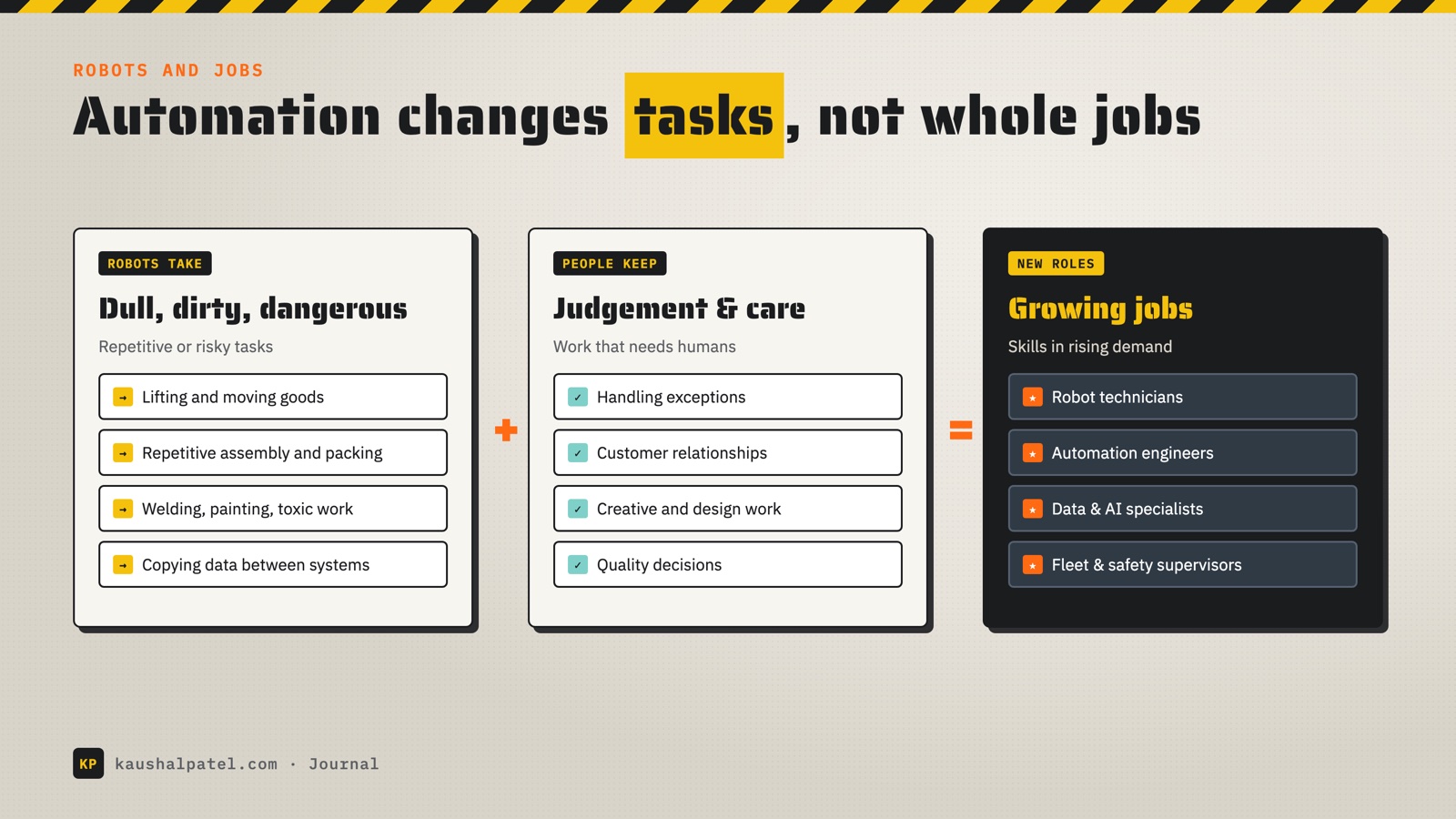
Automation mostly changes tasks within jobs, and creates new roles along the way.
It’s the question everyone asks. The honest answer: automation will change most jobs, eliminate some, and create new ones. The World Economic Forum’s Future of Jobs Report 2025 estimated that, by 2030, around 170 million new jobs could be created and 92 million displaced worldwide, a net gain, but one that requires huge numbers of people to learn new skills.
Robots are best at the “three Ds”: dull, dirty and dangerous work. People remain essential for judgement, care, creativity, relationships and handling the unexpected. The practical challenge is making sure workers can move into the new roles that automation creates.
Skill area
Why it matters
Example roles
Robot operation and maintenance
Every robot needs setup, programming and repair
Robot technician, cobot operator
Automation and controls engineering
Designing systems that connect machines and software
Automation engineer, PLC programmer
Data and AI
Training, monitoring and improving AI-powered systems
Data analyst, machine learning engineer
Safety and compliance
Keeping people safe around machines
Safety engineer, fleet supervisor
Human skills
Problem-solving, communication, customer care
Team lead, customer success
Benefits and challenges of automation
Benefits
Challenges
Consistent quality and fewer errors
Upfront cost and integration effort
Safer workplaces: robots take risky tasks
Skills gaps: people need training
Higher output and 24/7 operation
Less flexibility if processes change often
Helps with labour shortages
Maintenance, downtime and spare parts
Better data on every step of a process
Cybersecurity of connected machines
Frees people for higher-value work
Change management and worker trust
Quick game · Robotics myth or fact?
Test what you know about robots
Six common beliefs about robotics and automation. Decide, then tap to reveal.
“Robots are only for big factories with huge budgets.”
Myth. Cobots, rental models (RaaS) and software automation have made automation accessible to small and medium-sized businesses.
“Cobots are designed to work safely near people.”
Fact. That’s their whole purpose: force limits, sensors and safety standards make close collaboration possible, after a proper risk assessment.
“Humanoid robots are already doing most warehouse work.”
Myth. Humanoids are mostly in pilot projects. Today’s warehouse automation is dominated by mobile robots, conveyors and sorting systems.
“Not all automation needs a physical robot.”
Fact. Software bots and AI agents automate digital work like data entry and reporting, often the cheapest place to start.
“Automation always replaces whole jobs.”
Myth. It usually changes the tasks within a job. Many roles shift towards supervising, maintaining and improving automated systems.
“AI is making robots easier to teach.”
Fact. AI models that combine vision, language and action aim to let robots learn new tasks from demonstrations and instructions, rather than detailed code.
How a small business can start with automation
You don’t need a robot to start automating. Here’s a practical, low-risk path:
Step
What to do
Example
1. Map your processes
List repetitive tasks and how long they take each week
Order entry, stock counts, packing, invoicing
2. Fix the data first
Move information out of scattered sheets into one system
Use integrations, RPA or AI agents for digital work
Auto-create invoices from orders
4. Pilot one physical task
Choose one repetitive, measurable task for a cobot or machine
Machine tending, packing, inspection
5. Measure and scale
Compare time, errors and cost before and after
Expand only what clearly pays back
Treat your first automation project like an MVP: small, measurable, and designed to learn. Use this scorecard to choose where to start:
AUTOMATION OPPORTUNITY SCORECARD
Process: _______________________

Score each 1 (low) to 5 (high):
[ ] Repetitive: same steps every time?
[ ] Volume: done many times per day/week?
[ ] Pain: slow, error-prone, boring or unsafe?
[ ] Rules: clear rules, few exceptions?
[ ] Measurable: can we track time, errors, cost?
[ ] Stable: process won't change much this year?

Total: ___ / 30
24-30  Strong candidate: automate first
15-23  Simplify the process, then reconsider
<15    Leave it with people for now
And a simple way to estimate payback before you spend anything:
PAYBACK PERIOD (months) = Total cost of automation
                          ÷ Monthly savings

Monthly savings = hours saved per month × cost per hour
                + cost of errors avoided per month

Illustrative example (not real data):
Cost: ₹6,00,000 · Hours saved: 160/month · Cost/hour: ₹250
Monthly savings = 160 × ₹250 = ₹40,000
Payback = ₹6,00,000 ÷ ₹40,000 = 15 months
Frequently asked questions
What is the future of robotics?
Robots are becoming smarter through AI, safer around people through collaborative design, more mobile and more general-purpose. Expect cobots and mobile robots to become standard in factories and warehouses, AI vision to spread in quality control, and humanoid robots to move gradually from pilots into real work.
What is the difference between robotics and automation?
Automation is any technology that performs tasks with minimal human effort, including software. Robotics is the part of automation that uses physical machines to sense and act in the real world.
How is AI used in robotics?
AI helps robots see (computer vision), understand instructions (language models), plan movements and learn new tasks from demonstrations or simulation, making them more flexible than traditionally programmed machines.
What is a cobot?
A cobot, or collaborative robot, is designed to work safely alongside people, using sensors, force limits and safety standards. Cobots are popular with small manufacturers because they’re easier to program and deploy.
Will robots replace human jobs?
Robots will automate many tasks and some jobs, but they also create new roles. Most jobs will change rather than disappear, with people focusing more on judgement, problem-solving, care and supervising automated systems.
How can a small business start with automation?
Start by mapping repetitive tasks, organising your data in one system and automating software tasks first. Then pilot one measurable physical task, track the results and scale only what pays back.
The bottom line
The future of robotics and automation isn’t a single moment when robots take over. It’s a steady shift in how work gets done: AI-powered machines handling repetitive and risky tasks, while people focus on judgement, creativity and care. The businesses that benefit most won’t be the ones with the flashiest robots, but the ones that automate the right processes, one step at a time, and help their people grow alongside the machines.
Thinking about automating a process in your business, from software workflows to the shop floor? Let’s talk.
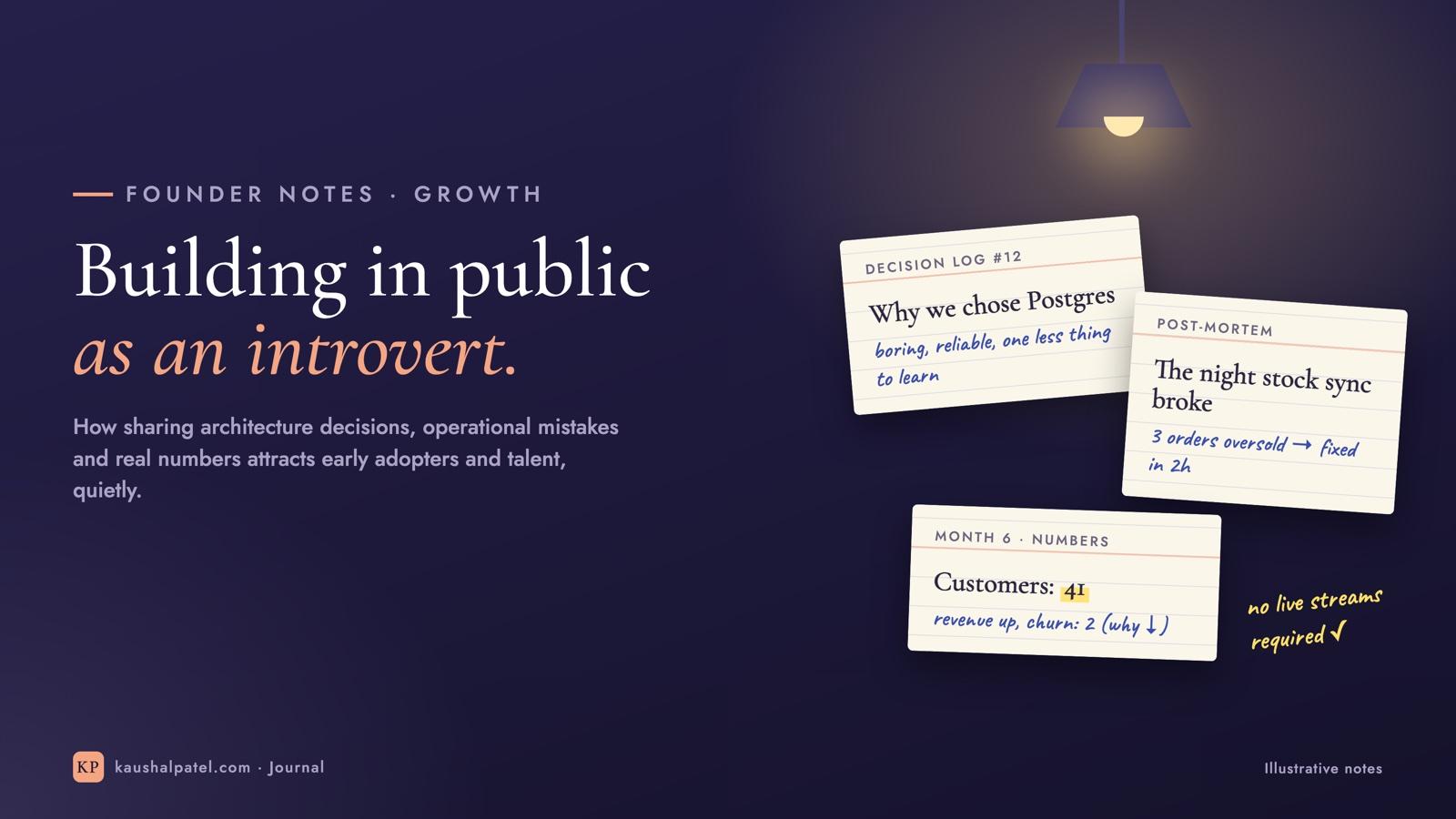
Quiet, written building in public: share architecture decisions, mistakes and real numbers to attract early adopters and talent, with an update builder.
Headless CMS, decoupled APIs or a monolith, managed hosting or a VPS: how to pick a 2026 stack one person can run, with a hosting cost calculator and checklist.
Marketplace fees, ad spend and D2C acquisition: how to see your true profit per order in every channel, with a margin calculator, break-even ROAS and a roadmap.