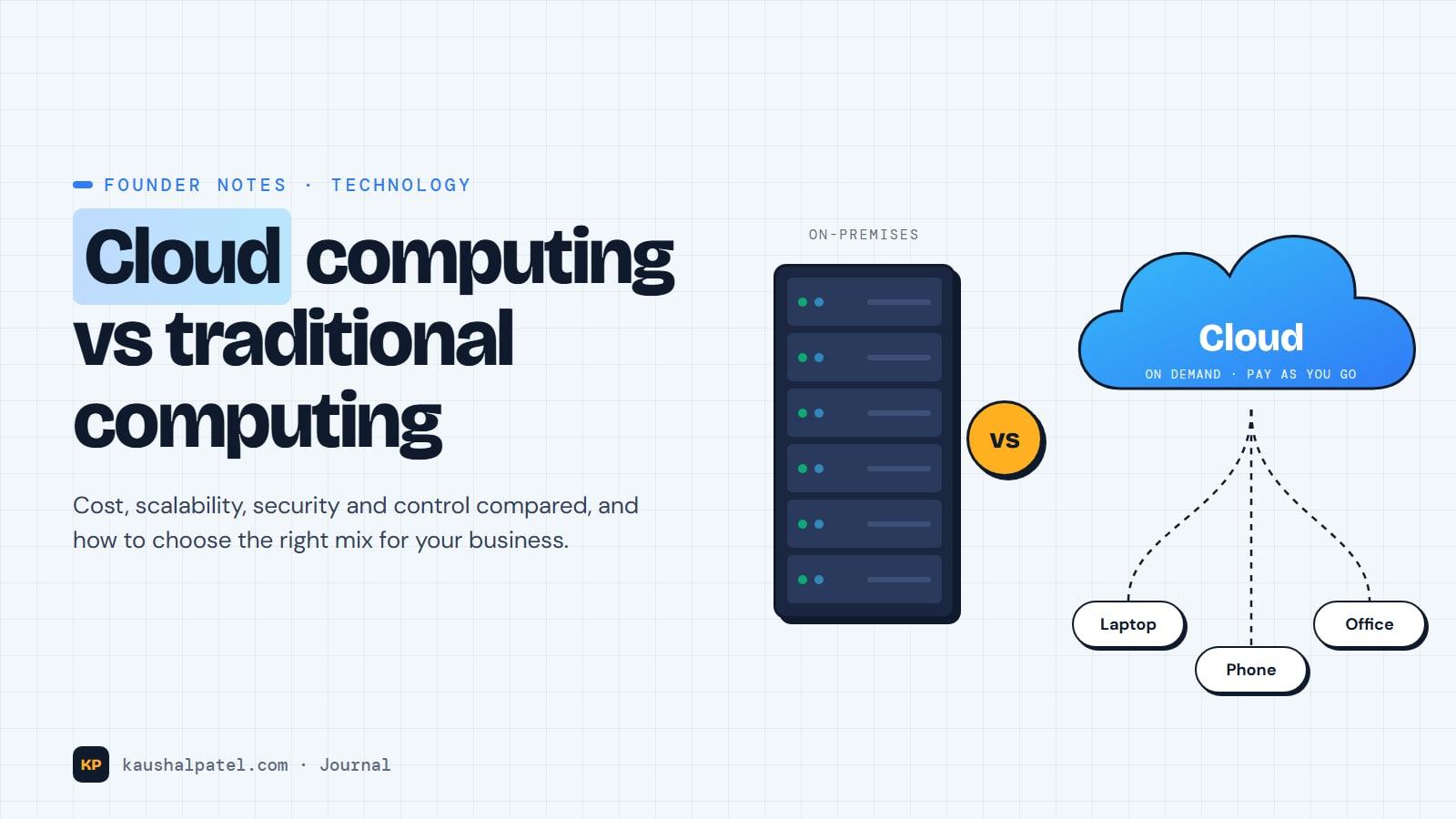
Cloud Computing vs Traditional Computing
Cloud computing vs traditional computing compared: cost, scalability, security, control and maintenance, IaaS vs PaaS vs SaaS, and how to choose and migrate.
15 min read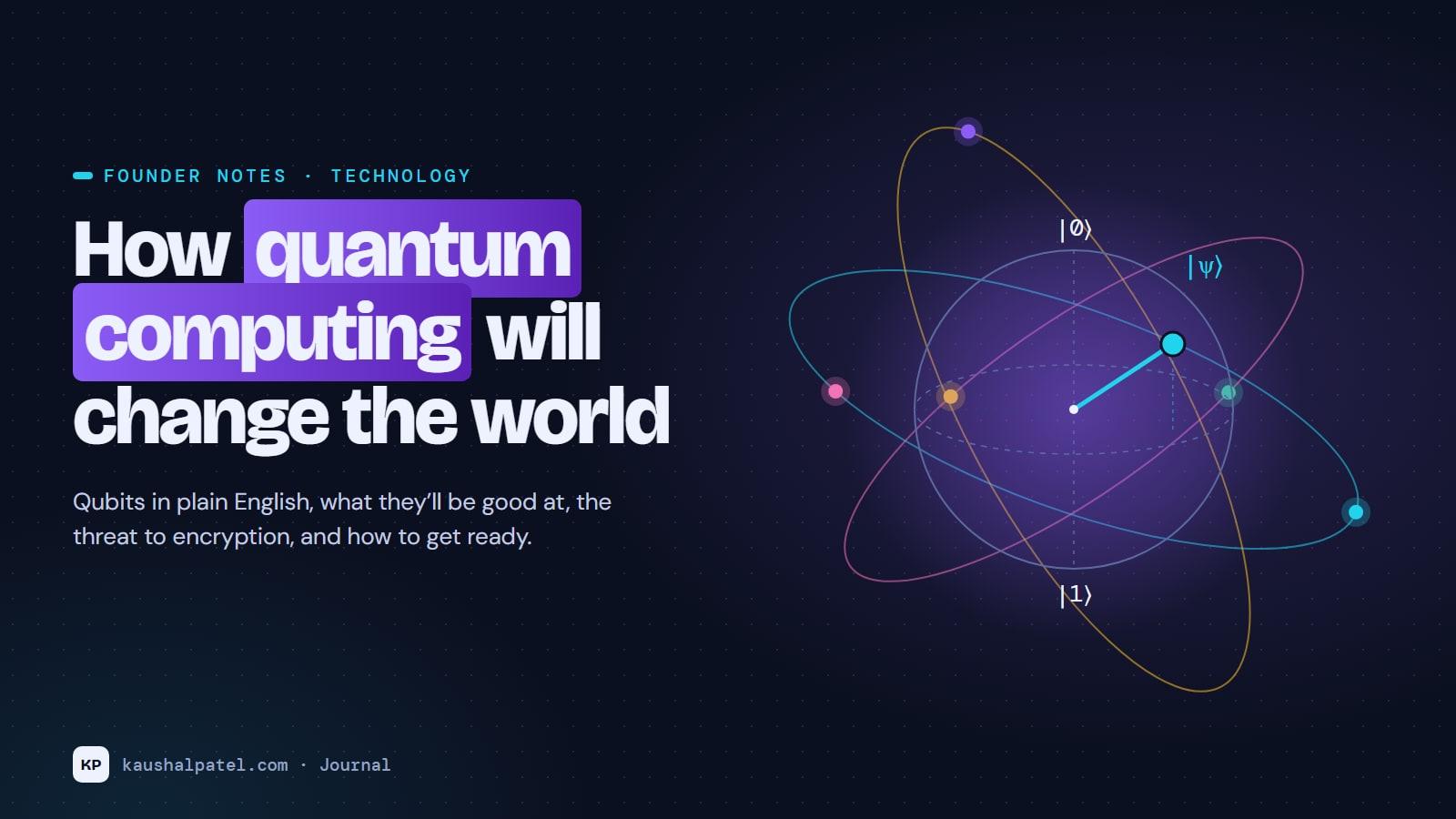
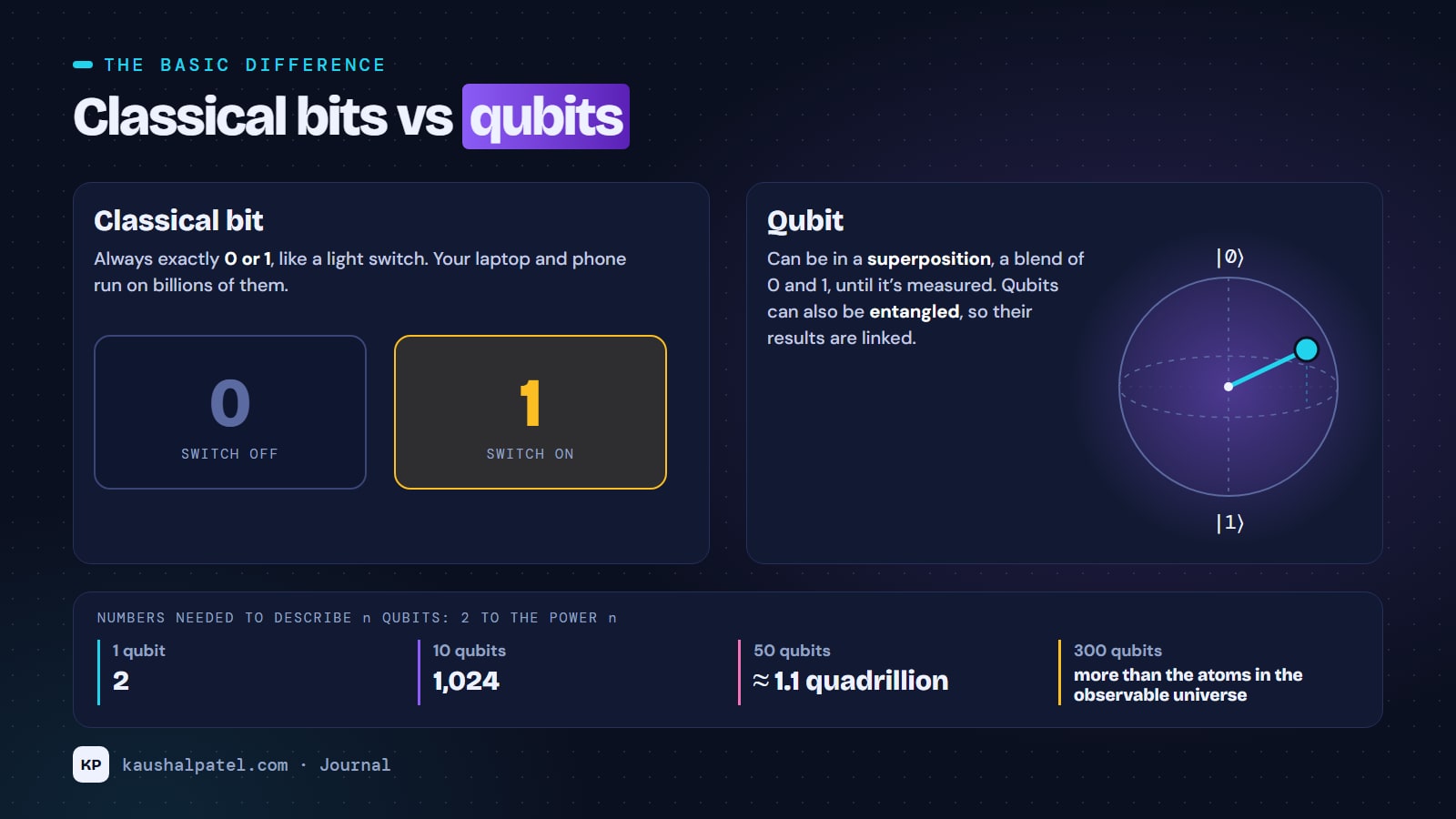
For seventy years, every computer, from room-sized mainframes to the phone in your pocket, has worked the same way: by flipping billions of tiny switches between 0 and 1. Quantum computers work differently. They use the strange rules of physics at the scale of atoms to tackle certain problems that would take classical machines thousands or even millions of years.
That doesn’t mean quantum computers will replace your laptop. But it does mean they could transform how we discover medicines, design batteries, manage financial risk, and, most urgently, how we protect data. This guide explains how quantum computing will change the world in plain language: what a qubit is, which industries will feel it first, the real threat to today’s encryption, realistic timelines and what businesses should do now. You’ll find comparison tables, animated explainers and a ready-to-use checklist, with the hype separated from what has actually been shown.
Quantum computing is a way of processing information using the principles of quantum mechanics, the physics that governs atoms, electrons and photons. Instead of bits, a quantum computer uses quantum bits, or qubits, made from things such as tiny superconducting circuits, trapped ions or individual atoms, often cooled to near absolute zero (about −273 °C).
Three quantum effects make qubits different:
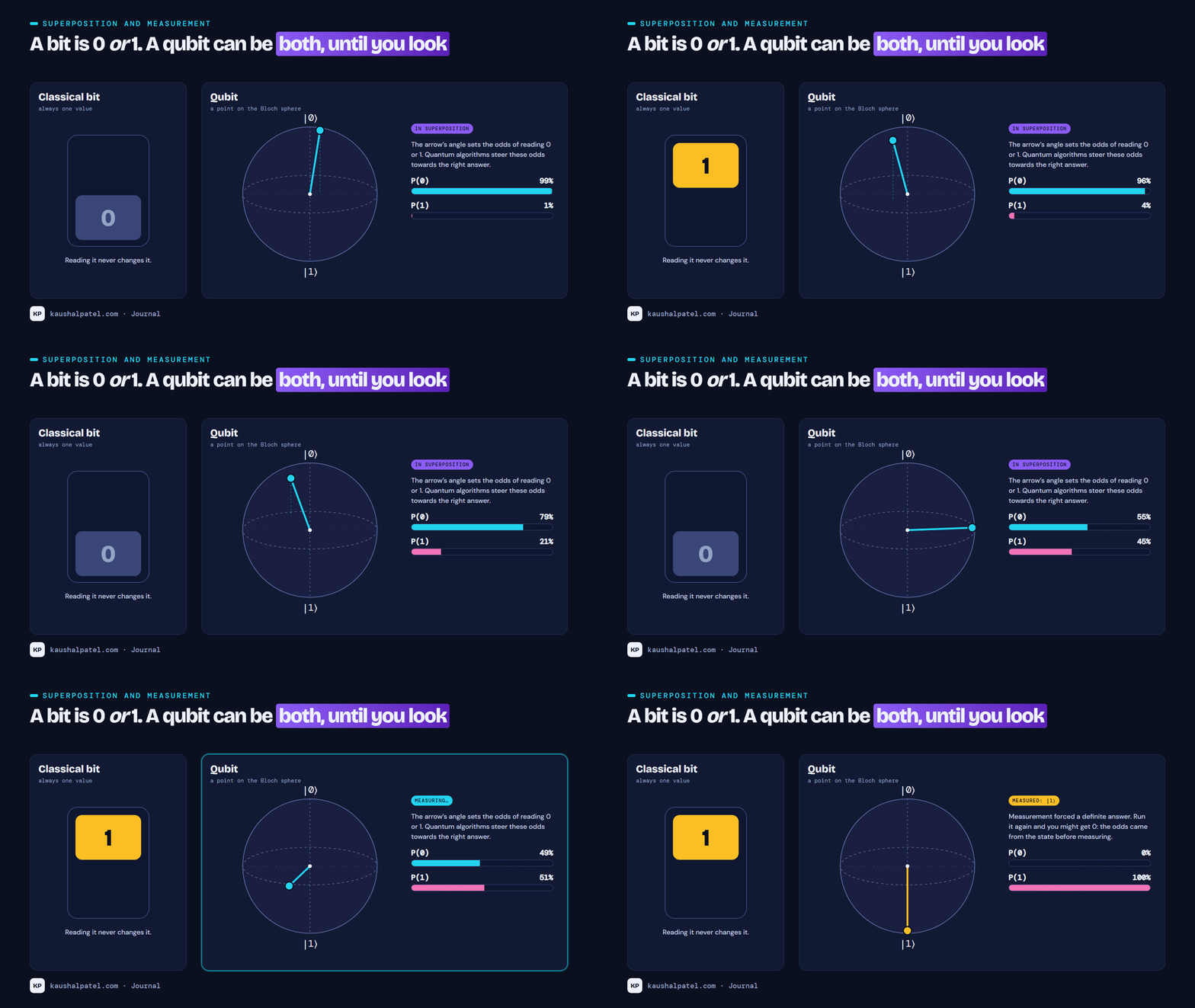
A common myth is that quantum computers “try every answer at once”. That isn’t quite right. A quantum computer does hold a huge combined state, but when you measure it you get just one result. The art of quantum algorithms is choreographing interference so that, by the time you measure, the right answer is by far the most likely one. That only works for problems with the right mathematical structure, which is why quantum computers are expected to be revolutionary for some tasks and useless for most everyday computing.
| Classical computer | Quantum computer | |
|---|---|---|
| Basic unit | Bit: 0 or 1 | Qubit: superposition of 0 and 1 |
| How it scales | Adding bits adds capacity linearly | Each added qubit doubles the size of the state space |
| Best at | Almost everything: apps, web, databases, video, AI training | Specific problems: simulating molecules, factoring, some optimisation and search |
| Errors | Extremely rare | Frequent; qubits lose their state quickly (decoherence) |
| Operating conditions | Room temperature | Often near absolute zero, in vacuum or shielded labs |
| How you use it | On your desk, phone or in the cloud | Mostly through the cloud, alongside classical computers |
| Maturity | Mature, mass-produced | Experimental; early commercial access |
The future is hybrid. Quantum processors will work as specialised accelerators next to classical computers, much as graphics chips accelerate AI today, and they’ll be reached mostly through the cloud. If you’re new to that model, see cloud computing vs traditional computing.
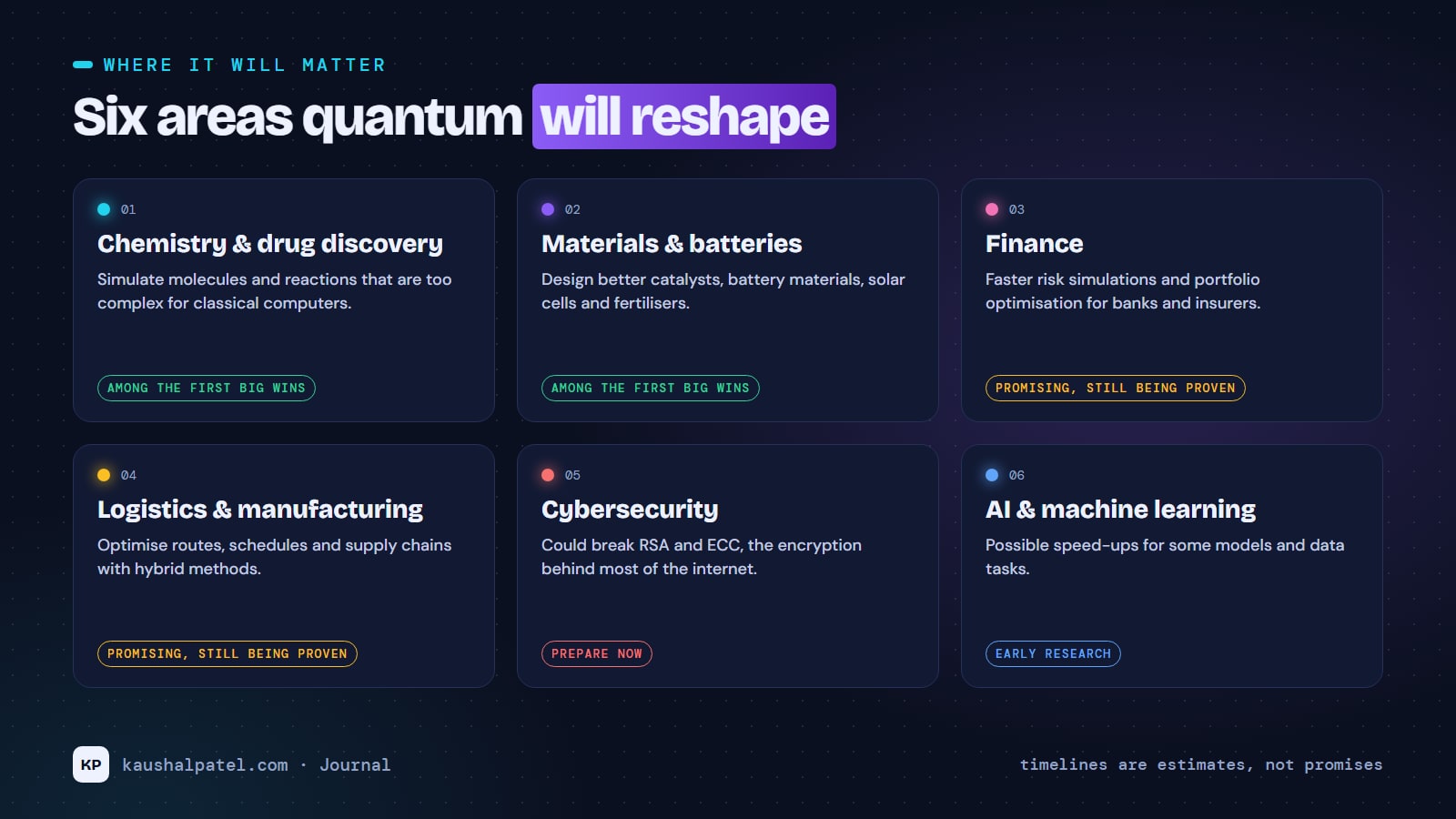
Molecules follow quantum rules, so simulating them exactly on a classical computer gets impossibly hard as they grow. Quantum computers are, in Richard Feynman’s famous framing, the natural tool for simulating nature. Accurate molecular simulation could help researchers understand how drug candidates bind to proteins, predict side effects earlier and cut years from the discovery process. Pharmaceutical companies are already partnering with quantum hardware makers to prepare.
The same strength applies to materials science: designing lighter, longer-lasting batteries for electric vehicles, more efficient solar cells, better superconductors and catalysts for capturing carbon. One often-cited target is fertiliser. Today’s ammonia production (the Haber–Bosch process) uses an estimated 1–2% of the world’s energy, and understanding how nature fixes nitrogen at room temperature could lead to far more efficient methods.
Banks spend enormous computing power on Monte Carlo simulations to price derivatives and measure risk. Quantum algorithms offer a quadratic speed-up for some of these calculations, and researchers are exploring quantum approaches to portfolio optimisation and fraud detection. These benefits are promising but still being proven at useful scale.
Routing delivery fleets, scheduling factories and balancing supply chains are hard optimisation problems. Quantum and “quantum-inspired” methods are being tested on them, usually in hybrid setups with classical solvers. Expect incremental gains here rather than overnight transformation. The same pattern of automation running alongside human planning is playing out in physical work too, as I covered in the future of robotics and automation.
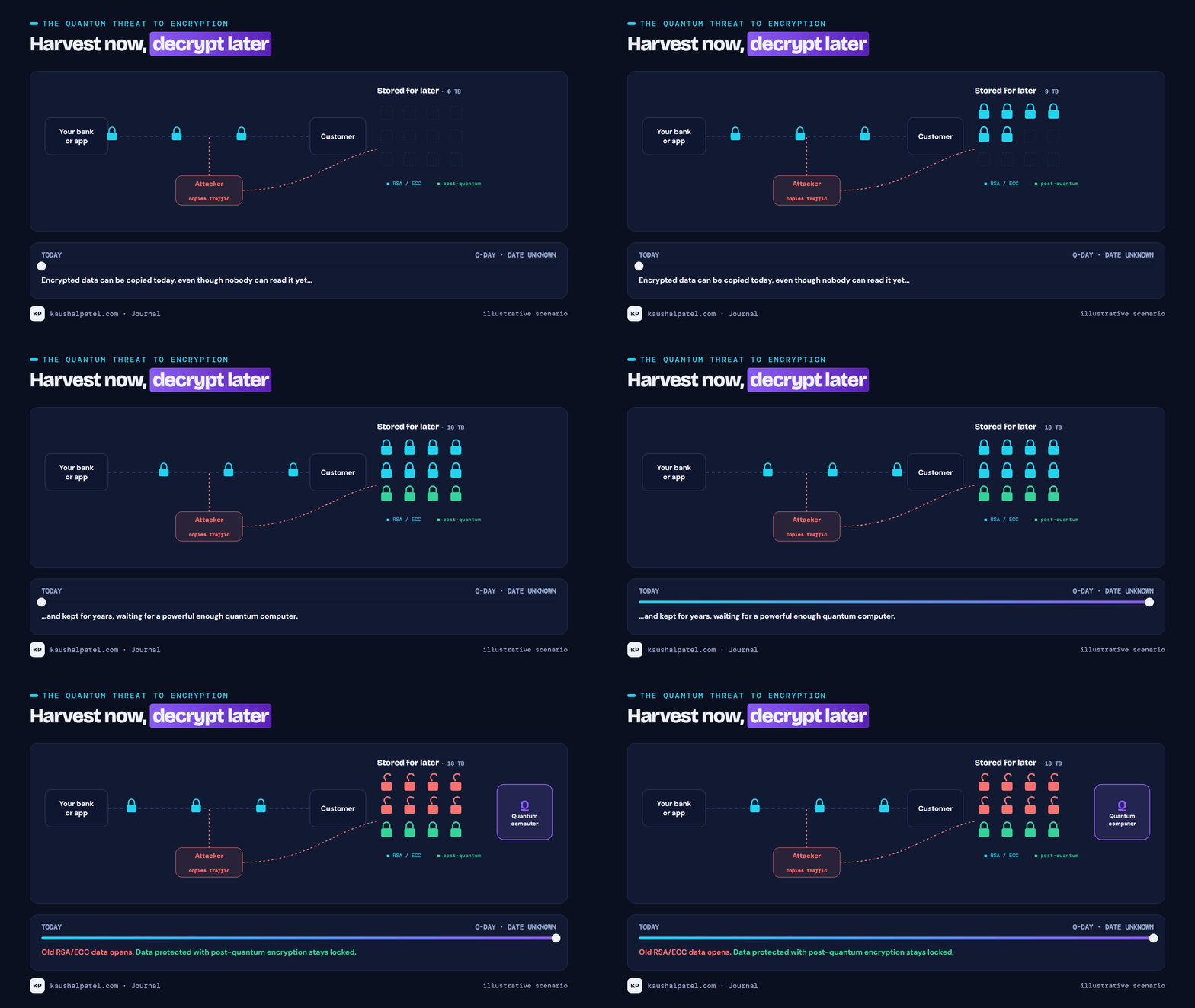
In 1994, mathematician Peter Shor showed that a large quantum computer could factor huge numbers efficiently. That matters because RSA and elliptic-curve cryptography (ECC), which protect HTTPS websites, banking apps, VPNs, digital signatures and cryptocurrency wallets, rely on exactly those problems being hard.
No quantum computer today comes close: a 2025 estimate by Google researchers put breaking RSA-2048 at under a million high-quality-enough physical qubits running for about a week, while today’s machines have hundreds to around a thousand noisy qubits. But attackers can already practise “harvest now, decrypt later”: copy encrypted data today and store it until a capable quantum computer exists. Anything that must stay secret for ten years or more (health records, contracts, government and financial data) is effectively at risk now.
The fix already exists. In August 2024, the US National Institute of Standards and Technology (NIST) published the first post-quantum cryptography standards: ML-KEM (FIPS 203) for encryption key exchange, and ML-DSA (FIPS 204) and SLH-DSA (FIPS 205) for digital signatures. Chrome, Signal and Apple’s iMessage already use post-quantum key exchange. For the everyday threats that matter today, see cybersecurity threats everyone should know about.
| Cryptography | Used for | Quantum risk | What to do |
|---|---|---|---|
| RSA, ECC, Diffie–Hellman | HTTPS, VPNs, logins, signatures, crypto wallets | Broken by Shor’s algorithm on a large quantum computer | Migrate to ML-KEM and ML-DSA (often in hybrid mode first) |
| AES-128 | Encrypting stored data and traffic | Weakened by Grover’s algorithm (roughly halves key strength) | Prefer AES-256 |
| AES-256, SHA-256/384 | Encryption, hashing, integrity checks | Considered safe with current knowledge | Keep using |
| ML-KEM, ML-DSA, SLH-DSA | The new post-quantum standards | Designed to resist quantum attacks | Adopt as vendors support them |
There’s a lot of excitement about combining quantum computing and AI, but this is the most speculative area. Some quantum algorithms could speed up specific linear-algebra or sampling tasks, and quantum computers could generate valuable training data for chemistry and materials models. A general quantum boost for chatbots and large language models is not on the near horizon. For where AI itself is heading, read how AI is changing the future of technology, and for AI you can use productively today, see the top 10 AI tools for productivity and ChatGPT vs Gemini vs Claude.
Not all quantum technology is about computing. Quantum sensors can measure magnetic fields, gravity and time with extraordinary precision, with uses in medical imaging, navigation without GPS and mineral exploration, and some are already in use. Quantum communication, such as quantum key distribution, uses the physics of photons to detect eavesdropping on a link.
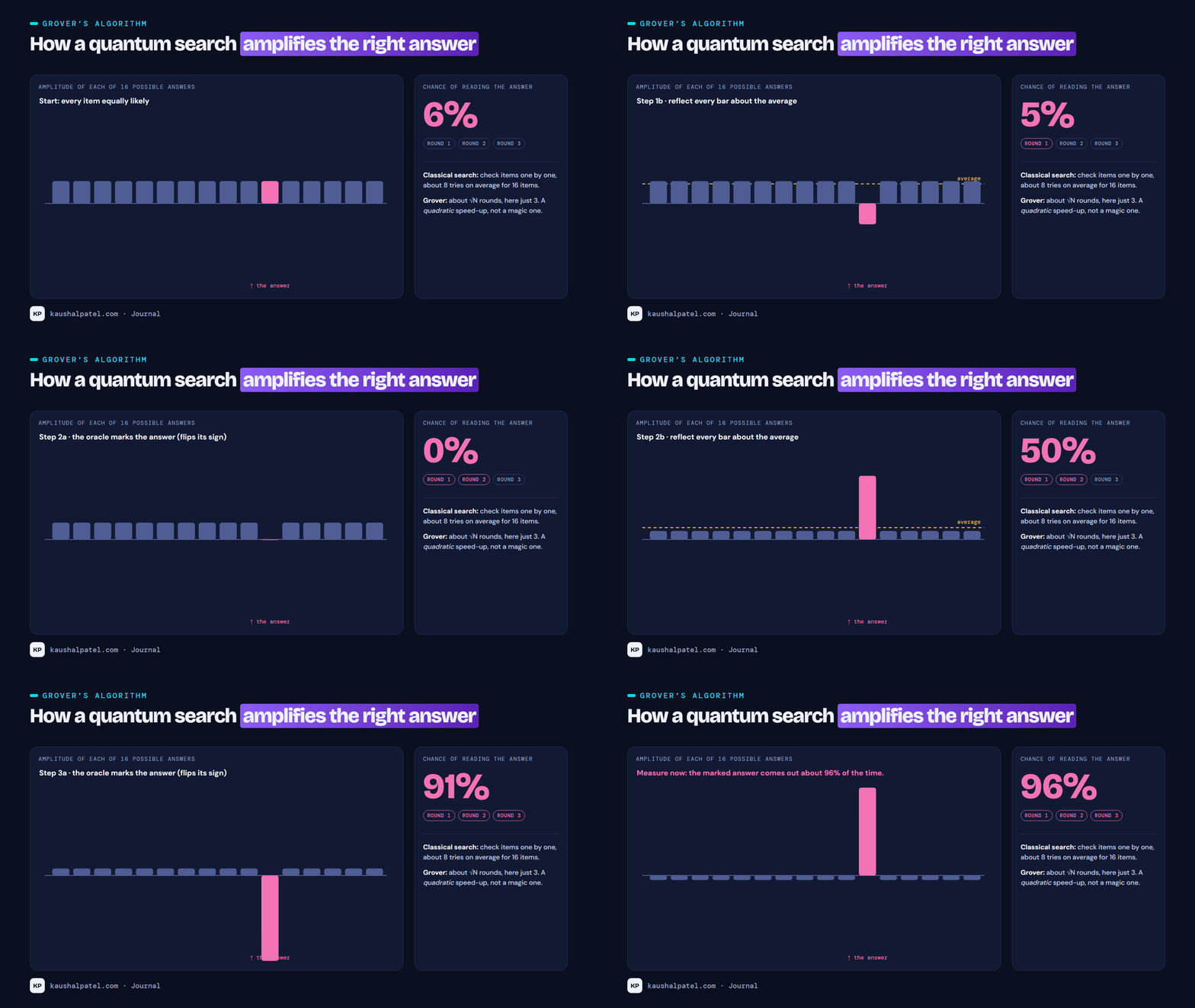
Grover’s algorithm (1996) shows interference in action. To find one marked item among N unsorted items, a classical computer checks them one by one, about N/2 tries on average. Grover’s algorithm repeatedly flips the sign of the right answer and reflects all amplitudes about their average, so the right answer grows while the others shrink. It needs only about √N rounds. That’s a quadratic speed-up, not an exponential one, and it’s a good reminder that quantum computers are powerful in specific, mathematically structured ways.
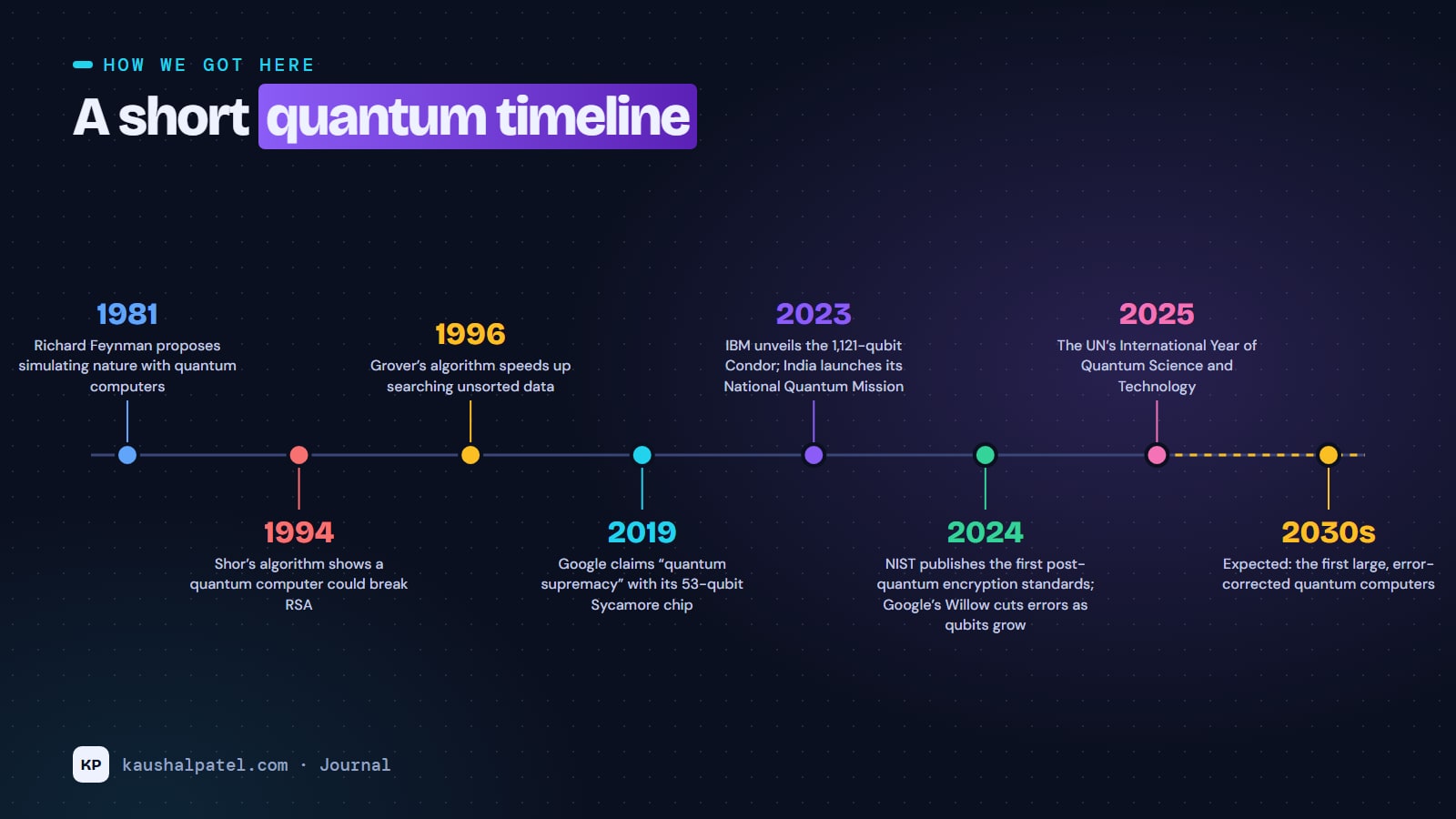
Progress has accelerated. In 2019, Google claimed “quantum supremacy” when its 53-qubit Sycamore chip completed a specialised task far faster than a supercomputer could, a claim IBM disputed. In 2023, IBM unveiled Condor, a processor with more than 1,000 qubits. In December 2024, Google’s 105-qubit Willow chip showed that errors can fall as more qubits are added to an error-correcting code, a key milestone on the road to reliable machines. In 2025, Microsoft announced a chip based on topological qubits, an approach researchers are still debating, and IBM published a roadmap targeting a large fault-tolerant quantum computer by the end of the decade.
The central challenge is error correction. Physical qubits are fragile, so many of them must be combined into one reliable “logical” qubit. Today we’re in the NISQ era (noisy intermediate-scale quantum): useful for research and experiments, but not yet for the big promised applications.
| Qubit technology | Who’s building it | Strengths | Challenges |
|---|---|---|---|
| Superconducting circuits | IBM, Google, Rigetti | Fast operations, built with chip-making techniques | Needs cooling near absolute zero; short qubit lifetimes |
| Trapped ions | Quantinuum, IonQ | Very high accuracy, long-lived qubits | Slower operations; harder to scale |
| Neutral atoms | QuEra, Pasqal, Atom Computing | Large arrays of identical qubits | Still maturing error correction and speed |
| Photonic | PsiQuantum, Xanadu | Works with light, closer to room temperature | Losing photons; complex engineering |
| Topological | Microsoft | Could be naturally resistant to errors | Early and experimental |
India approved its National Quantum Mission in April 2023, with a budget of about ₹6,000 crore from 2023–24 to 2030–31. Its goals include building quantum computers with 50 to 1,000 physical qubits, satellite-based secure quantum communication, quantum sensors and new materials, supported by thematic hubs at leading institutes. Indian startups and IT companies are also building quantum software and services, creating new career paths for engineers and scientists.
| Timeframe | What to expect |
|---|---|
| Now | Cloud access to small, noisy quantum computers; research and pilots; migration to post-quantum encryption begins |
| Late 2020s | Early error-corrected machines; first scientifically useful results in chemistry and materials; post-quantum encryption becomes standard |
| 2030s | Larger fault-tolerant computers; commercial impact in drug discovery, materials, finance; older RSA and ECC phased out (US guidance proposes around 2030–2035) |
| Beyond | Broad use as a cloud accelerator for science and industry; new applications nobody has thought of yet |
Treat every date with caution: quantum timelines have slipped before, and breakthroughs can also arrive suddenly. The safe assumption for businesses is that encryption needs fixing well before the machines arrive.
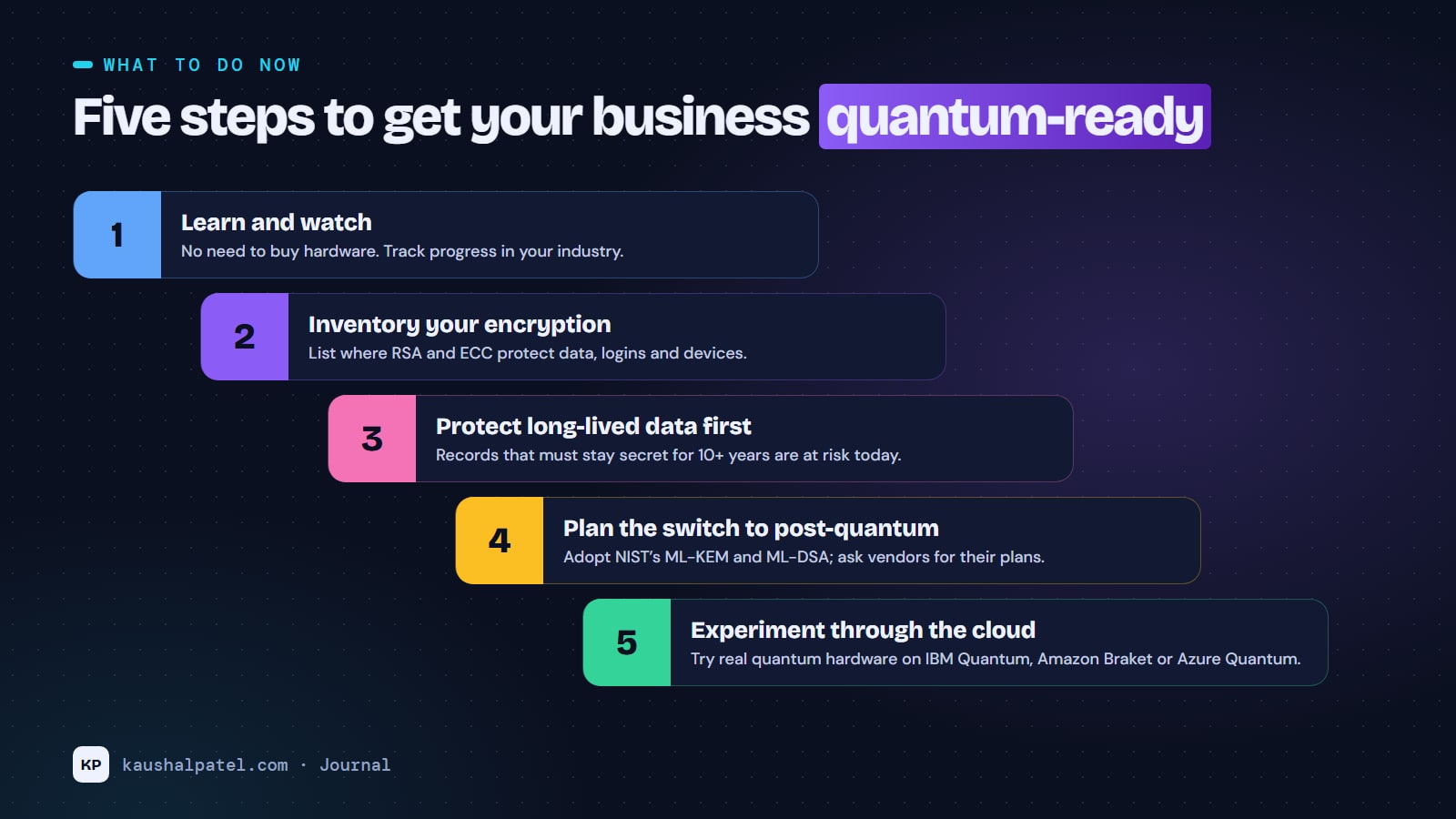
Use this simple template to start your encryption inventory:
POST-QUANTUM READINESS INVENTORY (one row per system)

System:            e.g. customer portal, mobile app API, VPN, backups
Data it protects:  e.g. customer PII, payments, contracts, health records
Must stay secret:  < 1 year | 1–5 years | 5–10 years | 10+ years
Crypto in use:     e.g. TLS 1.3 with ECDHE, RSA-2048 certificates, AES-256
Who controls it:   in-house | cloud provider | vendor (name)
Vendor PQC plan:   yes (date) | asked | unknown
Priority:          HIGH if 10+ years secret AND uses RSA/ECC

Next step: start with HIGH rows; enable hybrid post-quantum TLS where supported.
If your systems live in the cloud, many of these upgrades will come from your provider, which is one more reason to keep your tech stack simple and well documented. Blockchain projects face the same issue, since most rely on ECC signatures; see how blockchain works beyond cryptocurrency.
Quantum computing is expected to transform drug discovery, materials and battery design, financial risk analysis and optimisation by simulating nature and solving certain problems far faster than classical computers. It also threatens today’s RSA and ECC encryption, driving a global shift to post-quantum cryptography.
It’s computing with qubits instead of bits. A qubit can be in a blend of 0 and 1, and qubits can be entangled, letting quantum algorithms use interference to make the right answer to certain problems much more likely than wrong ones.
Small, noisy quantum computers are already available through the cloud. Large, error-corrected machines capable of the biggest promised applications are widely expected in the 2030s, though timelines are uncertain.
A large enough quantum computer could break RSA and elliptic-curve cryptography using Shor’s algorithm. Symmetric encryption like AES-256 is considered safe. New post-quantum standards (ML-KEM, ML-DSA, SLH-DSA) are designed to resist quantum attacks and are already being deployed.
No. Quantum computers are specialised accelerators that will work alongside classical computers, mostly through the cloud. Everyday tasks such as browsing, documents, video and most AI will remain on classical hardware.
Inventory where you use RSA and ECC, prioritise data that must stay secret for many years, ask vendors about their post-quantum plans, build crypto-agility into new systems and experiment with cloud quantum services to build skills.
Quantum computing won’t change everything, but it will change some very important things: how we design medicines and materials, how we model risk, and how we keep secrets. The machines that deliver those breakthroughs are still being built, yet the security shift is already under way. Understand the basics, separate hype from evidence, and start your move to post-quantum encryption now, while you still have time to do it calmly.
For more plain-English explainers on technology and business, browse the Business & Strategy section of the journal.
Want help assessing your systems or planning a security roadmap? Let’s talk.

Entrepreneur · Business Owner · IT Consultant — writing about startups, AI and building products.
Keep reading
Cloud computing vs traditional computing compared: cost, scalability, security, control and maintenance, IaaS vs PaaS vs SaaS, and how to choose and migrate.
15 min readThe cybersecurity threats everyone should know: phishing, passwords, ransomware, deepfakes, QR scams and more, with warning signs and simple defences.
18 min readHow blockchain technology works beyond cryptocurrency: blocks, hashes and consensus, 8 real use cases, smart contracts, limits, and when you need one.
18 min read